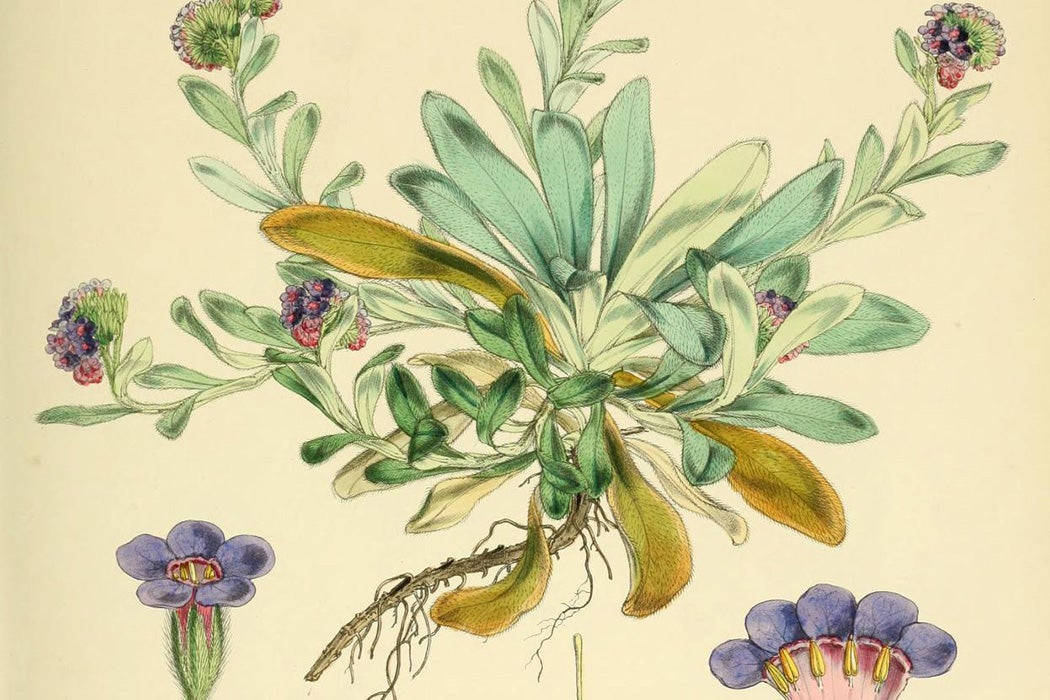
In 1843, English botanist Joseph Hooker returned from Antarctica with samples and illustrations of plants from his expedition. But when he found a publisher, he was distressed that they did not have the right priorities. He wrote that the publisher “cares nought for my descriptions at all, & would not care a straw whether all the plants were European or Antarctic.”


People bought these books primarily for the pictures. Advances in printing technologies had enabled a new type of popular science built around mass-produced illustrations. Historian Anne Secord argues that while some botanists saw these images as an important tool in a “quest to expand the scientific community,” others saw danger.
Making new botanists was a real problem. Secord writes that nineteenth century botanists “constantly lamented the small number of practitioners and stressed the need to sustain popular interest in the science in the hope of encouraging wider participation.”
Then the 1815 Apothecaries’ Act in Britain required doctors to learn botany, and the demand for lectures surged, among both students and interested outsiders. Secord writes that this gave a wider audience access to botanical illustrations. She quotes William Hooker, Joseph’s father, who lectured at the University of Glasgow. “I could have done nothing but for the illustrations,” he wrote. “Nothing could exceed the interest shown by that Class:—in short they came for the pleasure of the thing.”
But were they going to become effective botanists—or even botanists at all? Scientists disagreed about both questions. Secord argues that the controversy centered on the nature of pleasure.
Scientists struggled to find a balance between the pleasures of the eye and those of the mind. Secord writes that astronomer John Herschel “contrasted the ‘easy access’ of those ‘who cater for the passions’ with the difficulties experienced by promoters of ‘sound knowledge or rational instruction.’”
More to Explore
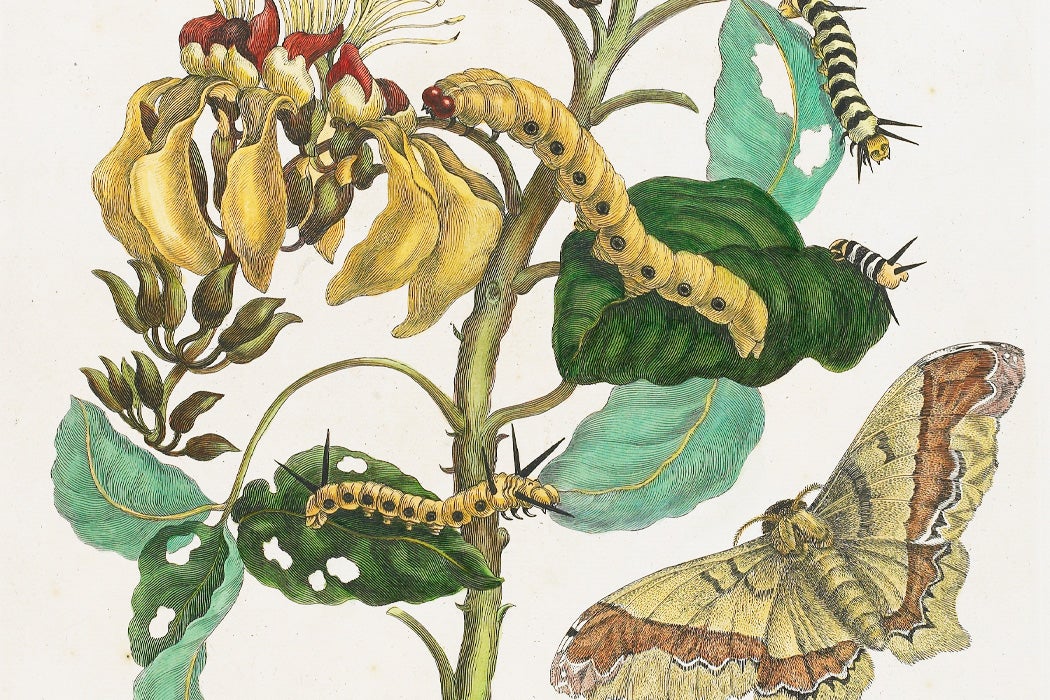
The Metamorphosis of a 17th-Century Insect Artist
For some, images produced the wrong type of pleasure, distracting from real learning. Naturalists like Peter Rylands believed that written descriptions would prevent unserious people from taking up the science, and would make better practitioners.
But others believed images were the key to botany’s future. Secord explains that Edwin Lees likened “Rylands’s objections … to rejecting a candle at dusk or refusing to use a guide in an unknown country.” There was “no talismanic power in scientific language,” Lees wrote, and he argued that images allowed the eye and mind to work together in a way that words could not.
Weekly Newsletter
"*" indicates required fields
Lees was careful to argue that images should be grounded in expertise. Herschel agreed, saying that images could be a good hook, but that pleasure “should not be a mere ‘cloak for the instruction intended to be conveyed.’”
Images had additional potential in disciplines like anatomy, where specimens were more difficult to obtain. For medical students, practicing with real cadavers would remain important. But lecturers increasingly used images to bring new groups of people into science.
Secord believes these episodes should bring us “a greater awareness of the inclusionist aims of expert practitioners, which were inscribed in the ways in which they promoted their science.”