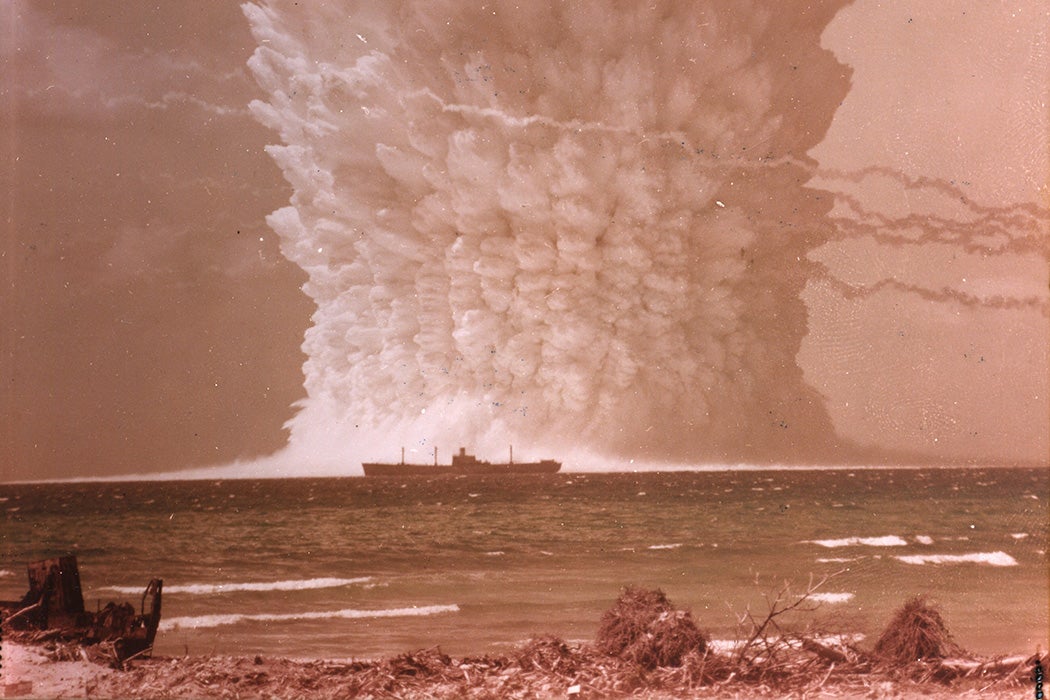
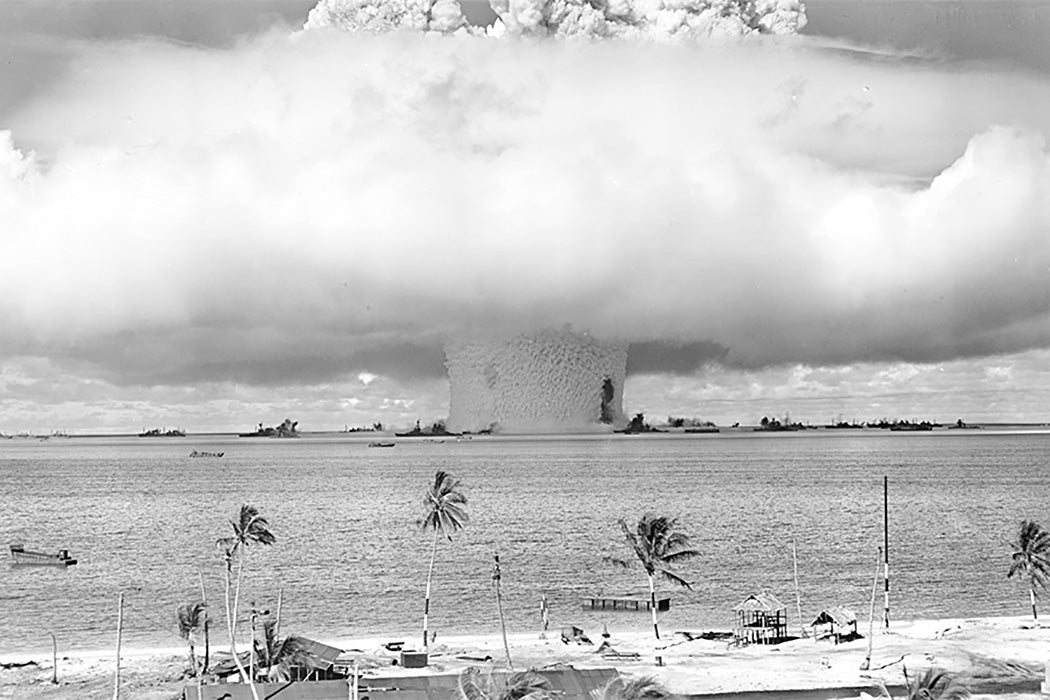
In the summer of 1946, the United States dropped nuclear weapons on Bikini Atoll in the Pacific in Operation Crossroads—the first nuclear weapons tests after WWII. In 1947, the Navy returned to the islands with a large team of scientists in the Bikini Scientific Resurvey. During the expedition, they drilled a hole that reached 2,556 feet deep, hoping to put one of Charles Darwin’s theories to the test.


Darwin suspected that atolls formed when coral grew around volcanoes, creating a ring that remained when the volcano subsided. Investigating such a theory would require an interdisciplinary team with access to specialized tools. Historian Ronald Rainger argues that the 1947 resurvey demonstrates how growing US military interest in science influenced oceanography.
During the interwar period, some oceanographers “did not consider oceanography a specific discipline,” Rainger writes. “Rather it was the study of a place, the oceans,” and fundamentally required a range of knowledge and skills. In the 1920s and 30s, university research centers like the Scripps Institution of Oceanography (SIO) and the Woods Hole Oceanographic Institution (WHOI) brought scientists from different disciplines together. As the US government gained interest in creating accurate navigational charts, they formed partnerships with the universities. This led to opportunities for graduate students like Roger Revelle at SIO.
And as World War II approached, the Navy sought more help from oceanographers to solve issues with submarine detection systems. Revelle joined the Office of Naval Research, directing research that broadly supported “subsurface warfare.” After the war, scientists continued their work with the navy, including studies during Operation Crossroads. Over time, they gained more control over such projects.
More to Explore
Bombs and the Bikini Atoll
“In contrast to Crossroads,” Rainger writes, “the Bikini Scientific Resurvey gave scientists a say about which vessels and instruments were necessary for their work.” Revelle coordinated with scientists at the U.S. Geological Survey (USGS) to plan projects involving sounding, photography, radar, and drilling.
Scientists H.S. Ladd and J.I. Tracey explained how they used the “1500 Holemaster” drill, which they “operated continuously in 12-hour shifts.” They encountered fossils at nearly every depth that helped tell the story of the reef. The fossils included corals, algae, foraminifera, and mollusks, some showing “original luster and traces of color pattern.” They conducted seismic tests, and Rainger writes that “work done at Bikini and later at other atolls in the Marshall Islands did confirm Darwin’s theory.”
Weekly Newsletter
"*" indicates required fields
Scientists often kept military utility in mind, recovering instruments from sunken ships and making observations about reef traversal. They had mixed feelings about military influence. But during this period, Rainger explains, “oceanographers needed the Navy as much as the Navy needed the oceanographers.”
For the most part, he argues, the scientists involved weren’t “piggybacking” to get research support, but “knowingly and willingly did military work.” Rainger quotes Revelle writing in 1947: “It has become apparent that the society which knows the most about its environment and how to turn it to account, is going to be the more likely to win the next war.”


_Detonation_-_DPLA_-_ca5ce4577d037b2ecb9f6659f75ffca8.jpg)