The Washington Monument towers above the nation’s capital at nearly 555 feet. Between 1884 and 1889, it was the tallest structure in the world. Art and architecture historian Kirk Savage writes that the monument “both overpowers and empowers, first diminishing the visitor into insignificance and then raising him skyward like a hero.”


The monument’s history is tangled. Savage continues, “The undertaking began in the eighteenth century …, ran into partisan warfare after [George Washington’s] death, and foundered for decades in unending disputes over designs and intentions.” Conflicts over monuments, it turns out, are not exclusive to the twenty-first century.
The problem was that the nation couldn’t decide what to do, what to think, about George Washington himself. And that, argues Savage, was wrapped up in “long-standing disputes over national identity.” Washington and his monument were “symbolic battlegrounds” over the nature of leadership in a republic, over the contradiction of a first citizen.
“Necessity made Washington an instant icon, and from the beginning necessity buried the real figure beneath a mound of verse, oratory, and imagery, all vying to give shape to the icon and therefore the nation.”
How then to portray an icon? The American Revolution was the first of many “no kings” protests, yet the Continental Congress’s initial effort to honor Washington in 1783 called for an equestrian statue on the model of imperial Rome (Marcus Aurelius) and Bourbon France (Louis XV). Federalists were for this grand gesture, but their opponents, Jeffersonian republicans (later called Democrat-Republicans), were against such monarchical trappings. Yet in 1791, they agreed to name the new federal capital Washington, District of Columbia.
More to Explore
The First Civil Rights Monument
Upon Washington’s death in 1799, the factions agreed that he should be buried in his eponymous capital city, despite his instructions that he be buried at Mount Vernon. But they could not come up with a consensus for the type of tomb. In early 1801, Federalists in Congress passed a scheme for a pyramid-shaped mausoleum, but newly inaugurated President Thomas Jefferson shelved the proposal. Washington stayed buried in Mount Vernon.
With the national government endlessly stymied over the issue, local Washingtonians stepped in to form the private Washington National Memorial Society in 1833. Belying its name, it was all D.C. players “active in promoting the unrealized city that was still a swampy backwater.” The Society’s George Watterston called for an obelisk that would be “the highest edifice in the world and the most stupendous and magnificent monument ever erected to man.”
Architect Robert Mills’ design, finally chosen by the Society in 1845, was almost exactly what Watterston envisioned. Mills’ plan included a 100-foot-high Doric colonnade around a flat-topped obelisk. Mills was reputed to have said that an unembellished shaft—which he would not live to see—would look like “a stalk of asparagus.”
The Society solicited donations of money and stone from around the world and started work. Pope Pius IX chipped in with a slab of marble from the ruins of the Forum in 1855. This enraged nativist “Know-Nothings” of the American Party, convinced that Catholic immigrants from Ireland and Germany were plotting to take control of the US. Fired up by telegraph inventor Samuel Morse, they smashed the Pope’s gift and threw it into the Potomac. They also seized control of the Society itself, insisting that only “Americans” (meaning native-born Protestants) could fund a monument to Washington. Their three-year fund-raising campaign proved a bust, however, yielding a mere $51.66.
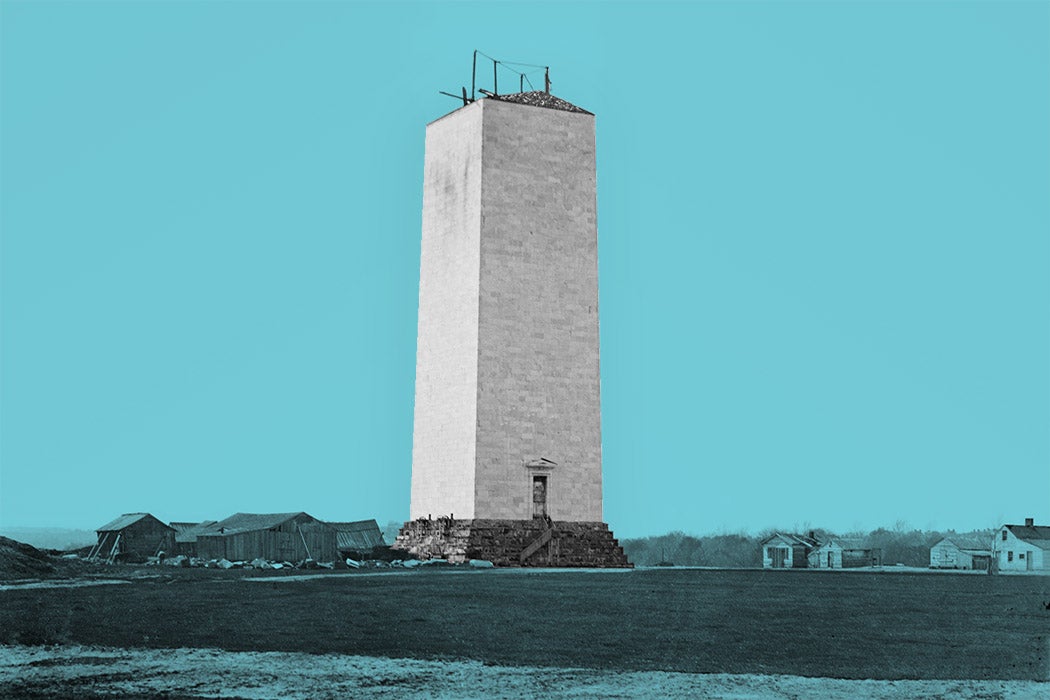
So for twenty years the uncompleted stump of a tower looked, according to Mark Twain, like “a factory chimney with the top broken off.” After the Civil War, in Savage’s words, “the stump seemed to represent a nation that had lost its way.” When Congress refused to fund its completion in time for the 1876 Centennial, there were even demands that the eyesore be torn down. But then, during the Centennial year, Congress suddenly acted to fund and complete the tower.
“The nation could unify around Washington’s monument only after dismissing the question it had so insistently posed, the question of his legacy,” writes Savage. “Washington no longer mattered, not even in his own monument.”
Weekly Newsletter
"*" indicates required fields
Lieutenant Colonel Thomas Casey of the Army Corps of Engineers became the designer of the revived project. Instead of proposed neoclassical or Neo-Gothic towers, he continued on with the obelisk, but stripped it of all embellishment and added a pyramidion to the top. Inside, he put in the technological marvel of an elevator. (Pro tip: they didn’t add plumbing.)
Elsewhere, Washington is portrayed astride a horse or atop a column; shirtless, in classical garb, or, more commonly, in a long coat and tricorn. At the national memorial to the man, however, he is nowhere to be found. Instead, as Savage observes, visitors ascend an empty obelisk and, for a moment, “take the place of the hero himself.”



.jpg)

