On December 2, 1922, the grisly remains of a white, 24-year-old high school teacher named Ruby Hendry were found in tall grass beside a train track in the town of Perry, Florida. As historian Christopher Calton writes, the manhunt that followed was also a campaign of terror shaped by economic and social forces that affected rural Florida in the years after World War I.


Perry is the seat of Taylor County, a part of northern Florida long known for being hostile to Black people. But, in 1913, the owners of a new sawmill began bringing in skilled workers from Louisiana, some of them Black, nearly tripling the Black population of the town.
Laura Scott Reaves, who was a child at the time of the manhunt, told Calton that white men in Perry, facing their own hardships due to the economic downturn following the end of the war, were furious at the hiring of Black foremen. They began a campaign of terrorism that drove many of them to flee north.
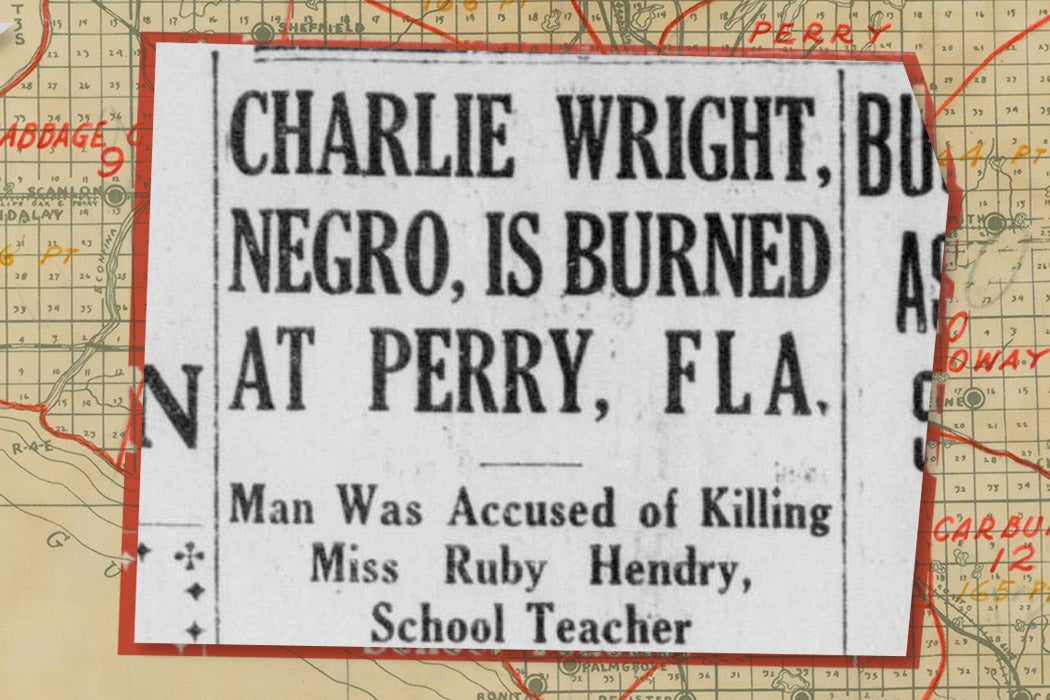
The day after Hendry’s body was discovered, police arrested four local Black men as suspects despite having found no meaningful clues. A few days later, they announced that the murder had apparently been committed by a man named Charlie Wright, an “escaped convict” from nearby Dixie County.
Calton writes that the label of escaped convict carried a very specific meaning—a Black man forced by the convict leasing system into hard labor at an isolated turpentine camp deep in the forest. Dixie County had been incorporated just the previous year on a nearly uninhabited area owned by the Putnam Lumber Company. By making it a county, the company created a jurisdiction with a local court that funneled incarcerated people into lumber and turpentine camps.
More to Explore
Remembering the Rosewood Massacre
Police might arrest a man at random on the street, extort him for money, and, if he was unable to pay, charge him with vagrancy. After being brought to a turpentine camp through the convict leasing system, men were often kept there through debt peonage, which could change a three-month sentence into a lifetime of enslavement.
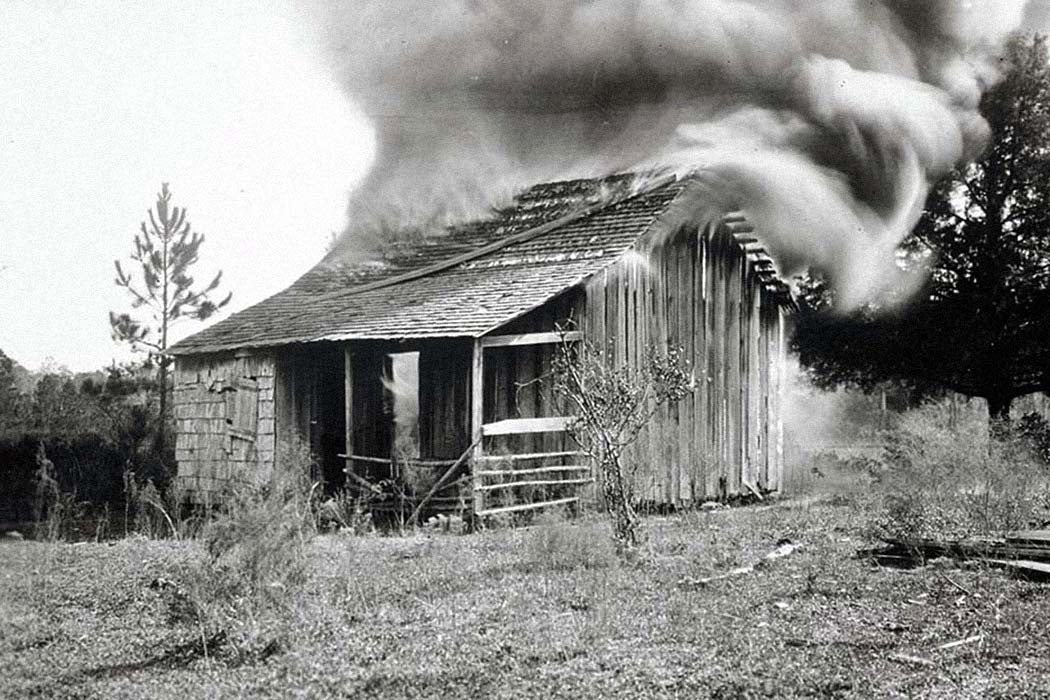
Calton writes that although no evidence was ever publicly released linking Wright to Hendry’s murder, hundreds of white men, assisted by tracking hounds, surrounded the swamp where he was hiding. Vigilantes also menaced the homes of Black Perry residents who they claimed might give him refuge and killed a number of Black residents, reportedly including children. The mob burned the community’s church, school, Masonic lodge, and amusement hall—one building each night that Wright remained on the loose.
Weekly Newsletter
"*" indicates required fields
“It is impossible to identify how much of the violence stemmed from a culture of racism and notions of honor and how much, if any, was motivated by labor tensions in a depressed economy,” Calton writes.
After six days on the run, Wright was finally captured. A mob of thousands, from across northern Florida and southern Georgia, chained him to a wooden stake, placed dried grass doused in turpentine on the ground, and set him on fire. The episode illustrates how systems of racial oppression and forced labor reinforced one another in the Jim Crow South.