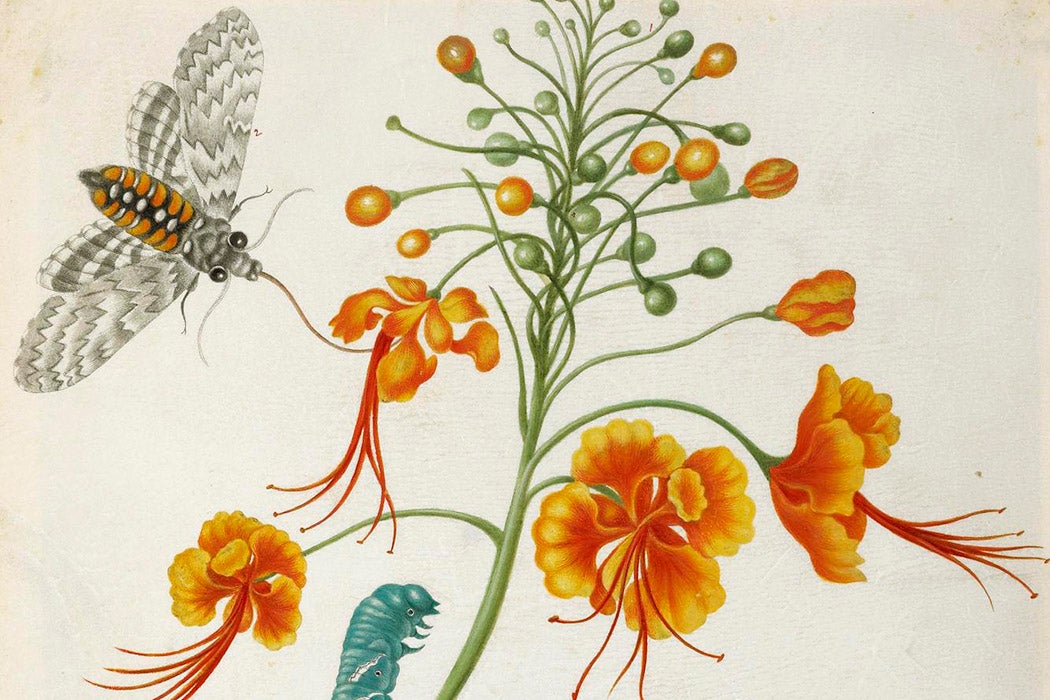
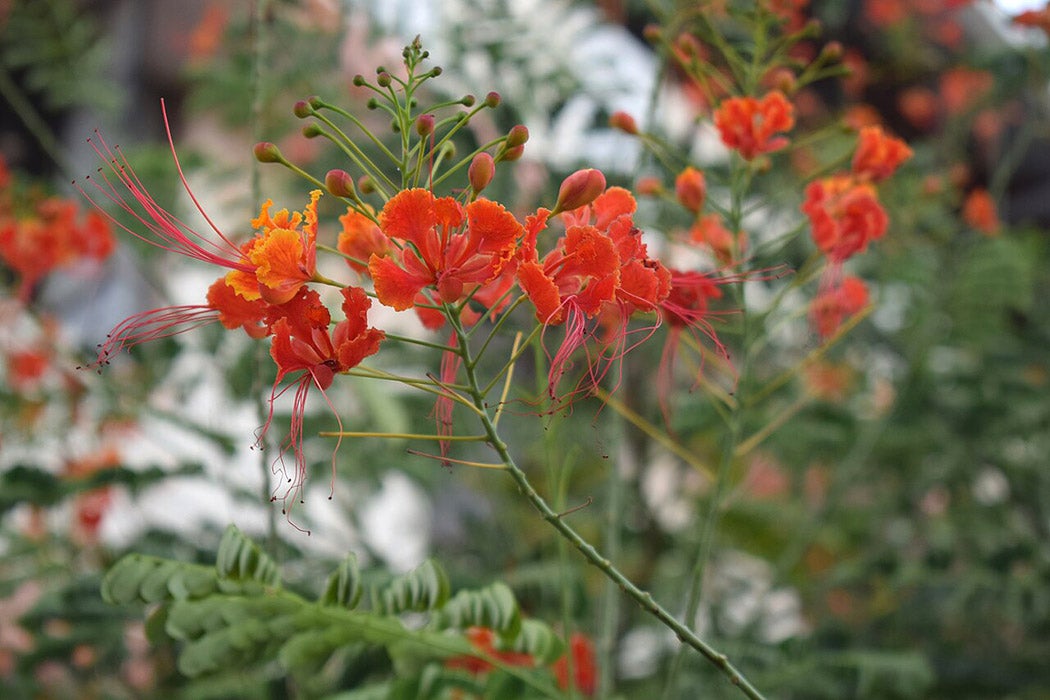
Admired for their striking beauty, the fiery blossoms of the peacock flower have long captured the attention of people across the Atlantic world. Known today as Barbados Pride and Red Bird of Paradise, the tropical shrub was identified by eighteenth-century naturalists as flos pavonis or Poinciana pulcherrima L., a species now classified as Caesalpinia pulcherrima (L.) Sw. As economic botany expanded throughout the New World, European collectors sought plants with potential commercial, medicinal, and agricultural value. Among the species they transported from the Caribbean to Europe was the peacock flower, where it became a favored ornamental plant in botanical gardens.


These Europeans did not similarly preserve the knowledge held by Caribbean communities about the plant’s medicinal uses. Enslaved women across the Caribbean possessed knowledge of the peacock flower’s medicinal properties and used it as an abortifacient, a substance that could be used to induce menstruation or facilitate abortion. For these women, using the peacock flower was one way to exercise control over their reproductive capacities within a racial capitalist system that commodified their fertility and viewed the birth of children as an expansion of enslaved property.
Historian of science Londa Schiebinger has used the history of the peacock flower to examine the unequal movement of botanical knowledge across the Atlantic world. European observers in Suriname, Jamaica, Saint-Domingue (modern-day Haiti), and Barbados recorded how enslaved and Indigenous women used the plant to induce abortion or menstruation. Although European naturalists encountered and documented its use as an abortifacient across the Caribbean, this knowledge was not incorporated into European medical and botanical traditions. The peacock flower’s history reveals that colonial science involved more than simply collecting and transferring knowledge. According to Schiebinger, it also operated as a process of selection and cultivation, through which some forms of knowledge were preserved and circulated while others were excluded from the bounds of recognized science.
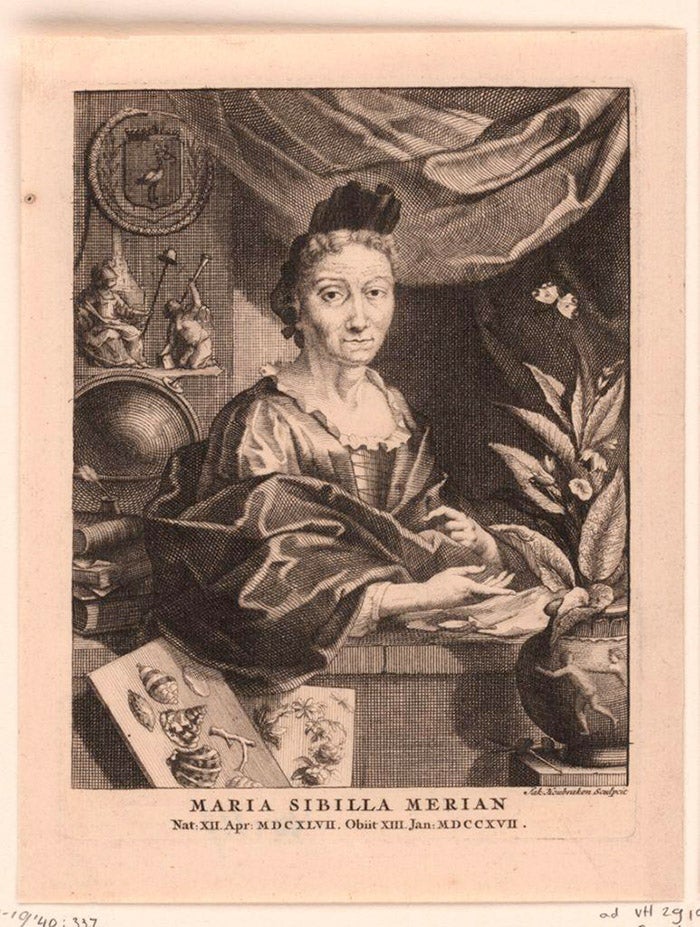
One of the most significant European accounts of this knowledge came from Maria Sibylla Merian, a German naturalist and scientific illustrator who traveled to Suriname with her daughter in 1699 on a scientific expedition. In her 1705 work Metamorphosis insectorum Surinamensium, or Metamorphosis of the Insects of Suriname, Merian documented the peacock flower alongside the insects and plants she studied in the Dutch colony. Notably, her account of the plant drew on testimony from enslaved African and Indigenous women who told her they used the plant’s seeds to prevent their children from being born into slavery. In the chapter “Lost Knowledge, Bodies of Ignorance, and the Poverty of Taxonomy as Illustrated by the Curious Fate of Flos Pavonis, an Abortifacient,” Schiebinger reproduces Merian’s account:
The Indians, who are not treated well by their Dutch masters, use the seeds [of this plant] to abort their children, so that their children will not become slaves like they are. The black slaves from Guinea and Angola have demanded to be well treated, threatening to refuse to have children. In fact, they sometimes take their own lives because they are treated so badly, and because they believe they will be born again, free and living in their own land. They told me this themselves.
As Schiebinger argues in Plants and Empire: Colonial Bioprospecting in the Atlantic World, Merian’s account differed from those of other European observers because she “placed abortion squarely within the colonial struggle,” recognizing enslaved women’s use of the plant as a form of resistance to a system that sought to control their reproductive lives. Historian Jennifer Morgan similarly contends that enslaved women’s reproductive capacities were essential for the economic logic of hereditary racial slavery. She argues that the Black female body became a site of labor, reproduction, violence, and resistance, making fertility itself a domain of political struggle. In this context, the refusal to bear a child served both to “inflict damage on the regime” and to reject the “legitimacy of enslavement to begin with.”
More to Explore
A History Wrapped in Banana Leaves
Merian was not the first European naturalist to record the use of the peacock flower as an abortifacient. Ten years earlier, English physician and naturalist Sir Hans Sloane had documented the plant in Jamaica, where he described its ability to “[provoke] the Menstrua” and “[cause] Abortion.” Unlike Merian, Sloane framed the practice as evidence of women’s trickery, warning of deceptive women who secretly sought abortions from “unsuspecting doctors” rather than considering the conditions of bondage that shaped enslaved women’s reproductive choices. A similar account emerged in 1799 from Michel Descourtilz in Saint-Domingue, where the French physician and naturalist also recorded the peacock flower’s abortifacient use but interpreted it through the perspective of plantation authorities, condemning enslaved women for the “‘ill intentions’ of the ‘negresses’ who aborted their offspring.”
These accounts demonstrate that European naturalists did not lack access to knowledge about the peacock flower’s abortifacient properties. Rather, the absence of this knowledge in European botanical and medical traditions reflected the priorities of colonial science. In the context of the peacock flower, European scientific communities “chose to remain ignorant of West Indian abortifacients.” Schiebinger uses agnotology, a methodological approach that examines how ignorance is produced and maintained, to analyze the making of this scientific ignorance. As she argues, scientific inquiry was shaped by broader forces including “funding priorities, global strategies, national policies, the structures of scientific institutions, trade patterns, and gender politics,” which directed attention toward certain forms of knowledge while leaving others unexplored.
Weekly Newsletter
"*" indicates required fields
For Schiebinger, the suppression of knowledge about abortifacients reflected a form of “cultured apathy or cultivated indifference” toward reproductive knowledge that challenged political and economic priorities. In the eighteenth-century Atlantic world, European governments advanced pronatalist policies that celebrated population growth as a source of national power. Meanwhile, amid debates over the end of the transatlantic slave trade, enslaved women’s reproduction became increasingly important to plantation societies seeking to expand the population of enslaved people in accordance with impending trade restrictions. Thus, knowledge about limiting fertility conflicted with the interests of European states and plantation societies that valued population growth. As Schiebinger explains, “the same forces feeding the explosion of knowledge we associate with the Scientific Revolution and global expansion led to an implosion of knowledge of herbal abortifacients.” As a result, knowledge of the peacock flower’s abortifacient properties remained rooted in Caribbean communities rather than becoming incorporated into European botanical and medical traditions.
The history of the peacock flower reveals that botanical knowledge is inextricably linked to the social and political worlds in which it was produced. In the case of the peacock flower, the gaps in the scientific record expose as much as the knowledge it contains, demonstrating how systems of power and culturally produced ignorance influenced what was and was not preserved as scientific knowledge. The Plant Humanities Initiative at Dumbarton Oaks seeks to explore histories like this one, illuminating the many ways that plants and people have shaped each other across time and place.


.jpg)
.jpg)