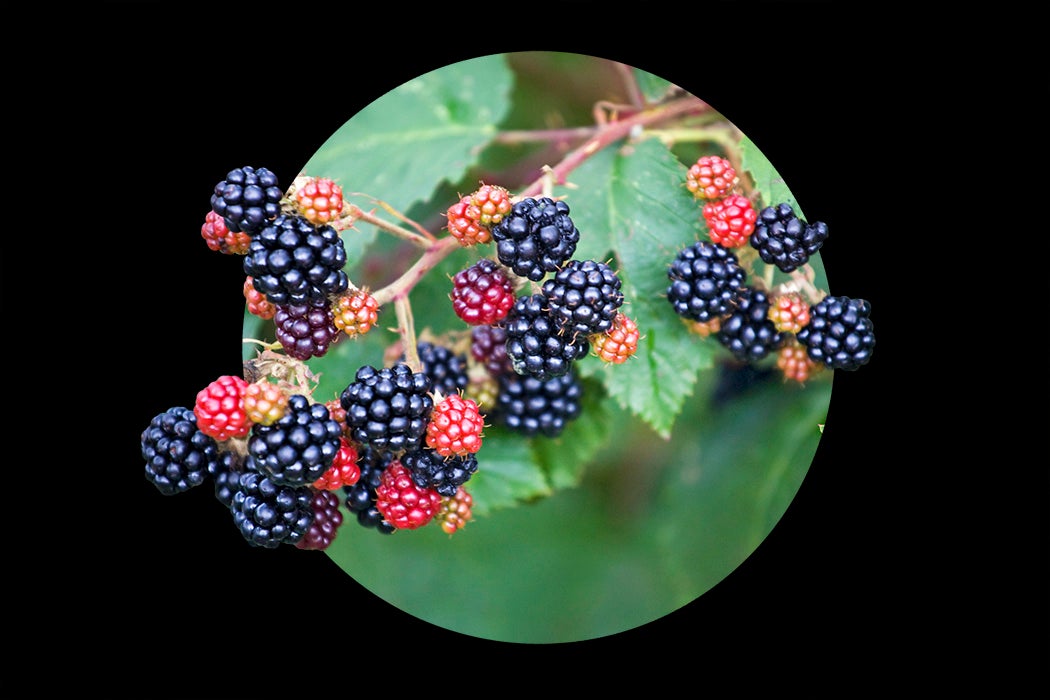
There is no summer in the Pacific Northwest without the blackberry. Across Washington and Oregon, jagged walls of blackberry brambles choke out nearly every hiking trail, highway shoulder, and vacant lot in the region. Come August, dense thickets beckon berry-pickers to stain their fingers with the juice of the sweet purple fruits, promising the potential of a fresh-baked blackberry pie after a long day’s harvest. But despite the strong association between the region and the fruit, the species of blackberry that most locals have come to enjoy is anything but native.


The story of how the Himalayan blackberry came to swallow the West Coast is a monument to late nineteenth-century industrial ambition. In the late 1800s, transcontinental rail travel revolutionized the United States’ approach to agriculture. A rapidly growing, urbanizing populace demanded a constant supply of fresh fruits and vegetables. To meet this demand, the market required crops engineered for this new era, encouraging innovation that produced plants sturdy enough for cross-country travel and aggressive enough to thrive in any backyard soil.
At the core of this innovation was the enterprising horticulturist Luther Burbank. Operating out of his experimental farm in Santa Rosa, California, Burbank functioned more like a “plant wizard” than a traditional farmer. His mail-order catalogs allowed amateur gardeners across the country to purchase from a selection of hybrids suited for the shifting needs of the nation. Among these plants were the Shasta daisy, plumcot, spineless cactus, and Russet Burbank potato, known today as the most widely grown potato in the United States. As historian Phillip Thurtle states, Burbank’s explicit goal in crafting his hybrids was “to take the rough spots out of nature,” domesticating the wild to promote utility and commercial efficiency.
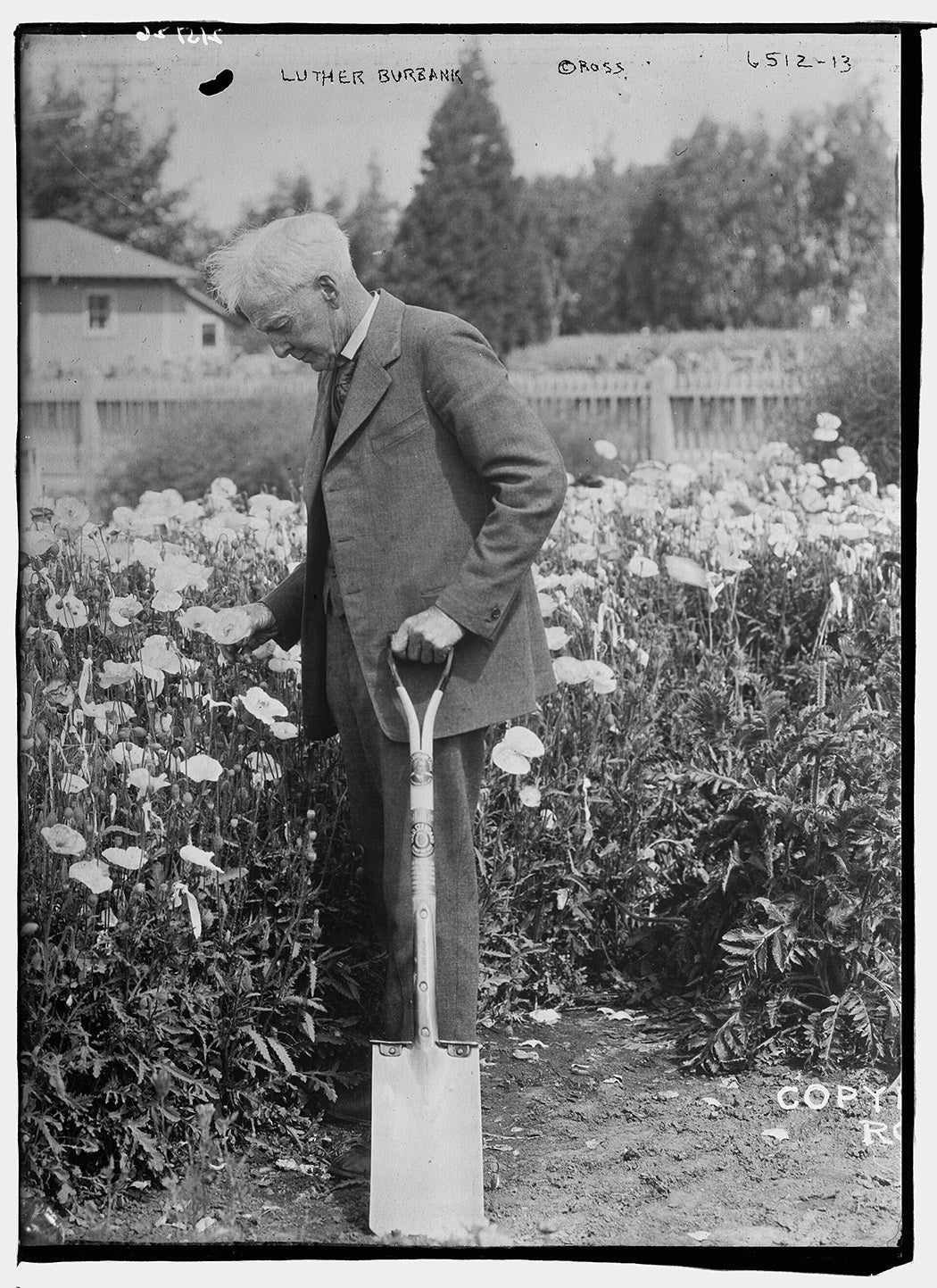
In 1885, Burbank received a packet of seeds that he had imported from India. Upon opening it, he discovered that the seeds bore a hardy blackberry plant that thrived in temperate areas and produced large, succulent fruits. Pleased by its capacity for growth, yet ill-informed of its true regional roots, Burbank named the plant the “Himalayan Giant” to signal its believed origins and great size. The name was a misnomer, as the species, known scientifically as Rubus armeniacus, is actually native to Armenia and northern Iran.
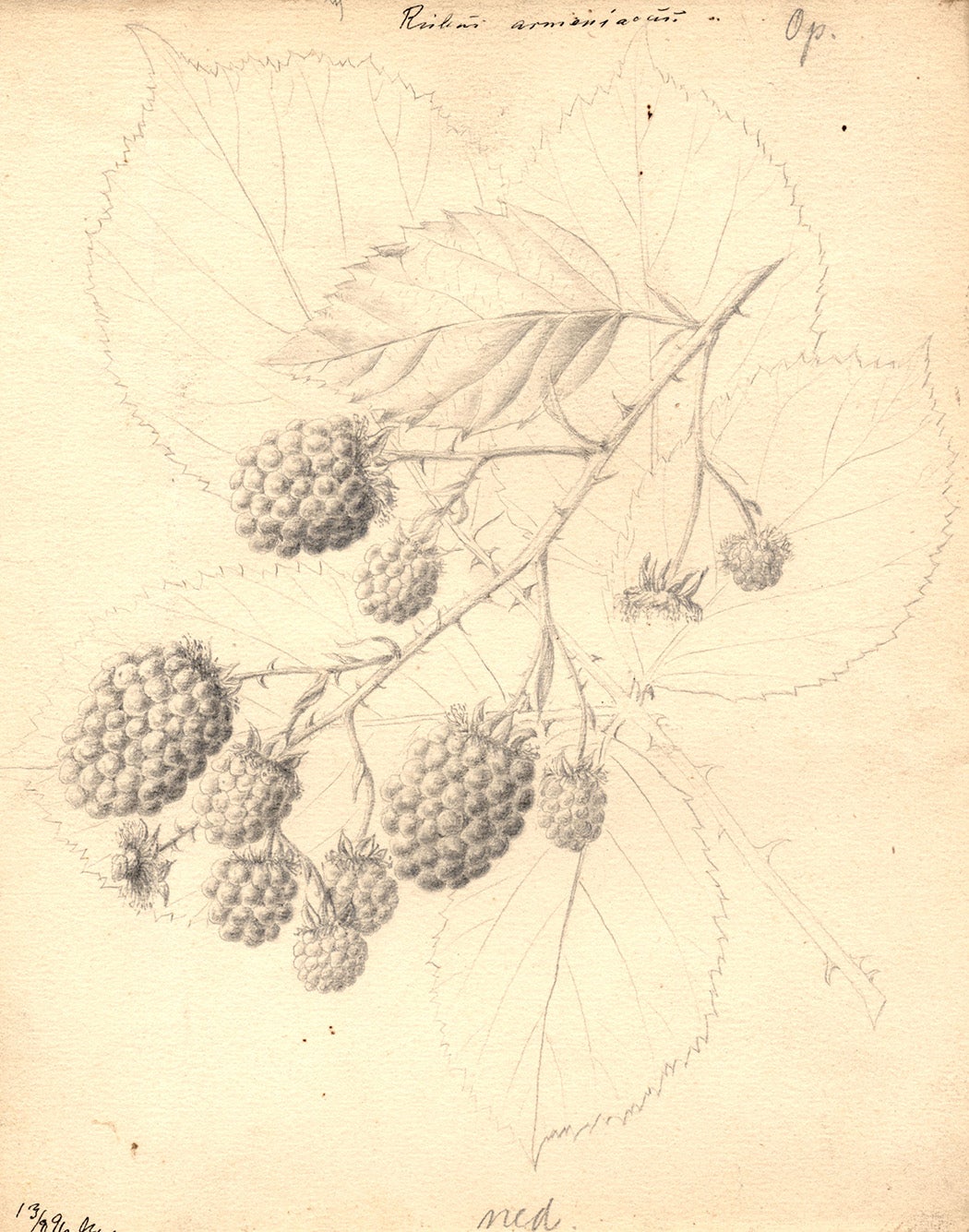
Impressed by the size and strength of the Himalayan Giant, Luther Burbank marketed the plant to growers in the damp, temperate climate of the Pacific Northwest in a targeted flyer in 1894, promising a plant of extreme utility. The marketing push was met with a large wave of orders from the region, and according to Burbank, “the plants could not be multiplied fast enough to meet the demand.” Over a century later, the Himalayan blackberry has spread far beyond the modest backyard bounds its importers envisioned, opting instead to take over indiscriminately and displace the native trailing blackberry (Rubus ursinus) in the process.
Like all blackberries, the Himalayan blackberry is not a berry but rather an aggregate fruit of multiple drupelets, with each drupelet containing an individual seed. These sweet fruits attract birds and other animals in the summer, which encourages seed dispersal and the rapid spread of the plants through their feces. In addition to reproducing through seeds, Rubus armeniacus may also clone itself through vegetative propagation, which occurs when the stem tips root as they come in contact with the ground, contributing to its aggressive growth strategy.
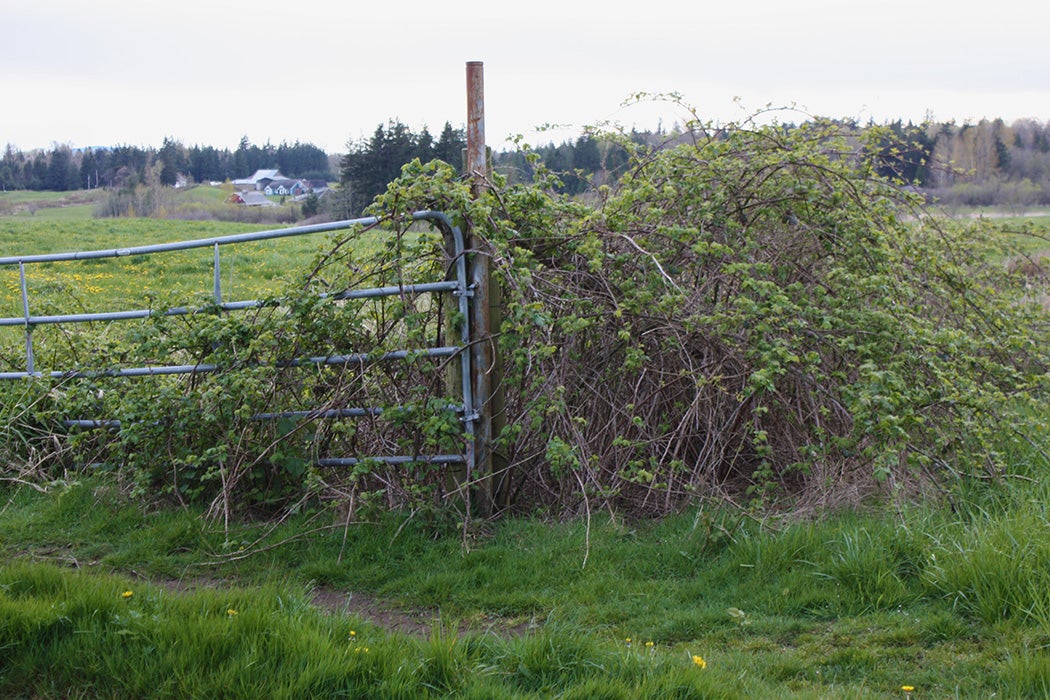
The plant is impressively sprawling and hardy. An individual bush can grow up to 15 feet high and 40 feet long, with thick stems, also known as canes, marked by sharp, hooked thorns. The density and hardiness of Himalayan blackberry thickets allow the plant to “choke out other foliage and prevent the establishment of trees.” Furthermore, Himalayan blackberry bushes thrive in poor and disturbed soils, allowing them to flourish in abandoned lots and fields.
Combined, these traits have led the plant to be known as the unofficial state weed of Washington. Frustratingly, Rubus armeniacus is notoriously difficult to get rid of, as traditional approaches to invasive management such as fire, herbicide, and mowing are insufficient at eradicating the plant. Thus, this weed, whether northwesterners like it or not, is here to stay.
The industrial impulse that welcomed this hardy blackberry also manifested in Burbank’s vision for the future of American society. In 1907, he released The Training of the Human Plant, in which he directly applied his plant breeding techniques to the development of a “superior” race of people. Burbank argued that just as plants could be improved through careful crossbreeding to optimize their positive characteristics, the same opportunity existed for the improvement of mankind. Deeply informed by his American context, Burbank alleged that the “vast mingling of races” brought to the United States via immigration presented an opportunity for “developing the finest race the world has ever known,” as the ethnic variety allowed for a wide array of traits to select from. In light of this potential, Burbank called for a long-term overhaul of American childrearing in order to immerse generations of children in favorable environments that would lend themselves to the development of a “healthy [human] animal.”
More to Explore
Sassafras: From Scent to Science in American Medicine
While it is tempting to categorize Burbank’s ideas as typical of the rigid, genetically determinist eugenicists at the turn of the twentieth century, his eugenic theories possessed a uniquely American appeal, emphasizing productivity, efficiency, and one’s ability to reshape their reality. Central to Burbank’s thesis was his belief that environment mattered as much, if not more, than heredity. For Burbank, heredity was “simply the sum of all the effects of all the environments of all past generations on the responsive, ever-moving life forces.” Under this view, human and plant species were entirely malleable, shaped profoundly by the pressures of the natural and artificial world around them. Thus, through enough hard work and careful attention to environment, one could bend the will of evolution to create more productive organisms in the plant and animal kingdoms.
By arguing that environment was the true “architect of heredity,” Burbank expanded the work of evolution into the American domestic sphere. As historian of science Katherine Pandora writes, this belief offered a vision of change that gave primacy to environment, “allowing women—as cultivators of the nation’s potential through their work as mothers and teachers of children—to assume a central role in the biological and sociological drama of American evolution.” If human traits were merely the accumulated imprints of past environments, then domestic and educational environments maintained by women could become bastions of human optimization. Under this environmental determinist framework, a mother’s work shaping her home could instill traits into a child “just as a plant-breeder puts better characteristics into a plant.” In this way, nature and society could each be perfectly disciplined, guided by human intervention toward near-unimaginable efficiency.
Weekly Newsletter
"*" indicates required fields
Burbank’s environmental determinism was tangled with a settler-colonial impulse to imbue the wild landscape with Western ideals of control and organization to not only manage but also improve populations, in both plants and humans. To control the volatile biological mixing between the influx of American newcomers, he believed that human designers should dictate their surroundings and regulate reproduction, ensuring that “evil” or “poisonous” traits do not influence the general stock or reproduce among themselves to create more “virulent” organisms that may wreak havoc on the social order. More broadly, through plant breeding, Burbank hoped to create the strongest, most efficient version of the United States to match its growing global industrial power. Drawing parallels between plant breeding and human culture, Burbank saw the environment as a high-stakes arena in which an organism’s positive traits could lift it up, thus proving its fitness compared to its weaker peers. Over time, the success of these traits would lead to the betterment of the species.
Ironically, Burbank’s obsession with eliminating the weak and nurturing stronger organisms ultimately unleashed a botanical “master race” that defied his ideals of human control and smothered the Pacific Northwest. Once introduced to the region, the Himalayan blackberry found an environment perfectly suited to its needs and adapted so completely that it has become an inseparable fixture of local cultural identity. In regional lore and literature, the blackberry is depicted as a terrifyingly untamable force, with vines that “[push] up through solid concrete” and “[force] their way into polite society.” Yet each summer, the region suspends its hatred for the stubborn weed, celebrating the plant’s sweet abundance through blackberry festivals and preparing enough jars of blackberry jam to hold them over until the next year’s harvest.

Today, the Himalayan blackberry stands as a humorous rejection of Burbank’s attempt at complete human control. Amidst his efforts to “take the rough spots out of nature” and promote plants that worked toward a vision of human utility, he introduced a vegetal force that fundamentally refused to be disciplined. In doing so, the story of Burbank’s Himalayan blackberry reveals the limits of human intervention and demonstrates plants’ agency in shaping their own environments. The Plant Humanities Initiative at Dumbarton Oaks seeks to highlight histories like this one, unearthing the mutual influences of humans and the plant world on one another.






.jpg)

.jpg)