In the 1958 Tennessee Williams play Suddenly Last Summer, the character of Sebastian Venable dies before the events of the play, during a summer afternoon described as “one of those white blazing days in Cabeza de Lobo, not a blazing hot blue one but a blazing hot white one,” where he is torn apart, almost cannibalized, by a mob of local youths. Thus, he only exists through the recollections of other characters. The play rests on two major recollections of Sebastian: the first, told by his mother, Violet Venable, relays an idealized, “chaste, not chased” version of her son; the second, told by Sebastian’s cousin, Catharine Holly, depicts a relationship tinged with repressed trauma and horror.


“Most readings maintain this focus on the role of Sebastian as a repressed homosexual—variously martyr, saint, and sadist—and on the implications of that sexuality for his relationships with his cousin Catharine and his mother,” writes Irene Morra in The Tennessee Williams Annual Review, proposing an interpretation of the play as a reelaboration of The Bacchae in a more metatheatrical way, rather than as a realistic depiction of queerness and its consequences. “The majority of critical receptions continue to read Suddenly Last Summer in psychosexual, biographical terms. This reading, however, risks overlooking the extent to which the play offers a concerted aesthetic response to the negative reception of Orpheus Descending.”
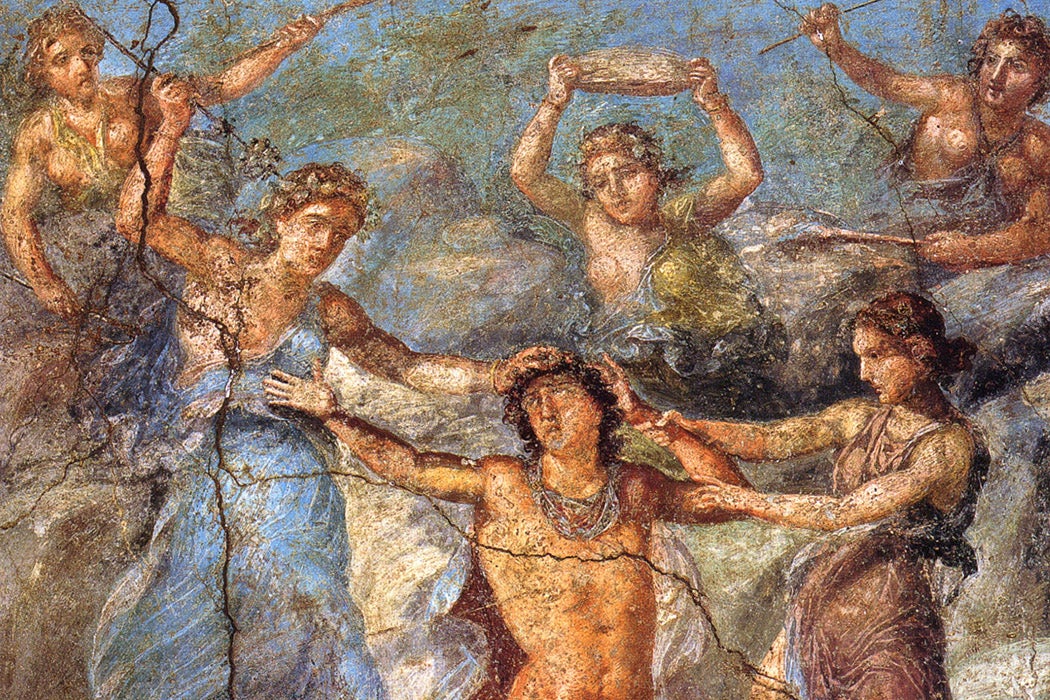
The Bacchae tells the story of King Pentheus of Thebes and his mother Agave, their rejection of the cult of Dionysus, and their subsequent punishment. At the start of the play, Dionysus has arrived in Thebes with his votaries to avenge the slander, repeated by his aunts, that he is not the son of Zeus. He moves about disguised as a foreign holy man to introduce Dionysian rites into the city, which Thebans are not exactly thrilled about. Thus, Dionysus drives Pentheus insane, lures him to the mountains, and the women of Thebes, in a state of Dionysian frenzy and led by Agave herself, tear Pentheus apart. Eventually, Agave brings her son’s head to her father, Cadmus, believing it to be that of a mountain lion.
More to Explore
How Sir Lawrence Alma-Tadema Imagined Ancient Rome
So how does The Bacchae parallel come in? “Both The Bacchae and Suddenly Last Summer are characterized by a male protagonist strongly devoted to his mother, and both protagonists share with their mother an Apollonian resistance to the truth of sensual experience,” writes Morra. In The Bacchae, Dionysus arrives to avenge himself on Agave and her family, and she eventually joins the Dionysian mysteries. Pentheus, for his part, is curious to witness his mother under the spell of Bacchic rites, and this curiosity results in his death at the hands of Agave, unable to recognize her own son due to her Dionysian frenzy. Unlike Agave, however, Mrs. Venable never yields to the “truth” of Dionysian experience, but instead is forced to partake in the destruction of her son by the very forces she has attempted to repress and deny. Like Sebastian, Pentheus yields to destructive natural impulses he had been repressing. Awakened to an awareness of what she has done, Agave mourns her son in language reminiscent of the bereft and aged Mrs. Venable: “now I long only to compose my son’s body for burial, and lament for him . . . let me touch my son, and say farewell to that dear body which I loved, and destroyed unknowing,” writes Morra.
In The Bacchae, Dionysus becomes violent only because his existence has been denied and his followers persecuted, and his maenads similarly become destructive only when pursued. Thus, the more Pentheus attempts to contain Dionysus, disguised as a foreign holy man, the more vehement and destructive the god becomes. And just as, in The Bacchae, the messenger describes the women as being “like birds, skimming the ground as they ran,” bearing down “like an enemy army,” Catharine describes the children who dismember Sebastian as “dark naked children that looked like a flock of plucked birds, and they would come darting up to the barbed wire fence as if blown there by the wind.”
Weekly Newsletter
"*" indicates required fields
Structurally, The Bacchae and Suddenly Last Summer are dominated by two key monologues, and, specifically, Violet’s and Catharine’s monologues turn Sebastian into the subject of a performed drama. “Sebastian himself, of course, exists only within the competing dramatic accounts of Catharine and Violet,” says Morra. “These expressions are themselves contained within a work that calls continuous attention to itself as drama, vehemently anti-realist and self-consciously subjective. The play refrains from staging or confirming the violence of Sebastian’s demise; even more so than The Bacchae, it contains its narrative at the level of language rather than action.”