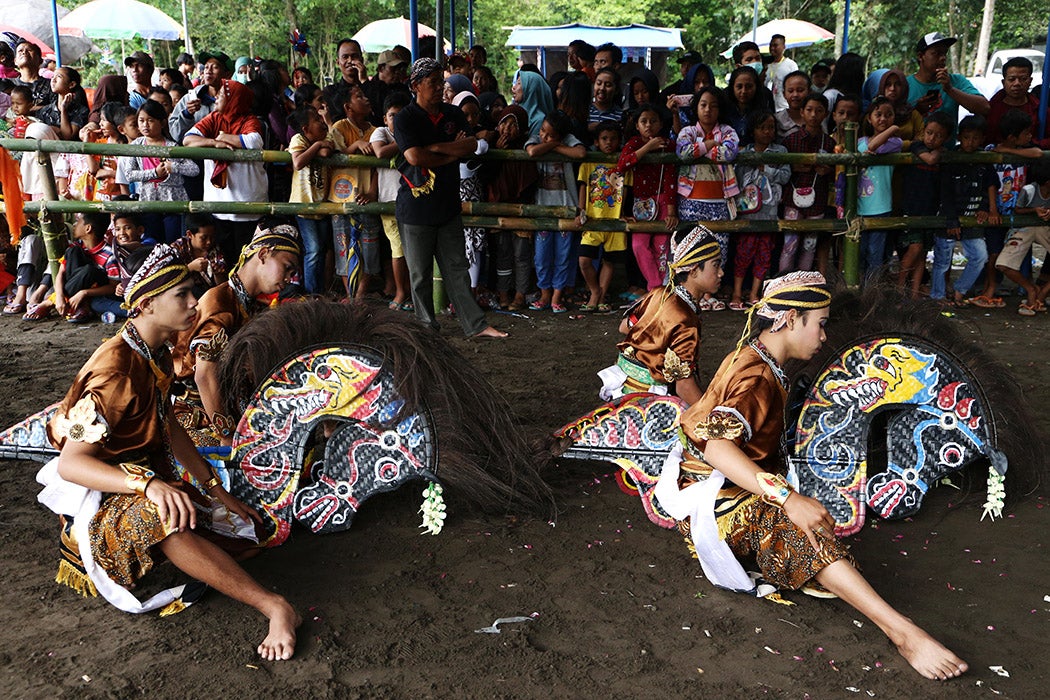
Mounted on handcrafted hobbyhorses, the dancers prance in circles, stamp, gulp down buckets of water, and chomp on fodder. Have they been possessed by horse-like spirits? Performed through deceptively simple repeated steps set to a rhythmic orchestral beat, the art form of kuda kepang—“horse of woven bamboo”—has become a flashpoint in the debate over the roles of religion and ethnicity in shaping a modern Malay identity.


Kuda kepang is a type of Javanese “trance dance,” in which dancers “enter an altered state and become mediums for another presence,” as theater scholar Kathy Foley explains. As dancers engage in superhuman feats, “[t]hese forms allow audiences to see beyond their everyday existence into the normally hidden world of the spirits who perform.”
While doing fieldwork, Foley witnessed a small village troupe perform with the aid of a pawang—a folk ritual practitioner, also called a dukun or a dalang—who induced a trance by burning incense, chanting mantras, and applying a magical artifact to the dancers’ bodies. The dancers themselves reported that they did not need to undertake any special preparation, because “all power comes from the pawang, who calls the spirits into their bodies and insures that they will emerge from the experience unharmed.”
It’s this supernatural element of kuda kepang that continues to make local religious authorities uneasy. Last year, the chairman of Johor’s State Islamic Religious Affairs Committee reiterated that “Muslims are urged not to take part in kuda kepang performances that carry superstitious elements” and forbade practices such as summoning spirits. The Islamic Religious Council of Singapore has likewise long warned against what it calls “non-Islamic practices” in kuda kepang.
Kuda kepang was introduced to the southern Malaysian state of Johor by Javanese migrants who had settled in the peninsula as plantation workers and farmers in the 1910s through the 1930s. The dance is also well known in neighboring Singapore, thanks to visits by troupes from Java in the 1940s. Today, performances can be staged at birthdays, weddings, circumcisions, and even Chinese religious festivals, according to researcher Patricia Hardwick.
Still, an aura of taboo lingers over this tradition. Although people of Javanese descent are part of the Malay racial community in Malaysia and Singapore, anthropologist Koji Miyazaki notes that they “have not always become Malay without any difficulty,” especially as their ethnic group is linked to the practice of sorcery.
“Islamic orthodoxy is more pervasive in Malay society than in Java, where the beliefs tend to be more syncretic,” Miyazaki explains. To better assimilate in Malaysia, Javanese-Malays often adopt more pious Muslim habits in a process Miyazaki dubs “re-Islamization.”
The process of becoming Malay, however, also implies the abandonment of their niche and their skill in magic. Some dukun lament their loss of power (semangat [spirit]) which, they believe, is still held by Javanese in Java or Indonesians who remain less Islamic.
Kuda kepang practitioners in Singapore—where the dance has been adopted by Malay performers from a variety of backgrounds—also navigate the complexities of race and religion. The Singaporean dancers who have mastered kuda kepang are not necessarily of Javanese origin. Though one practitioner describes herself as a “pure Malay,” she goes on to clarify that her heritage was Bugis and Malaccan, while calling other members of her troupe “different-different types of Malays” with roots not just in Java but also in Bawean or Penang.
More to Explore
The Supernatural Side of Malayan Rice Farming
Mindful of the cultural importance of orthodox Islam, Singaporean practitioners respond to religious authorities’ objections in various ways. One troupe leader—who links kuda kepang to legends about the historical conversion of the Javanese population from Hinduism to Islam—tells Hardwick that the dance is “not contrary to Islam” because Quranic verses, not mantras, are recited to enter the trance.
On the other hand, Hardwick quotes the leader of another troupe, who argues that kuda kepang performances should not include Islamic prayers. Instead, he insists, “Culture is culture. Religion is religion.”
At the same time, Singaporean kuda kepang has started to incorporate other cultural forms—such as local styles of the regional martial art silat—into its performances.
Weekly Newsletter
"*" indicates required fields
Though cultural purists might scoff at this blend of traditions, “Singaporean kuda kepang performers understand that this process is a means of articulating the complexity of the rojak [mixed] nature of Singaporean Malay identity,” Hardwick writes.
In fact, as kuda kepang is performed across Malaysia, it can now be described as a traditional folk dance from Johor, instead of as Javanese, according to Miyazaki. This shift “shows that the formation of Malay culture, and ‘Malayness,’ has incorporated elements from different ethnic origins.”
In other words, “becoming Malay is not necessarily a process of adopting one thing and abandoning another.” The dance remains a living expression of an identity that continues to evolve.