For over a century, the physical phone book could be found everywhere, yet seemingly belonged nowhere: a book without a genre, at once mundane and mysterious, raising questions that vexed courts and corporations alike. In print, it’s all but vanished, though it lingers in the names of the websites and search engines that replaced it, the data they were built from, and the way we’ve learned to interact with information.


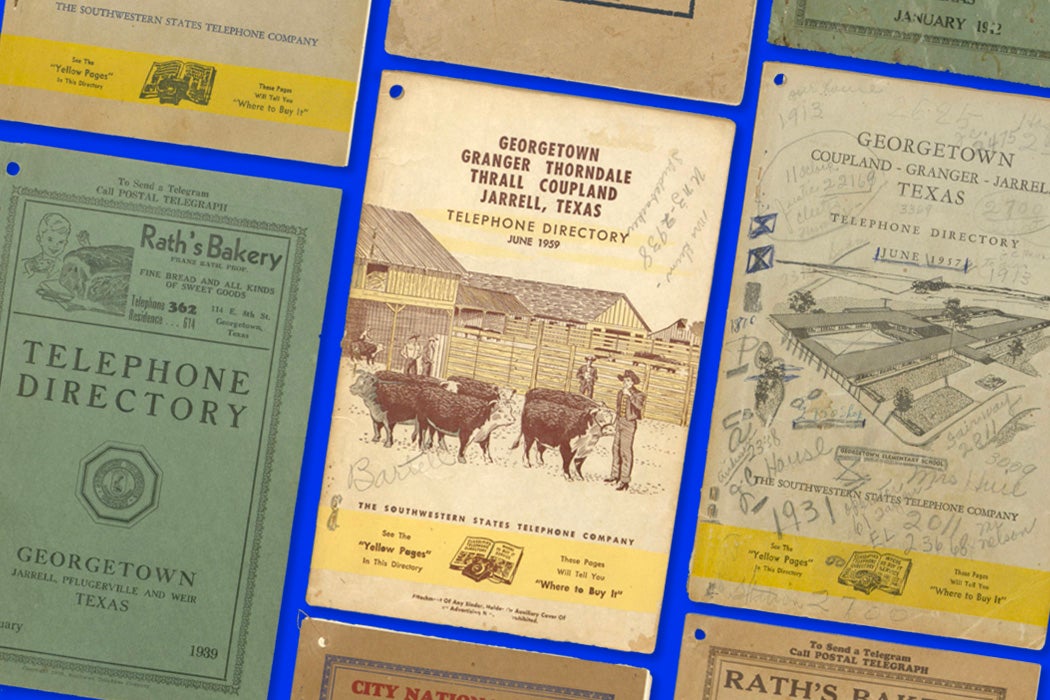
Southwestern University’s collection of Georgetown, Texas directories—eighteen volumes spanning 1913 to 1959—charts the evolution of the phone book in fine print and shows how it helped shape a vision of something new: networks people could not merely connect to, but could also ask things of.
The phone book is nearly as old as the phone itself. The telephone was born out of a mid-1870s race to improve upon the telegraph, which required trained operators at both ends and dedicated wires between them, and still wasn’t fast enough for an increasingly global market. The directory followed soon after to encourage its adoption and use.
In retrospect, the competition to top the telegraph ended on February 14, 1876, when two men filed competing U.S. patent claims for a method of transmitting speech electrically. Courts would eventually set the course of the American telecommunications industry by naming Alexander Graham Bell the sole inventor of the telephone and his Bell Company the sole holder of rights to electronically transmitted speech. At the time, though, there was real doubt about the business value of the so-called “talking telegraph”—enough that when Bell offered Western Union his patent, the telegraph company declined. The refusal reflected the verdict of the “practical telegraph men,” which Elisha Gray—the loser of the patent battle—put plainly: “In a business light it is of no importance. We can do more . . . with a wire now than with that method. And speed is the only thing we are after.”
The public, too, “had to be educated,” as the Bell Company itself put it, “to the necessity and advantage of the telephone.” Advertising could turn people into customers, but helping phone owners form what Bell called a “telephone habit” required a different tool. A 1941 article in the Bulletin of the Business Historical Society, “Business and the Telephone, 1878: As Illustrated by Early Directories,” links the telephone’s rapid adoption by businessmen to the equally speedy evolution of its instructive paper counterpart. Printed in New Haven in February 1878, the first phone book was not a book at all but a single page, with fifty-odd names listed in no discernible order. Boston and New York issued improved versions over the following months, with added attention to organization.
The twelve-page Chicago directory arrived in October, and with it came the familiar phone book formula: alphabetically arranged names, call numbers, and classified listings. But Chicago’s real innovation, the Bulletin notes, was that it “set out especially to educate the businessman to see the value of the telephone.” While its focus was on efficient business dealings (“By the turn of a crank the pork dealer is placed in verbal communication with his packer, miles away-the merchant with his manufacturer”), it also pitched a more expansive promise of personal connection: “the husband with his wife, and the lover with his sweetheart.”
By acknowledging the possibility of more intimate uses, the Chicago directory anticipated what the industry sought to avoid: non-business calls, which it discouraged outright, and non-business customers, whom it effectively excluded by concentrating on the cities. Social calls, the companies argued, threatened the telephone’s standing as a “serious” business instrument—and, by tying up both lines and operators’ time, the very speed on which business depended. Subscribers used phones in their own ways regardless, and when Bell’s patents expired in 1893–94, thousands of independent companies formed to serve the markets Bell had left alone—including those in and around Georgetown, Texas.
The same decade that produced the telephone was a consequential one for Georgetown. Southwestern University began operating there in 1873, and the railroad arrived in 1878; both helped expand the town and the farming communities around it, creating a demand for connection that Bell had little interest in meeting. What a city dweller could get by stepping outside—the news, the price of grain, another person’s voice—a farm family could access only by going to town. Having sprung from the dispersed, often isolated communities they served, the independents strung wires to bridge the distance and supplied a person to furnish all three, the last of them simply by answering.
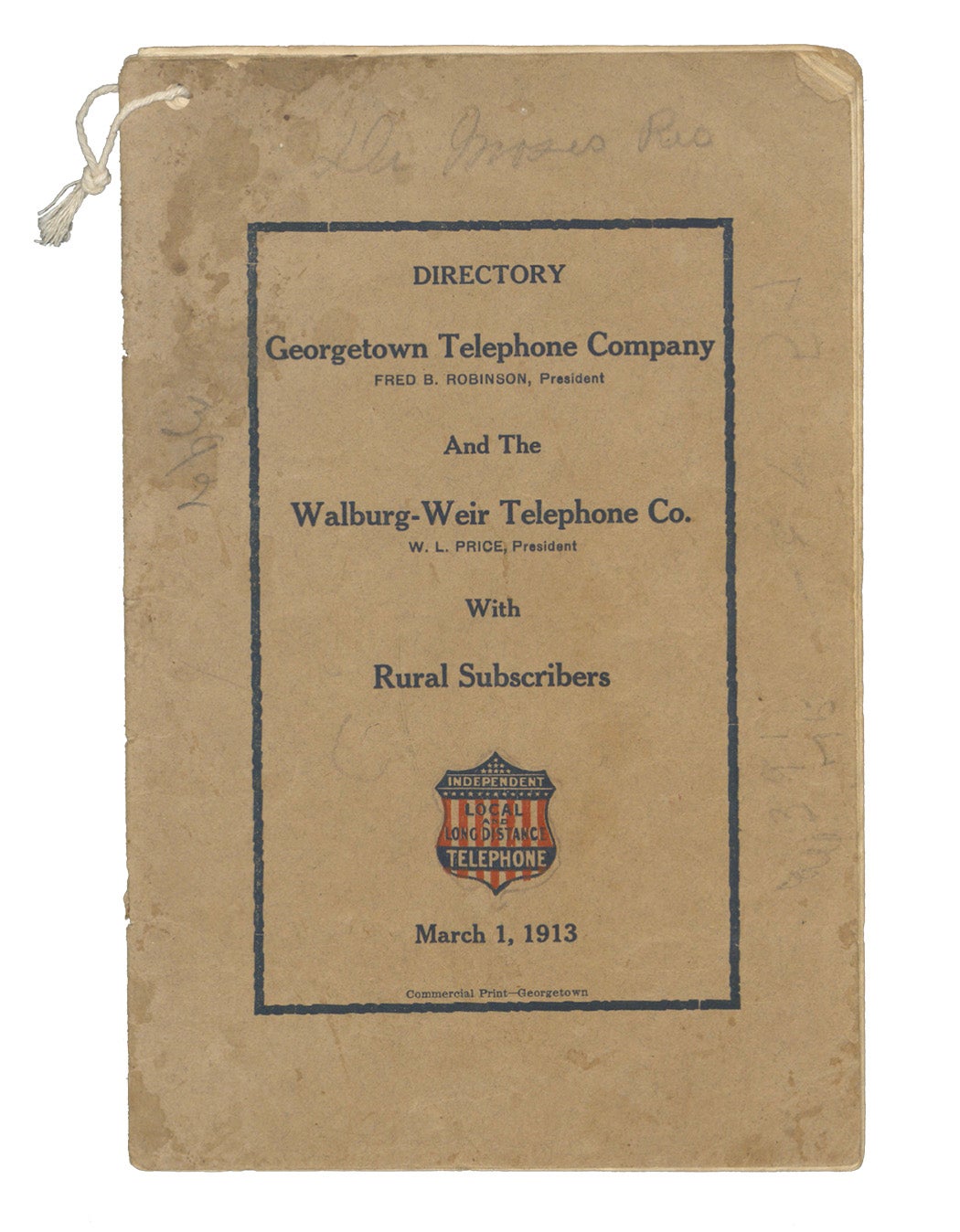
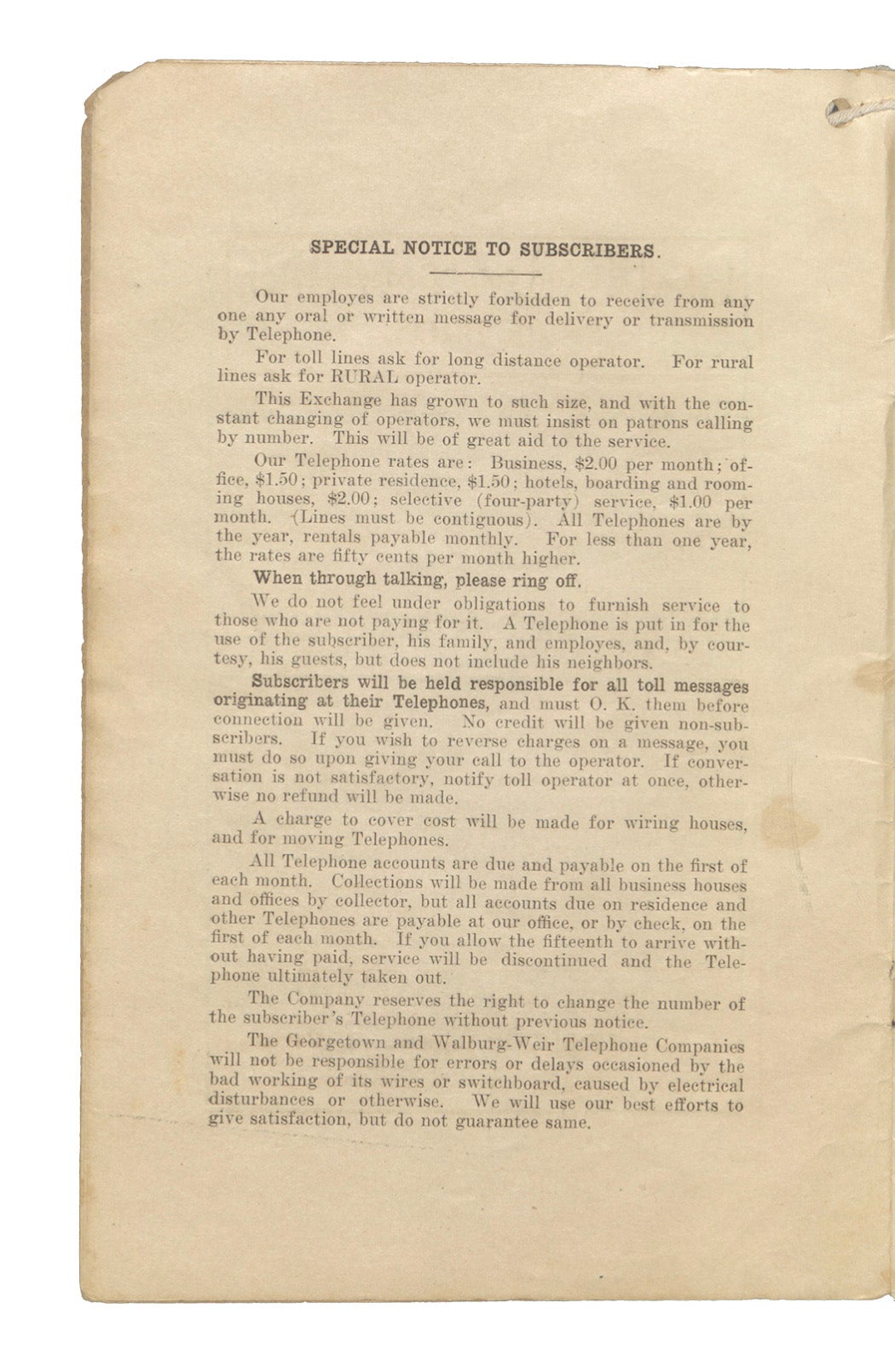
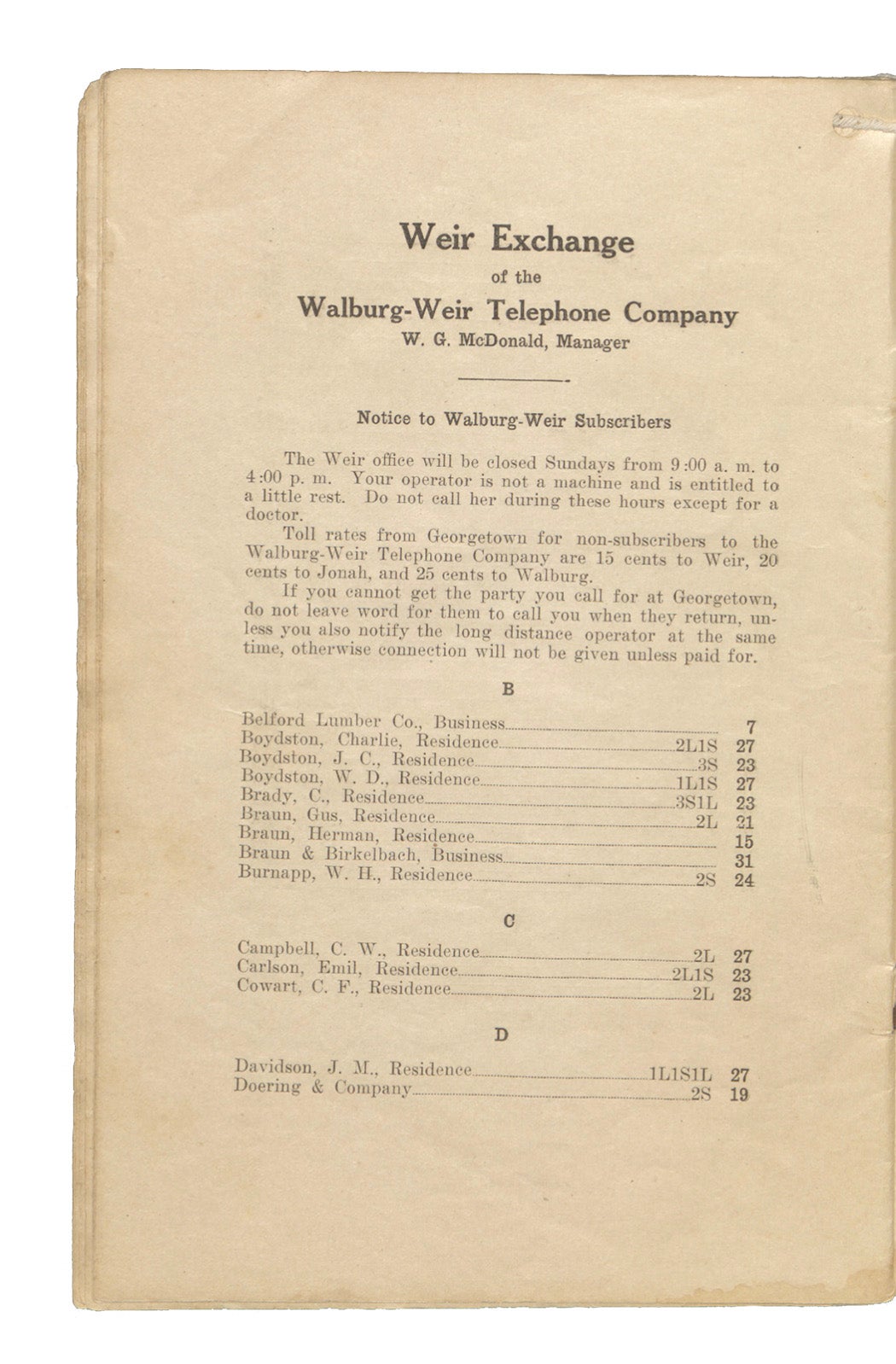
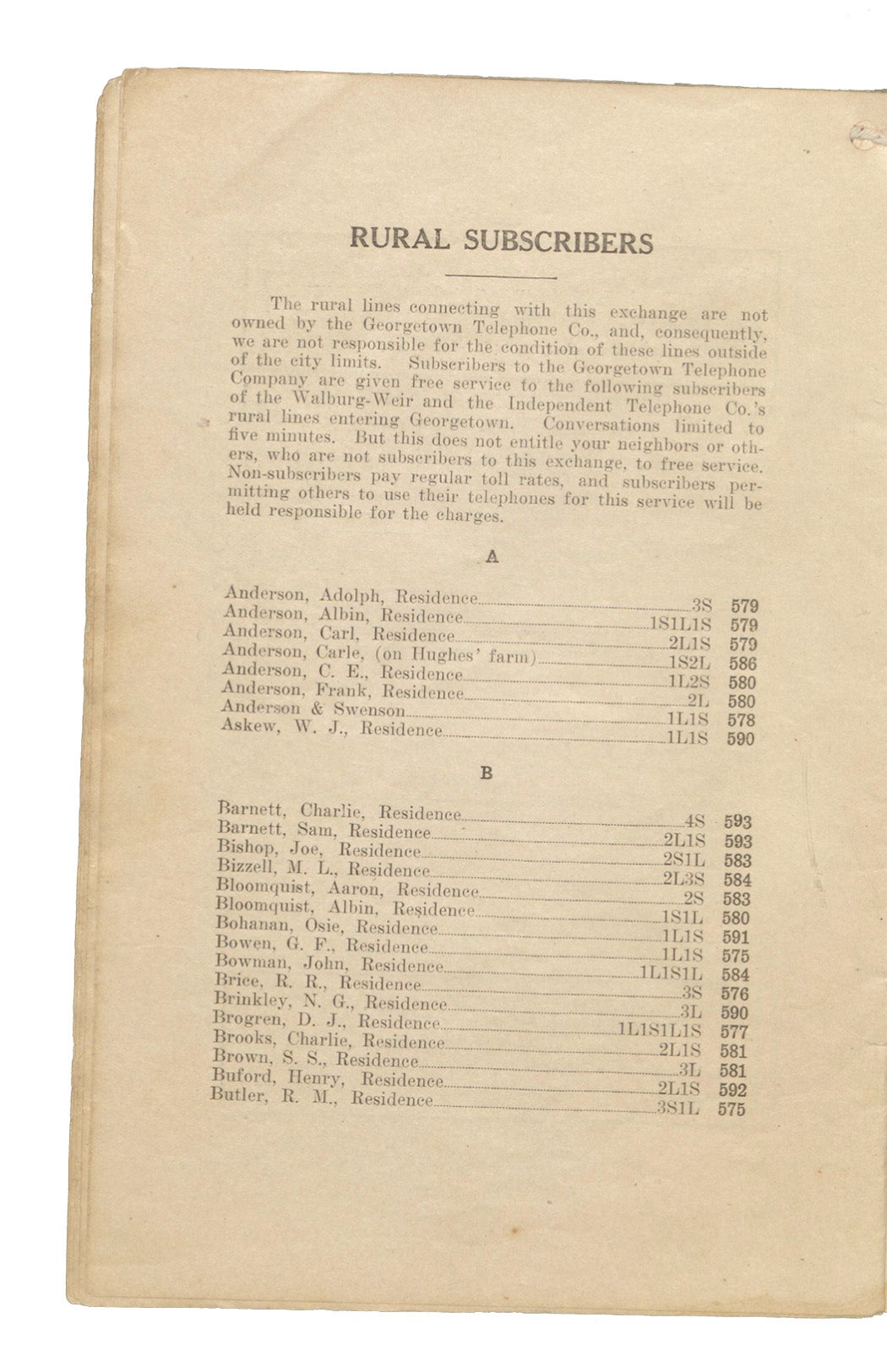
Throughout the U.S., telephone operators were typically female, as companies preferred women for their perceived congeniality and because they could be paid less. In rural settings, however, the operator was rarely anonymous; instead, she was a community member, even a farmer’s wife or daughter. The 1913 Georgetown Directory, which served the two town companies and the “rural subscribers” of a separate exchange, describes the operator differently depending on the audience. Those on the rural Walburg-Weir Exchange are reminded that the operator “is not a machine and is entitled to a little rest”—and that she is a specific someone rather than an interchangeable employee: “Do not call her during these hours except for a doctor.” In the Georgetown section, on the other hand, the operator has no pronoun at all. Citing the exchange’s growth and “the constant changing of operators,” the company insists that patrons call by number rather than relying on someone who knows every name in the book.
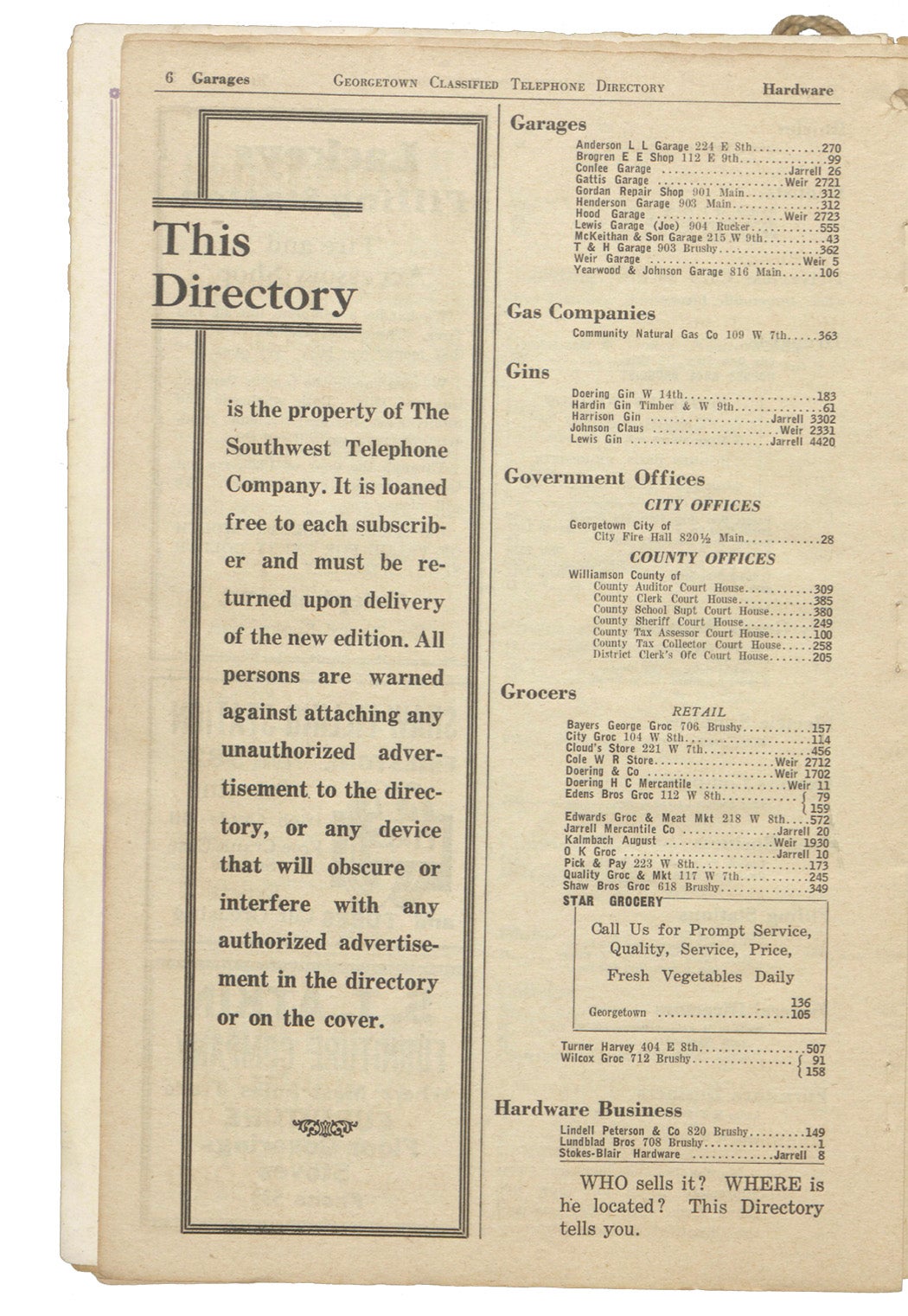
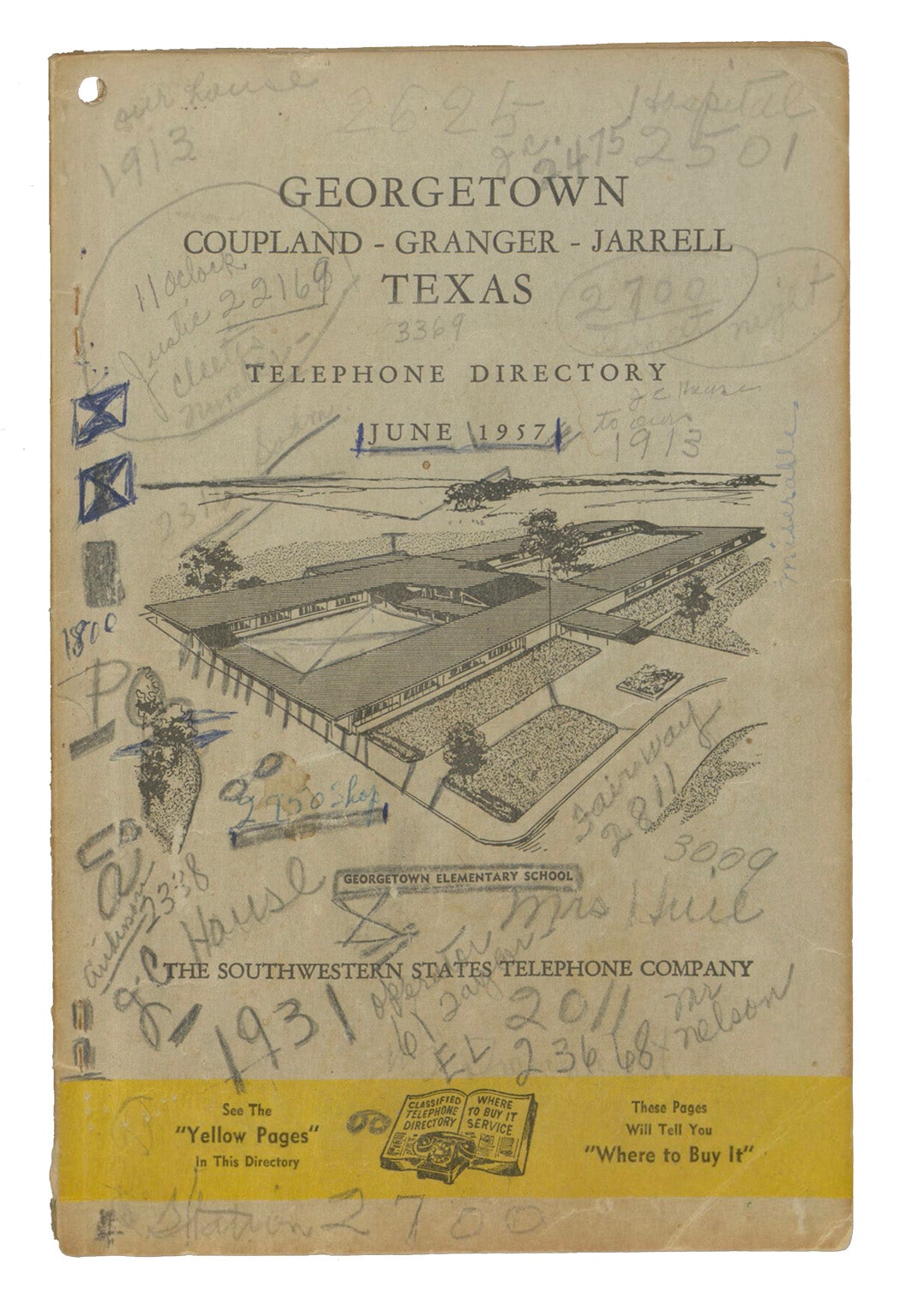
The historian Emily Goodmann has shown how, as phone use spread, the data in directories grew both more alluring and harder to keep current. On the one hand, the promise of possible connections packed into a list of names could make a directory seem enchanted—“a conjuror’s hat of magic possibilities,” as one journalist quipped in 1916. On the other, its incompleteness was increasingly evident to users. Though phone books were ostensibly the property of the phone companies and due back to them each year, subscribers often annotated their covers with information missing from their pages—new subscribers, changed addresses, and out of town numbers. They then took up operators’ time asking for the rest. The phone companies, ever interested in efficiency, responded by introducing an operator who would handle nothing else. They named her “Information.”
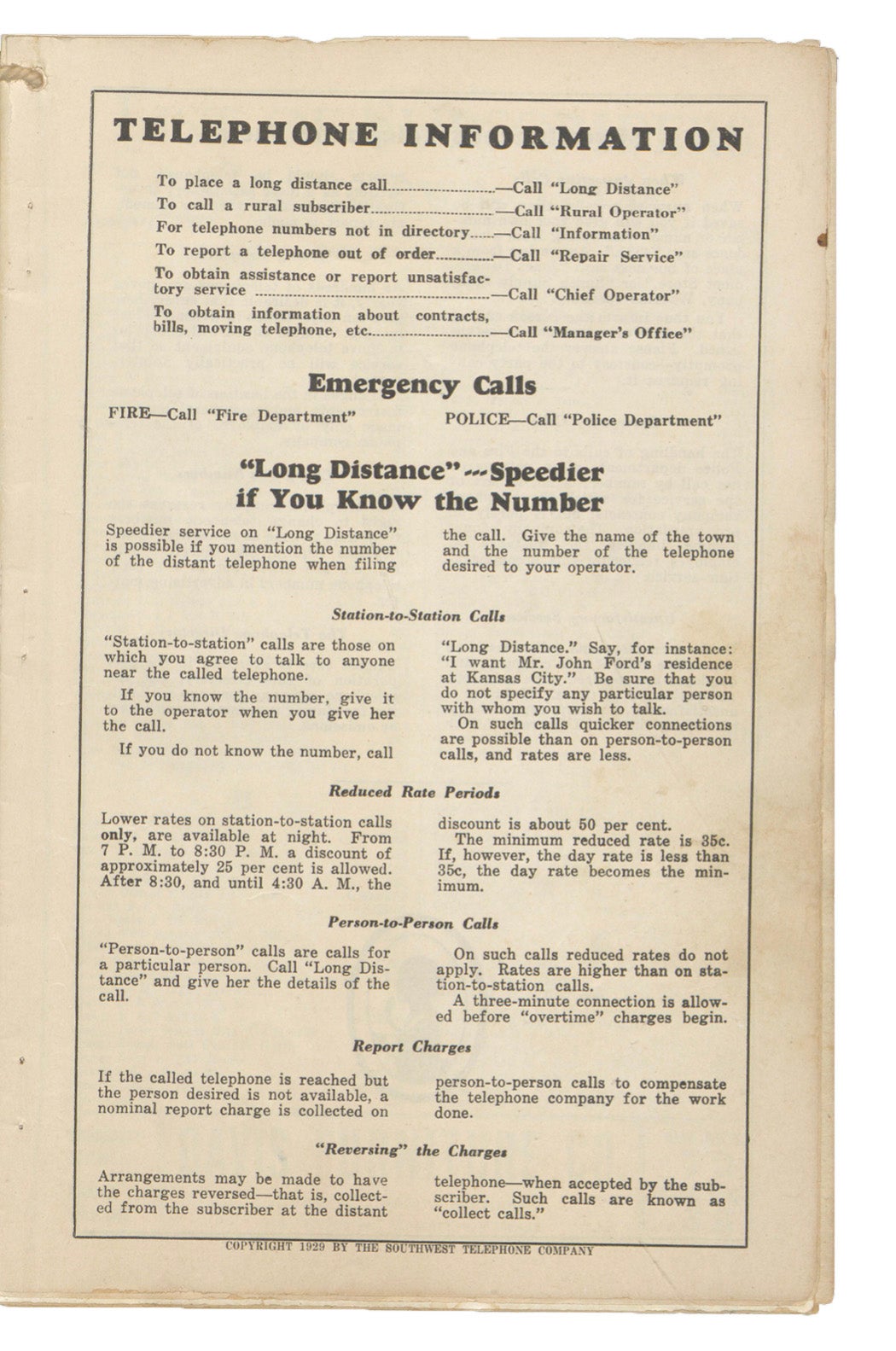
The word “Information” does not appear once in the 1913 Georgetown directory, even casually. By 1929, subscribers could find instructions to “Call Information” on page 2. Bell described these “information operators” as “human supplements to the directories.” Equipped with ongoing updates to the annual book, along with business and city directories, the information operator had a job the 1929 Georgetown directory defined narrowly: she was there to supply “numbers not in the directory.”
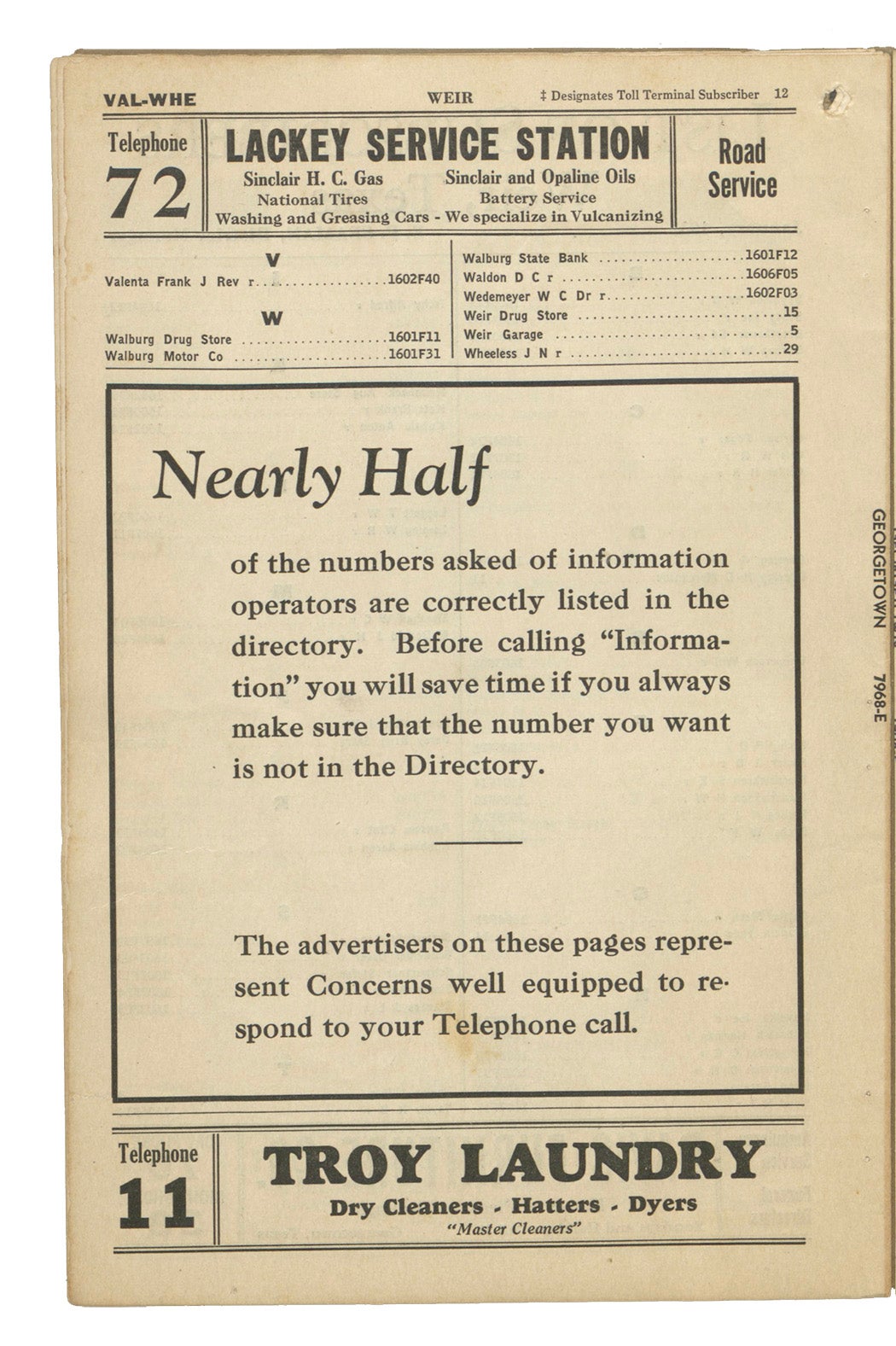
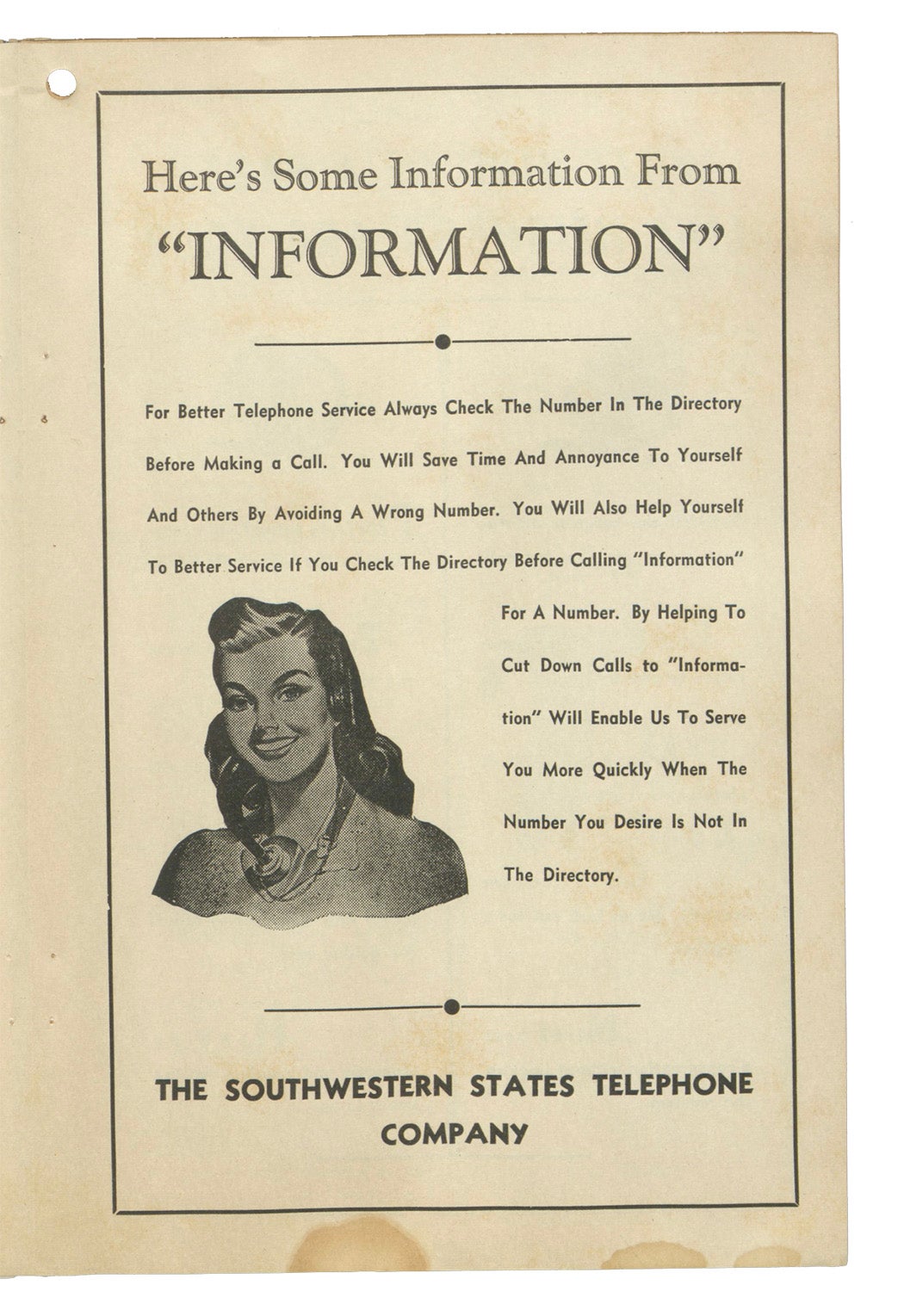
Given users’ demonstrated penchant for pushing the limits of acceptable use, it’s remarkable that telephone companies would hand them a word so obviously open to interpretation. But they did, and people interpreted it in its broadest sense almost at once. One consequence was a drop in directory use–why look up a number when you can ask someone for it? The result was notices like the one in the 1932 Georgetown directory, which scolded subscribers with the observation that “Nearly half of the numbers asked of information operators are correctly listed in the directory,” and implored them to “save time” by looking first.
But the bigger problem was what else people asked. As a Boston Daily Globe reporter observed in 1907, the telephone user had “learned that the telephone company maintains what is known as an information desk . . . and so when he has yearned to know something which would require the consultation of a dictionary, a directory, or a gazetteer, or in some cases the application of ordinary common sense, he adopts the easier method of stepping to the telephone and calling up, ‘Information.’”
The directories did not help, tending to use “Information” loosely themselves: the 1929 directory sent users to “Information” for numbers not in the directory and, a few lines later, to the “Manager’s Office” for “information about contracts, bills, moving telephone, etc.” A full-page notice in Georgetown’s 1953 directory, urging readers to check the book before calling, was headed “Here’s Some Information From ‘INFORMATION’”—as though the addition of scare quotes could resolve the real (if willful) confusion the page only partially acknowledged.
Telephone companies began rescinding the offer of “Information” almost as soon as it was introduced. But just as the rollout of the word itself differed by region and exchange, so too did its withdrawal. Bell engineers studying operating methods concluded as early as 1904 that “the giving of information which is contained in the directory should be discouraged.” The Georgetown directories show that conclusion being carried out decades later through a new form of mechanization: the dial.
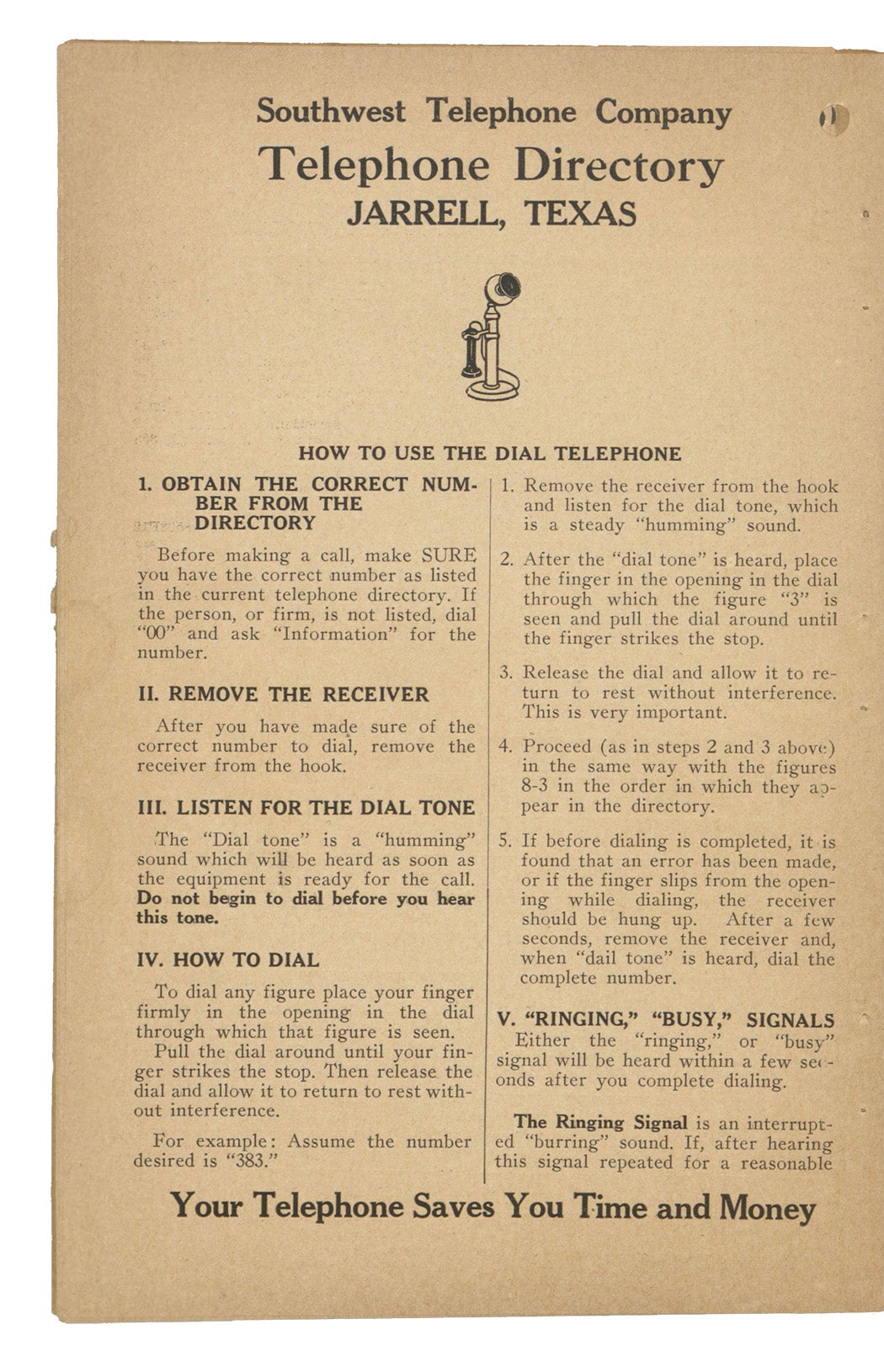
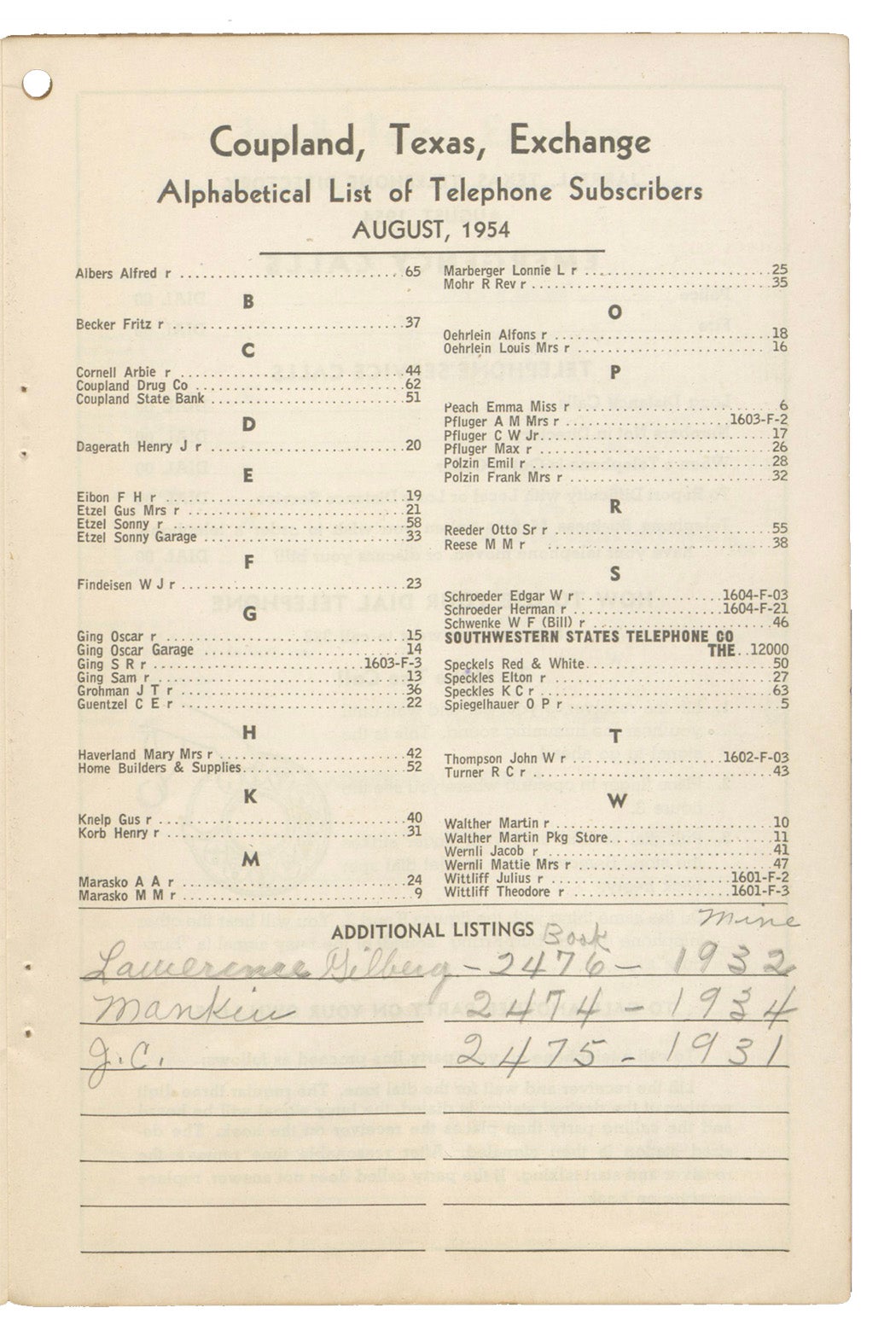
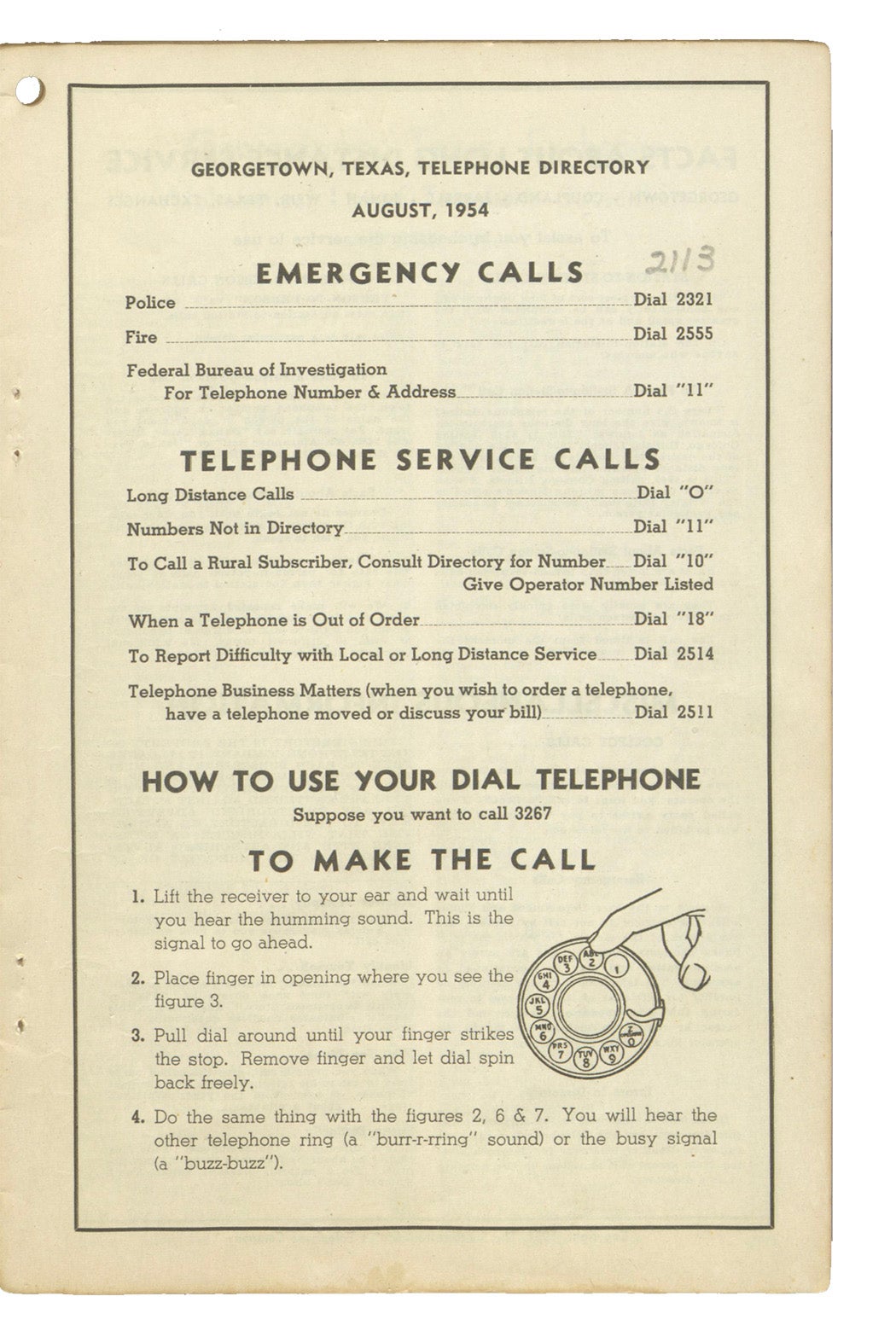
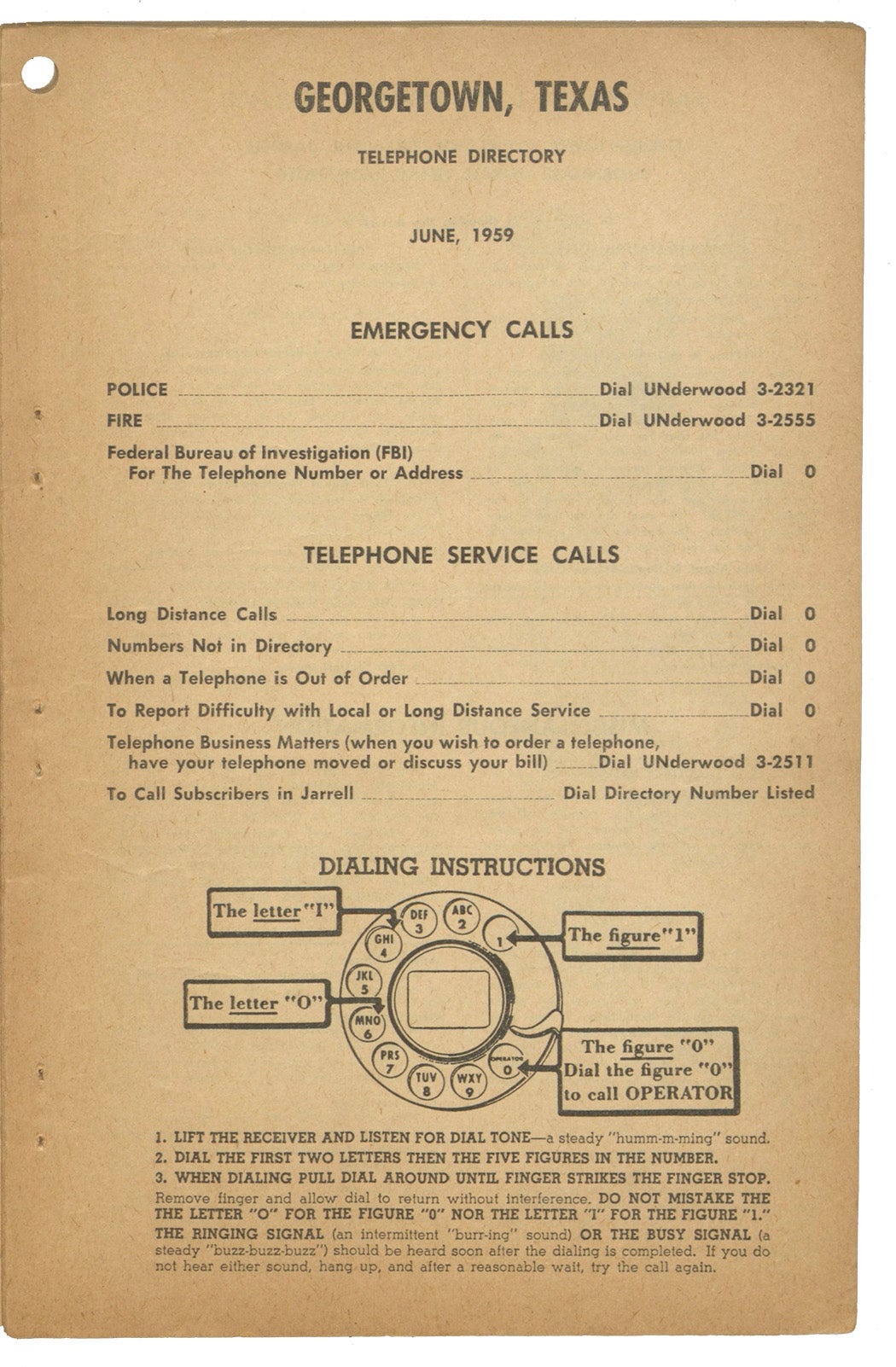
The 1940 directory featured a two-page spread on the dial—not for Georgetown, which remained manual, but for Jarrell, which converted first. Here, the information operator could be reached not by asking for her, but by dialing 00, though she would still—tantalizingly–“give you every possible assistance.” Georgetown followed in 1954, and “Information” went with the switchboard: subscribers were instructed to “Dial 11” for “Numbers Not in the Directory.”
In 1968, more than a decade after “Information” disappeared from Georgetown’s telephonic vocabulary, Bell officially retired the term and renamed the service “Directory Assistance.” Publicly, it maintained the personal framing—one ad observed that “When she was called ‘Information,’ people kept calling her for the wrong reasons”—while privately acknowledging an intentional shift toward mechanization. Nearly a century after the public had to be educated into the “habit” that built the telecommunications business, AT&T’s chairman, Frederick Kappel, said there was now a need for “public understanding that without mechanization, without automation” companies “couldn’t come close to giving the quantity and quality of service that customers today require.”
While, as one op-ed writer put it, the change to “Directory Assistance” meant the loss of “something warm and reassuring” found in “a friendly voice say[ing], ‘Information,’” a look back at the history of the telephone reminds us that intimacy was never the point. The phone’s invention sprang from a search for speed, and the insistence on its efficient operation had produced the very “human” function now being withdrawn for the same reason. Yet what the directory had taught, across all those years, was a habit in two parts: look it up, and when the book fails you, ask somebody.
More to Explore
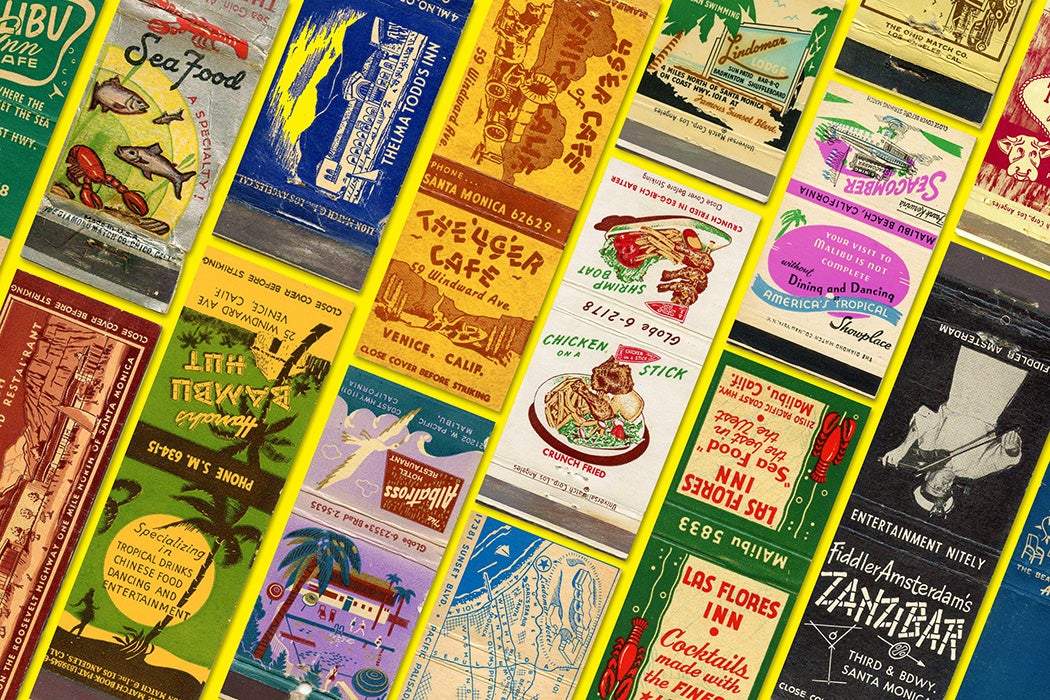
Malibu in Matchbooks: Clues to a Lost Coast
In 1991, the Supreme Court held that a white-pages listing was “devoid of even the slightest trace of creativity” and therefore not copyrightable, overturning a century of doctrine that had protected directories as a reward for the labor of assembling them. In the Court’s view, the listings were raw fact, free for anyone to use. The value lay in what could be made of them, which was precisely the business of a fledgling tech industry inventing new ways to connect information and the people who used it. By the mid-1990s, companies were building online city directories using directory data, reducing the print versions to relics.
Two decades earlier, in 1969—a year after “Information” became “Directory Assistance”—a conference at the University of Chicago had taken up the future of information. In a keynote speech, psychologist and computer scientist J. C. R. Licklider called the decisions ahead “truly a crux for our civilization,” leading either “down to a mindless complex of electronically stored and retrieved facts” or “up toward a realization of the potentials of human creativity and human cooperation.” The stakes, he said, came down to a distinction: “It’s a choice between data and knowledge. It’s either mere access to information or interaction with information.”
Weekly Newsletter
"*" indicates required fields
But as Goodmann observes, the telephone-using public had long been exploring both paths “for nearly a century, albeit on less user-friendly platforms.” What the experts in Chicago saw as the future, the subscribers the telephone industry kept scolding had been improvising since before the First World War—a phenomenon made especially visible on the cover of the 1957 Georgetown directory, where a household filled the blank spaces in pencil, pulling information out of the book and adding meaning to it: digits like any others became “our house,” alongside the hospital, the station, the shop, and a number circled for calling at night. People weren’t confused about what “Information” meant. They had worked out, earlier than the institutions serving them, that a network is worth what you can ask of and add to it. And they’d invented something new accordingly—through their use of technology that no company could fully contain, and by hand, on the front of books they did not own.