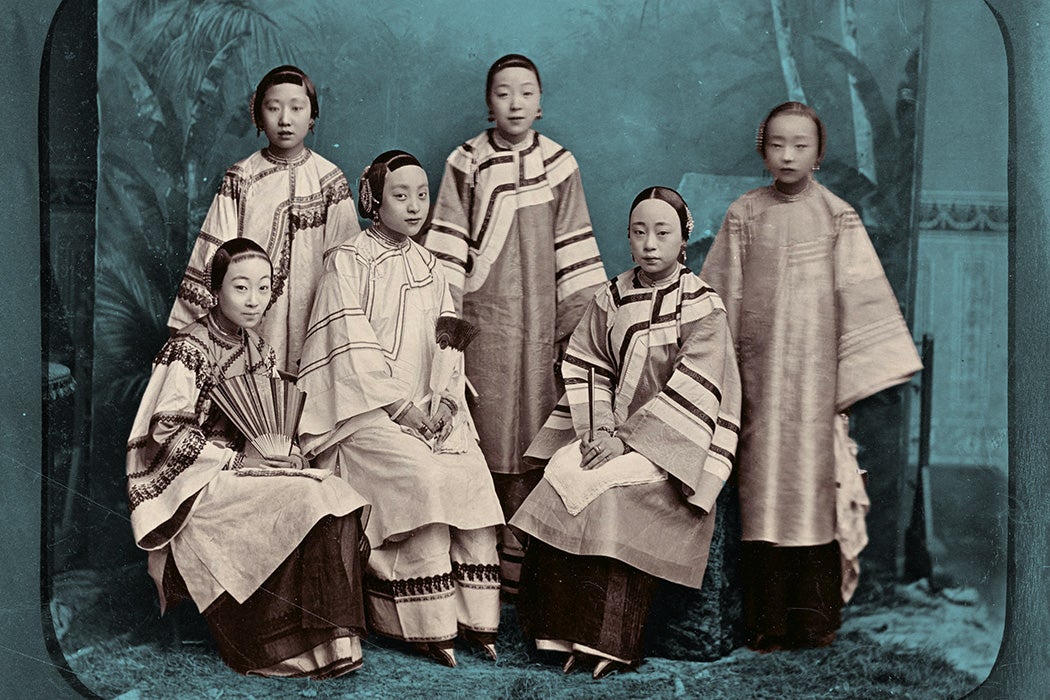
Their dalliances with elite men made the tabloids, and their biographies were printed in guidebooks. If the record is to be believed, courtesans were the glamor girls of old Shanghai.


But Chinese sex workers were not all equal in the historical public imagination. Popular discourse held that “courtesans were a source of pleasure and streetwalkers a source of danger” in early twentieth-century Shanghai, notes historian Gail Hershatter, who estimates that as many as one in 19 women in the city worked in the sex trade by the 1940s.
Their story begins with traditional performers—later called shuyu—who, like the geisha of Japan, might engage in liaisons with patrons. The nineteenth century saw the emergence of a new class of sex workers that was “sexually more accessible,” as historian Christian Henriot puts it.
The courtesan demimonde began to lose its luster, which Henriot attributes to the fact that “a status-dominated society was increasingly replaced by a money-dominated society” from the 1860s onward, as social changes drove up the demand for commercial sexual services.
In the twentieth century, a class of entertainers sometimes known in English as “sing-song girls” continued to command prestige. Many had “comparable artistic skills” to those of the shuyu, but charged fixed rates for their sexual services rather than depending on gifts from elite patrons. Despite their singing and storytelling skills, Henriot argues that the sing-song girls were more akin to “common prostitutes” than historical courtesans.
Indeed, Hershatter agrees that “the sing-song girls had been absorbed into a less exalted group” by the 1920s: changsan sex workers. Named after a mahjong tile that means “long three,” the changsan charged three yuan for drinks and three more for overnight company.
Modern Shanghai also attracted sex workers from far and wide, including so-called “American girls”—white women who, despite their moniker, were more likely to be Russian.
Courtesans aside, the sex trade also included women who sold no-frills sex—either in brothels called “salt pork shops” that catered to laborers, or as “pheasants” on the streets. Such women had low social status. Hershatter notes that salt pork shop workers were compared to a dish that “has not only lost the true flavor of meat, but always smells foul.”
As more women entered the modern workforce, certain occupations—such as tea hostesses or masseuses—also came to involve offering sexual services to supplement their income. “[E]ach of these new types of prostitute appropriated some aspect of the older courtesan traditions; but they did so in Westernized dress,” Hershatter writes. “Theirs was a ‘modern’ form of prostitution, with emphasis on functional and efficient delivery of service.”
More to Explore

Regulating Sex Work in Medieval Europe
Amid the increasing commercialization of the sex trade, authors continued to produce guidebooks on courtesans that rank “[a]mong the richest sources on Shanghai prostitution.” With titles like Pictures of the hundred beauties of flowerland, these guidebooks contained information on correct etiquette with courtesans, along with an overview of fees and tips.
Lamenting the supposed loss of a golden age, the authors modeled themselves on classical historians to produce what Hershatter calls a “literature of nostalgia.”
“Just as historians frequently mourned the failure of contemporary rulers to measure up to the sagacious rulers of yore, guidebook authors mourned the decline in entertainment skill, refinement, and classical training of upper-class prostitutes,” she writes.
Though the guidebooks recommended patronizing courtesans because “it is impossible to avoid disease” among sex workers in other strata, the authors showed little concern for sex workers’ welfare.
In contrast, mainstream newspapers frequently depicted sex workers as “poor, oppressed, exploited, often battered” streetwalkers trafficked into the industry by their madams. This portrayal was in line with a broader social campaign against the sex industry, which was seen as a retrograde vice on par with foot-binding, gambling, and opium smoking.
Weekly Newsletter
"*" indicates required fields
This was the image of sex work that eventually came to dominate in modern China: “Stories of attractive, entrepreneurial, successful, socially and geographically mobile prostitutes” were overtaken by a narrative of “litigation, violence, victimization, medicalization, and taxation.”
After coming to power in 1949, the new Communist government drew on the language of “social illness” in its effort to re-educate sex workers and eradicate sex work.
“Continually obscured in all of this are the voices of the prostitutes themselves—voices which, while surely not unified, given the variety of arrangements under which women sold sexual services, certainly would sound different,” Hershatter writes. Behind the competing images of glamour and exploitation were women whose own stories have largely been lost to history.