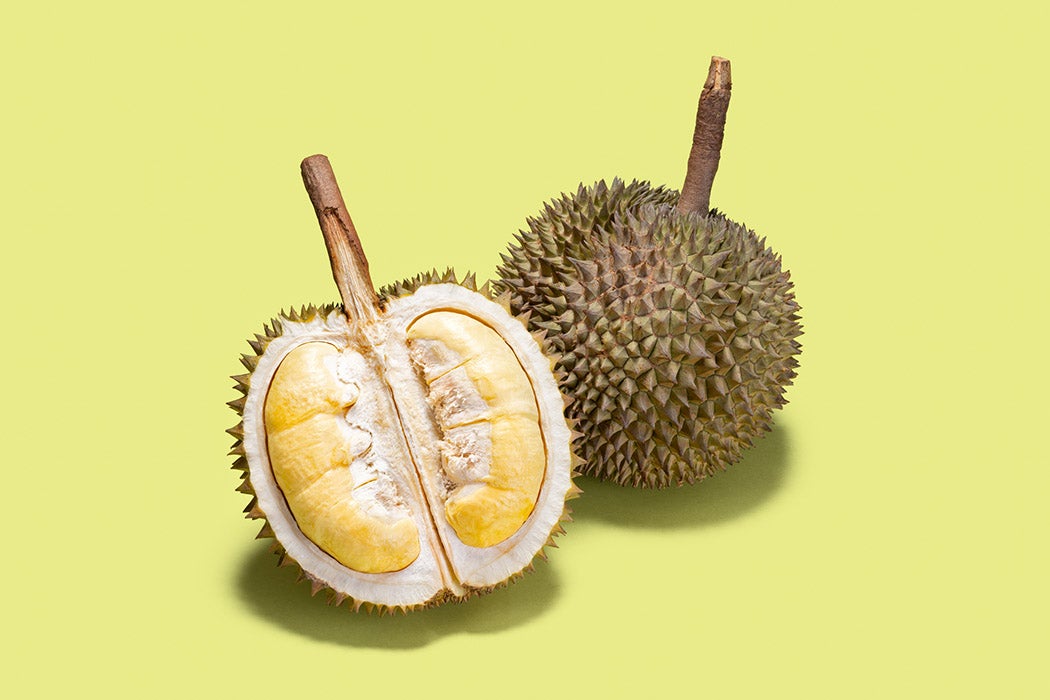
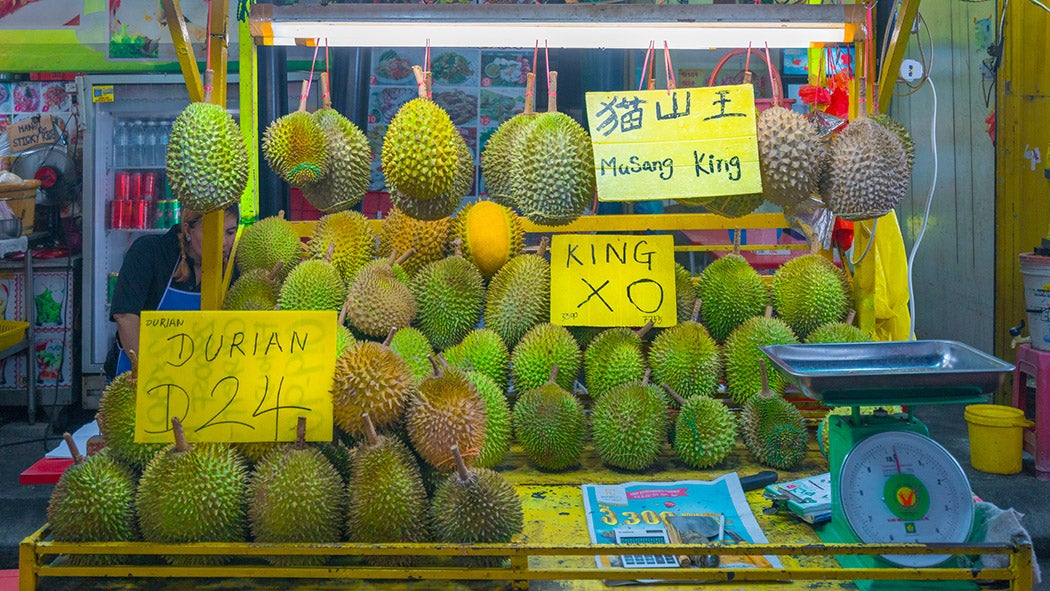
In 2019, 550 students evacuated the University of Canberra’s library because of one fruit: durian. Its sulfuric odor had been mistaken for a gas leak, a common occurrence that has grounded planes and baffled fire departments worldwide. Known colloquially as the “King of the Fruits,” durian commands attention with its pungent scent and spiky husk. Despite these seemingly unsavory qualities, durian’s sweet flesh has created a multibillion-dollar consumer market that fuels economic growth in countries like Vietnam, Malaysia, Cambodia, and Thailand. Central to Southeast Asia’s ecological systems, economic development, and sociopolitical organization, durian’s overpowering presence shapes local customs and mobilizes transnational supply chains, testifying to the sensorial hold that plants have over us.


For those unacquainted with the peculiar odor, taste, and texture of durian, American botanist Francis Ramaley’s 1905 account offers a helpful starting point. He describes durian’s smell as a “rare combination of vile odors”: “first one thinks of rotten eggs, then of sewer gas and garlic and finally he gives up any attempt at a classification of the different smells.” By contrast, in one of the most vehement defenses of the fruit, British naturalist and “confirmed Durian eater” Alfred Russel Wallace waxes lyrical in his 1869 travelogue The Malay Archipelago:
A rich butter-like custard highly flavoured with almonds gives the best general idea of it, but intermingled with it come wafts of flavour that call to mind cream-cheese, onion-sauce, brown sherry, and other incongruities. Then there is a rich glutinous smoothness in the pulp which nothing else possesses, but which adds to its delicacy. It is neither acid, nor sweet, nor juicy; yet one feels the want of none of these qualities, for it is perfect as it is. […] In fact to eat Durians is a new sensation, worth a voyage to the East to experience.
These contrasting colonial accounts show that durian was just as polarizing then as it is today. More importantly, Ramaley and Wallace both recognized durian’s powerful effect on the senses and the intensely visceral responses it evoked, whether expressed in terms of disgust or desire. It is precisely this complexity and intensity that characterizes durian, a fruit whose importance in Southeast Asia goes beyond simple binaries like the detestable and the delightful, the economic and the cultural, or the local and the transnational.
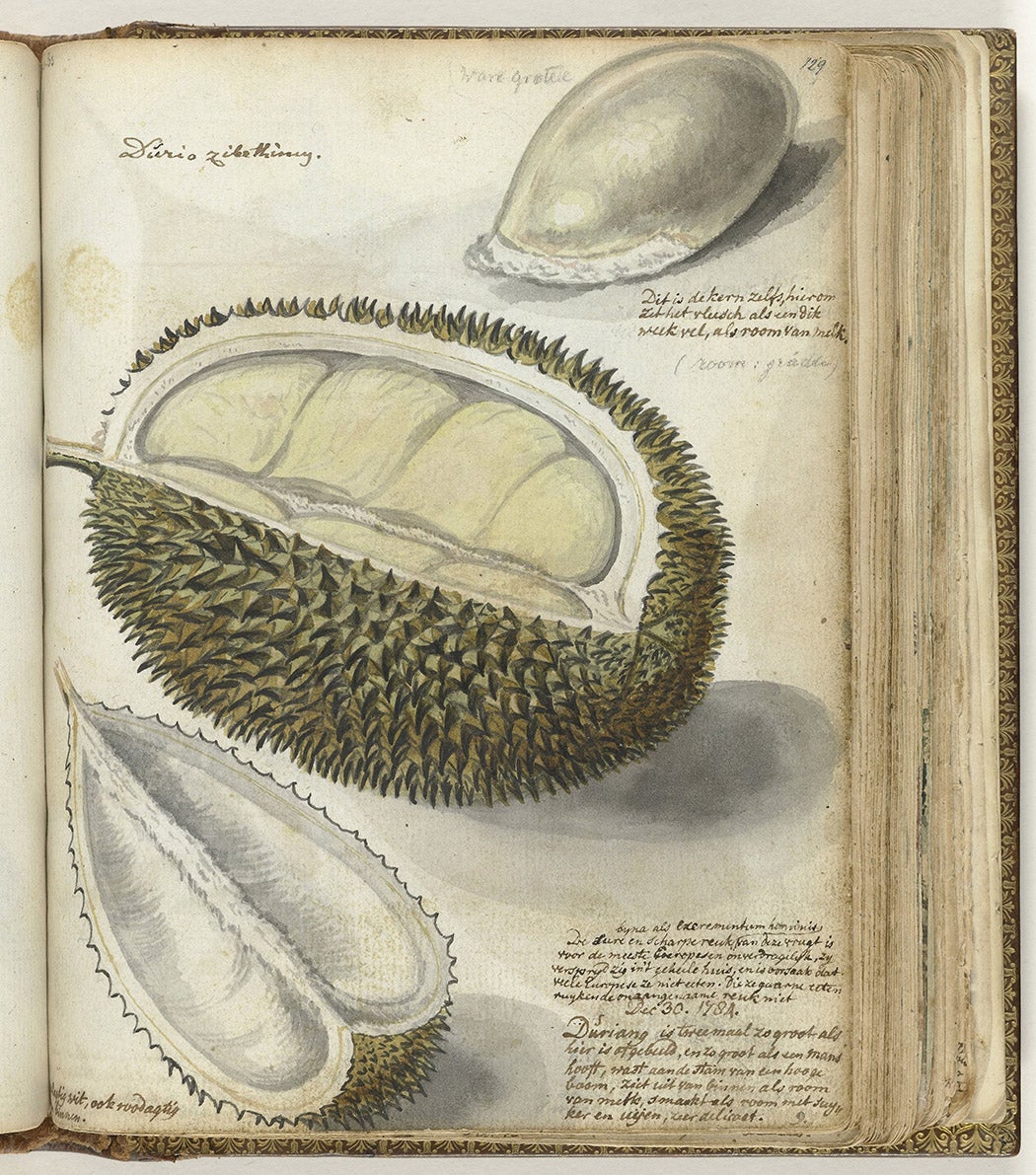
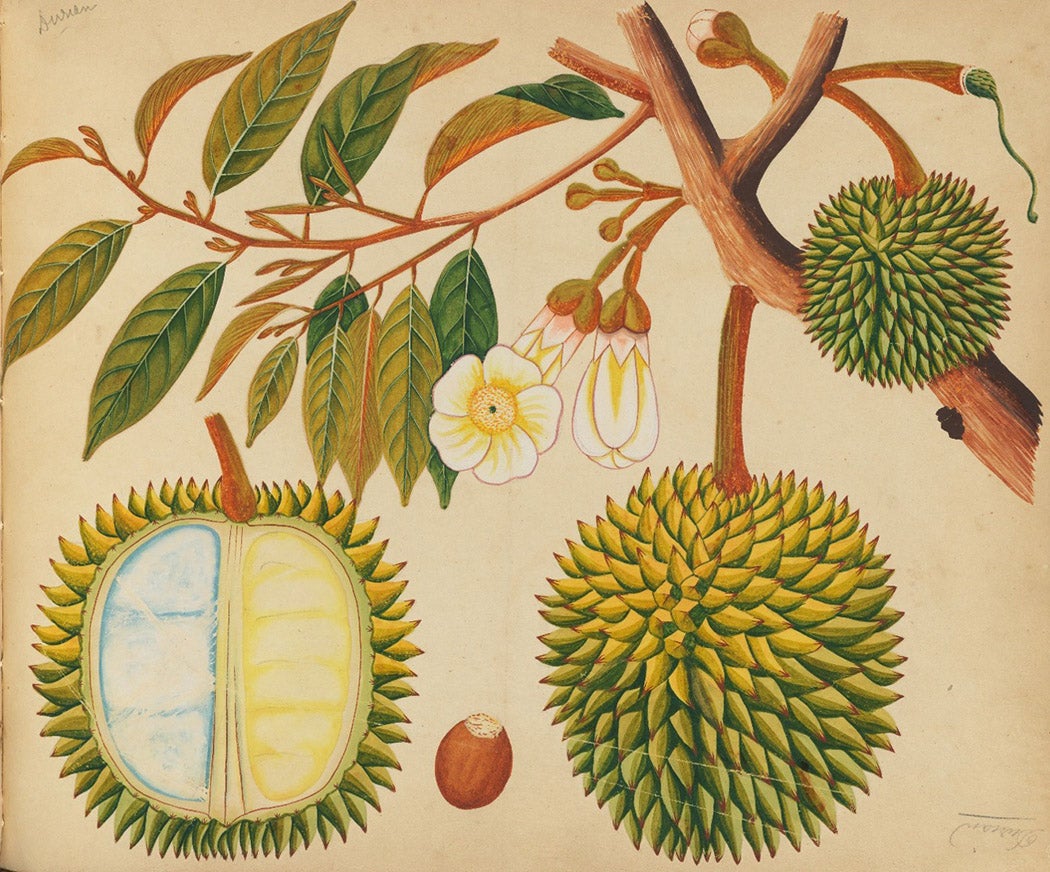
Although the Durio genus has more than 28 recognized species, durian (Durio zibethinus) is the most commonly cultivated species for human consumption. At least 200 cultivars have been developed through human selection, and the plant has spread from its native Borneo, Sumatra, and Peninsular Malaysia to Thailand, Cambodia, and Vietnam. The characteristic smell of durian has been attributed to a combination of many different scent molecules, but scientists still struggle to pin down the exact compounds responsible, even with advanced chemical analysis techniques. The strong notes of fruity esters and sulphurous compounds are thought to serve as an important biological mechanism for attracting animals to consume the fruit and disperse its seeds.
Still, wild durians are relatively scarce because the fruit’s large seeds, tough husks, and thorny exterior mean that only large terrestrial mammals like elephants and macaques can participate in its seed dispersal. As a result, durian is now primarily found in human-managed landscapes, where it is grown semi-wild for household consumption or on commercial plantations. The method of commercial durian cultivation heavily depends on the region. For example, monoculture plantations are common in peninsular Southeast Asia, whereas on the Indonesian island of Sulawesi, durians are grown in mixed agroforestry systems alongside other fruit crops and secondary forest.
Even before durian was recognized as a commercial crop, it was deeply significant to many Southeast Asian communities due to its cultural value. In Malaysia, the Indigenous Bersisi people celebrate the ripening of durian fruit with a feast. They create a communal space by setting up an ornamental railing with simple decorations and serdang leaves around the oldest durian tree, where cooked durians and other fruits are served wrapped in banana leaves. In Indonesian folklore, durian also often appears in proverbs and riddles. One example is the Balinese saying, “Buka durene hulung, masih ada ngaput,” which translates to “As with a fallen durian, there is someone who picks it up.” This proverb draws on the fact that durian fruits fall from the tree when they are ripe, suggesting that there will be somebody to help those going through a hard time. These practices highlight how durian is interwoven with the spiritual and cultural beliefs and practices of Indigenous communities in Southeast Asia.
The role of durian in Southeast Asian culture has also evolved alongside its cultivation as a cash crop, bringing together traditional values and modern economic practices. Among the Baduy people in the Kanekes region of Indonesia, fallen durians are considered public property, and neighbors often help each other sell unattended fruit. These collective farming and trading practices embody shared cultural values that have since been recognized as offering an alternative vision of governance that maintains public trust. For Indonesians who practice Islam, in which charging interest is prohibited, durian trees have served as a type of collateral for farmers who use the profits from durian harvests to pay back lenders until their loans are repaid. Thus, in addition to being traditionally valued in Southeast Asian communities, durian has taken on new significance as these communities respond to economic, religious, and cultural influences.
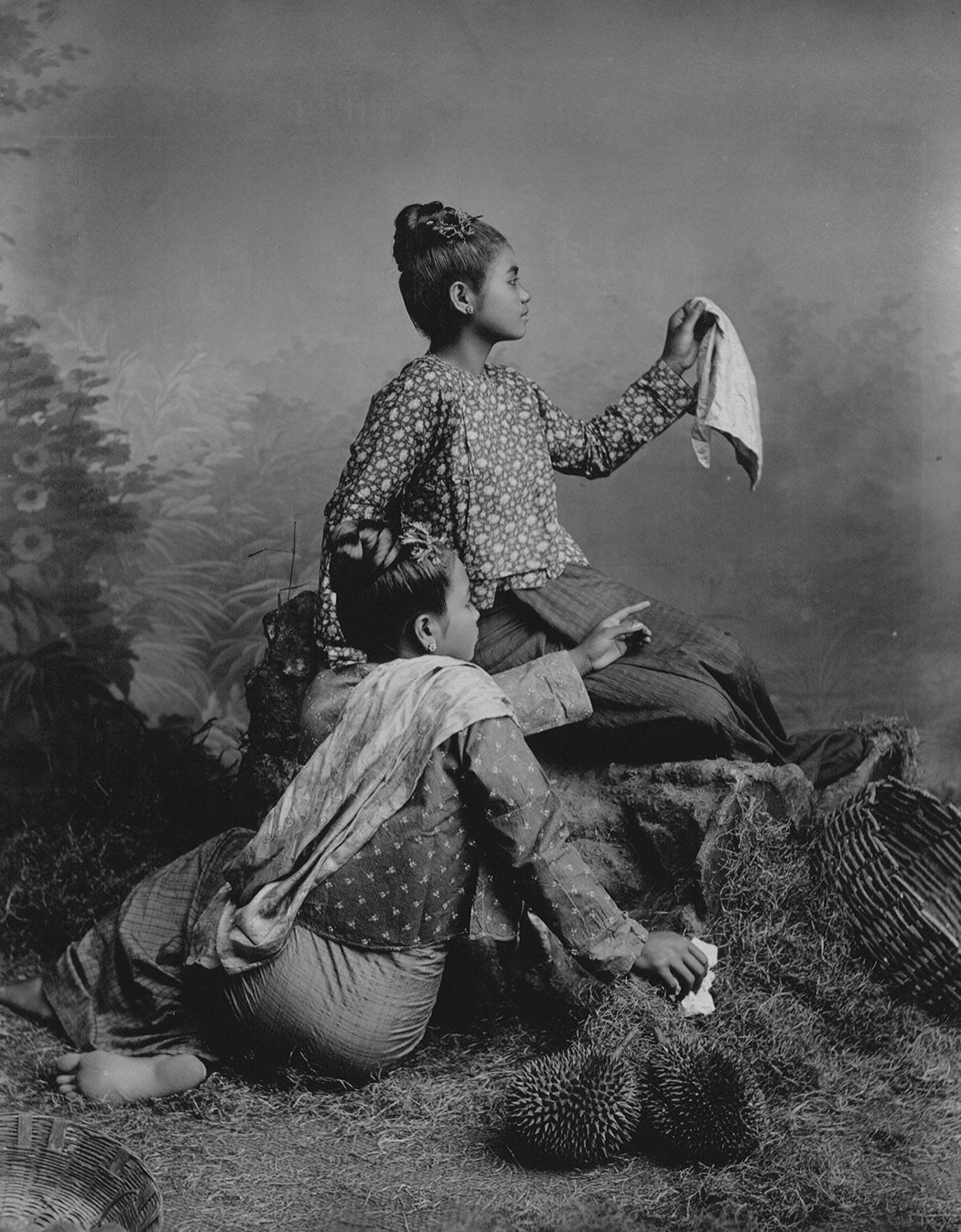
Early colonial records reveal the danger of viewing durian solely in economic terms. In an 1886 report on the economic plants of the Straits Settlements, Nathaniel Cantley, the British-appointed superintendent of the Singapore Botanical Gardens, noted that the supply of durian failed to meet local demand. Cantley attributed the lack of accessible land for cultivation to a racist characterization of Indigenous Malays as “indifferent to money-making further than sufficient for their daily requirements.” This perspective is not just a relic of British colonial rule but also offers a warning against understanding the importance of plants solely through the lens of economic productivity.
More to Explore
Cucumber: The Plant That Moves More than You Think
Against the backdrop of Southeast Asia’s colonial history, durian’s signature smell can also be understood as a means of nationalistic self-assertion. In the comic short story “Durians” by Filipino author Alejandro Roces, the first-person narrator is blamed and punished for the village’s disasters—typhoons, floods, and even volcanic eruptions—because he never goes to church. His mother eventually forces him to attend church when the Japanese invade the Philippines and station troops in their village. The narrator brings durians as a gift for the Spanish priest but is thrown out when the priest cannot stand the fruit’s odor. The story ends with the narrator feasting on durians alone. Roces plays on durian’s polarizing smell by contrasting the local narrator’s love of the fruit with the foreign Spaniard’s intolerance. In this way, Roces confronts the Spanish missionary efforts and the Japanese occupation by appropriating durian’s characteristic pungency as a symbol of Indigenous pride—an image so enduring that literary critic L.M. Grow described Roces’s brand of realist satire as “durian humor.”
More recently, as China has become the world’s largest market for durian, the fruit’s distinctive odor has also become intertwined with East Asian identity. The female narrator in Asian Canadian author Larissa Lai’s novel Salt Fish Girlsearches for a cure for the lingering smell of durian on her body. This striking olfactory motif draws on durian’s intimate yet disruptive scent, as well as the fruit’s fraught history with import regulations, to assert an alternative form of Asian agency in a Westernized and de-odorized world. While Lai’s novel and the broader circulation of durian as a commodity in China position the fruit as a potential pan-Asian symbol, this broader identity can obscure the regional specificity that makes durian a source of pride for Southeast Asian communities.
These complicated cultural dynamics are mirrored in tensions surrounding the expansion of durian production in Southeast Asia to meet Chinese consumer demand. In 2020, Malaysia aimed to increase its durian exports to China to 8,000 tonnes annually, driving the expansion of monoculture plantations onto the unrecognized ancestral lands of the Indigenous Orang Asli. The resulting forest clearing caused biodiversity loss and disrupted cultural practices, leaving the Orang Asli unable to gather native plants central to their forest-honoring ritual, sewang. Ironically, as production expands, the traditionally valued durian now threatens to displace the very Indigenous communities that have long celebrated it.
Weekly Newsletter
"*" indicates required fields
At the same time, durian remains a symbol of national pride in countries like Thailand and Malaysia, where the fruit is presented as a prized gift to visiting Chinese officials as part of “durian diplomacy,” helping bolster durian trade networks. Demand has grown so great that export systems are being shaped around the fruit, from QR code tracing systems for cross-border supply chain transparency to a proposed “Smart Durian Fast Track” to expedite transnational transport, inspection, and certification. Durian’s cultural resonance, then, emerges as much from its place in evolving political and economic networks as from its longstanding role in traditional societies.
Ask anyone who has ever tried durian: they either love it or hate it or, at the very least, vividly remember the experience. Just as its peculiar smell and taste continue to resist description, durian continues to challenge our understanding of its ever-evolving role in the history, politics, and economics of Southeast Asia and beyond. Appreciating durian in all its full-bodied complexity requires a plant-focused approach that goes beyond traditional methods of study. The Plant Humanities Initiative at Dumbarton Oaks brings this interdisciplinary approach to exploring the evolving and entangled relations between plants and societies.