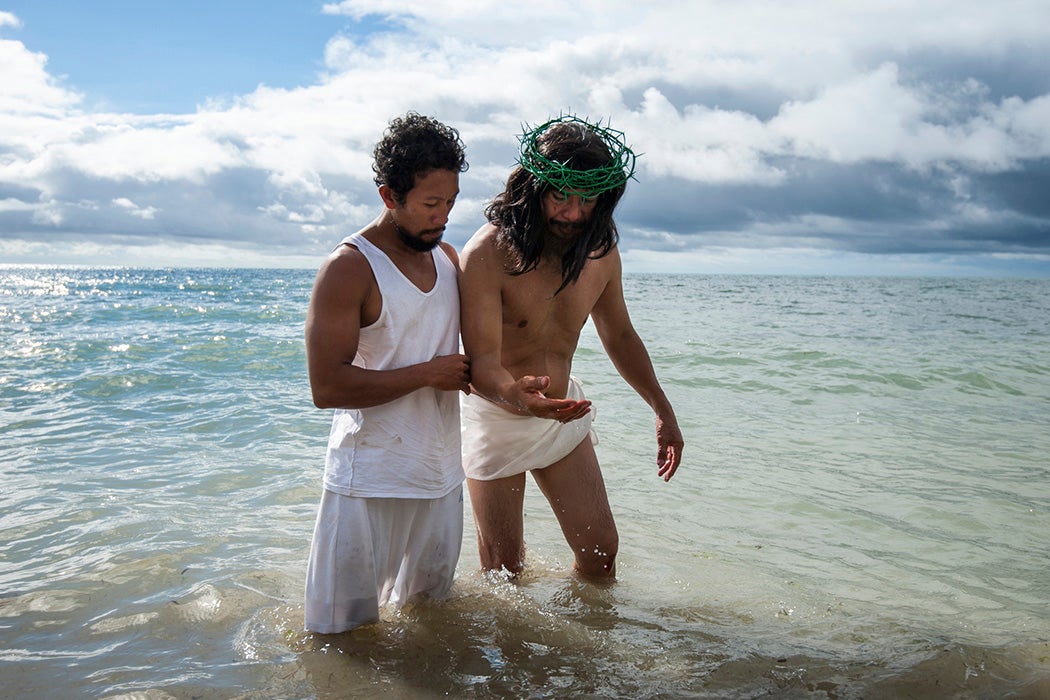
Does signing up to be crucified take ethnography too far? Anthropologist Julius Bautista once had to confront this unexpected question while doing fieldwork in Cutud, San Fernando.


This barangay or district in provincial Pampanga is home to perhaps the most spectacular commemoration of Good Friday in the Philippines. There, devotees annually re-enact Christianity’s holiest week in an amateur performance that culminates with the crucifixion of some participants. The tradition was introduced in Cutud in the mid-twentieth century, but was thrust into the spotlight when televised by the media in the 1980s.
Theater scholars Anril Pineda Tiatco and Amihan Bonifacio-Ramolete trace Holy Week performances (sinakulo) to European “passion plays” about the death of Christ. Self-mortifying pamagdarame rituals, including whipping and crucifixion, likewise have roots in medieval Christian tradition.
Those traditions became more than an object of study when Bautista was invited to take part himself. When the director of a passion play offered to nail Bautista to a cross in the name of empirical authenticity, the anthropologist declined.
“Although I was brought up Catholic, I did not have any specific religious motivations for pursuing nailing,” Bautista reflects. “[W]ithout those religious motivations, I would not be engaging in the same act that I was attempting to understand.”
Key to this practice of crucifixion is a vow called a panata, which Bautista describes as “a divine transaction… for which self-mortification would be the reciprocal act.”
The anguish that devotees experience during crucifixion “is seen in the light of sacrifice and is associated with panata as a contract” with God, explain Tiatco and Bonifacio-Ramolete.
As some participants vow to be crucified in exchange for family members’ recovery from ill health, panata is also understood as a sacrifice made out of love for others in the community. Such faith can help to sustain residents of Cutud, where poverty and hardship are common.
More to Explore
A Christian Case for Gossip
Participants take panata so seriously that the play’s director initially refused to permit a 40-year-old welder who had spent his life savings traveling to Cutud to be crucified.
The man claimed that “he was committed to absolving himself of a grave sin, which he refused to reveal,” Bautista recounts. But the director insisted that crucifixion “was not based on atoning for sinfulness but… a promise of vow fulfillment or thanksgiving.”
Bautista also quotes the director’s admonition: “I will only allow him to be nailed if he can show me that he understands what panata means.”
In other parts of the country, Holy Week penitents may fulfill their vows in different forms. On the island of Marinduque, local men express panata by performing in the sinakulo as elaborately costumed Roman centurions called morions. Heavy masks, worn to preserve morions’ traditional anonymity, contribute to their discomfort. As one scholar observes, “Presumably the pain provides penitents with greater empathy for the sufferings of Christ.”
Meanwhile, Catholics in a small barangay in lowland Bicol center their worship on the Amang Hinulid. This term, meaning “the father who is laid out in death,” refers to a wooden figure of the “dead” Christ, which is venerated in a ritual funeral on Good Friday. Some devotees cured of illness vow to stage a days-long passion play or tanggal in the Ama’s honor.
In fact, Tiatco and Bonifacio-Ramolete note that “[e]very Catholic community in the Philippines has its own version” of sinakulo. But they aren’t always bound by panata.
Weekly Newsletter
"*" indicates required fields
For example, nailing is also carried out in the village of Kapitangan, in Bulacan province, where it emerged after the crucifixion of a teenage girl in the late 1970s. Unlike in Cutud, participants are mostly female faith healers adhering not to vows but to mystic trances and possession.
Here, “the ritual serves as an instrument of empowerment” that “demonstrate[s] the intimate relationship” between faith healers and God to their own followers, explains Peter Bräunlein.
In contrast with popular narratives about “the peculiarity of Philippine crucifixion and its bizarre, exotic aura,” Bräunlein argues that Filipino Catholics identify themselves as Christian through “literal interpretation of the ‘founding myth’” of their religion: the Passion of Christ.