Path to Open Books on JSTOR
In one of the most heartwarming scenes of the 1944 Christmas musical Meet Me in St. Louis, six-year-old Tootie (Margaret O’Brien) builds snowmen of her family members. In one of the show’s most heartbreaking scenes, which follows not long after, Tootie learns her family is moving from St. Louis to New York and runs into the yard to smash her icy relatives to bits.


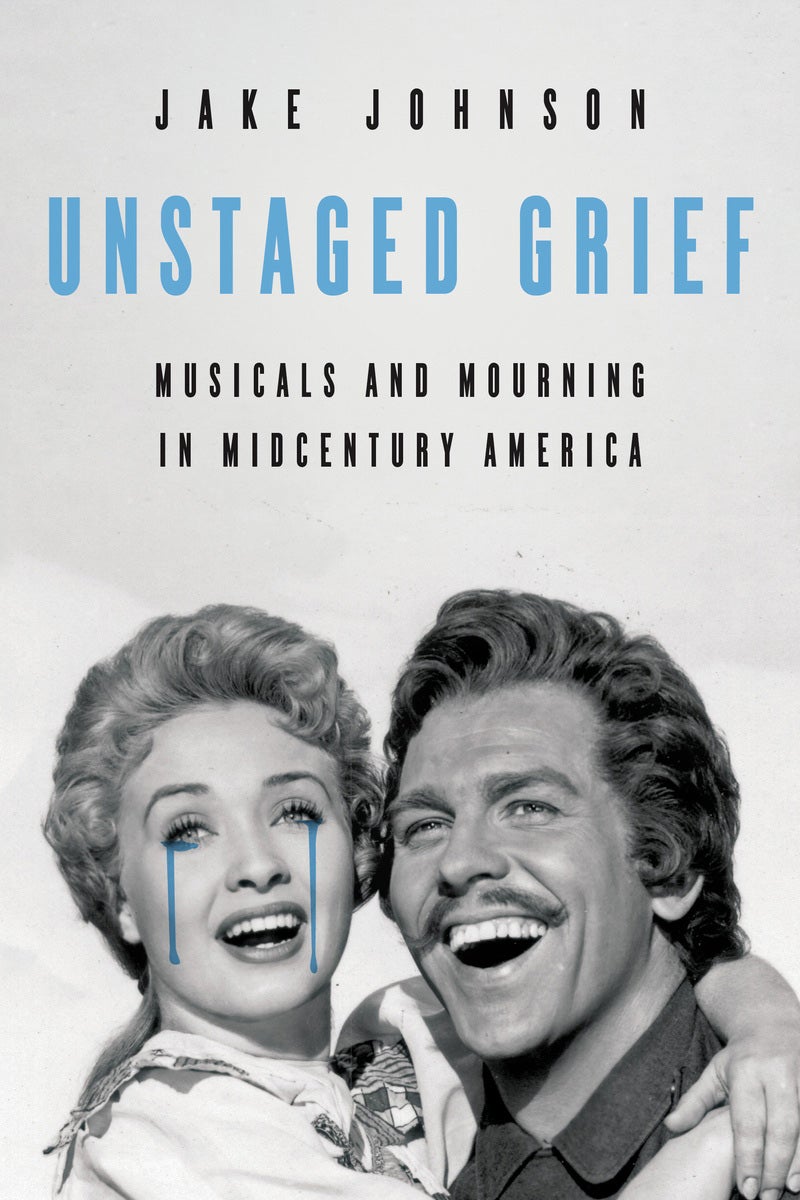
When we think of musicals—especially those from the early twentieth century—we imagine the narrative equivalent of cotton candy: a barrage of hugs, kisses, and histrionic dialogue interspersed with moments of song and dance, tying up every strand of conflict with an ornate bow before the curtain drops. But though musicals tend to be rather upbeat compared to novels, films, and television, they’re not without their dark side. As Jake Johnson, a pianist, vocal coach, and assistant professor of musicology at the University of Oklahoma, explains in his new book Unstaged Grief: Musicals and Mourning in Midcentury America—part of JSTOR’s Path to Open initiative—the “American musical is an unsuspecting, squeaky-clean surface” that “cleverly holds back grief … a skin, a covering, a hide for deeper, darker, bigger feelings.”
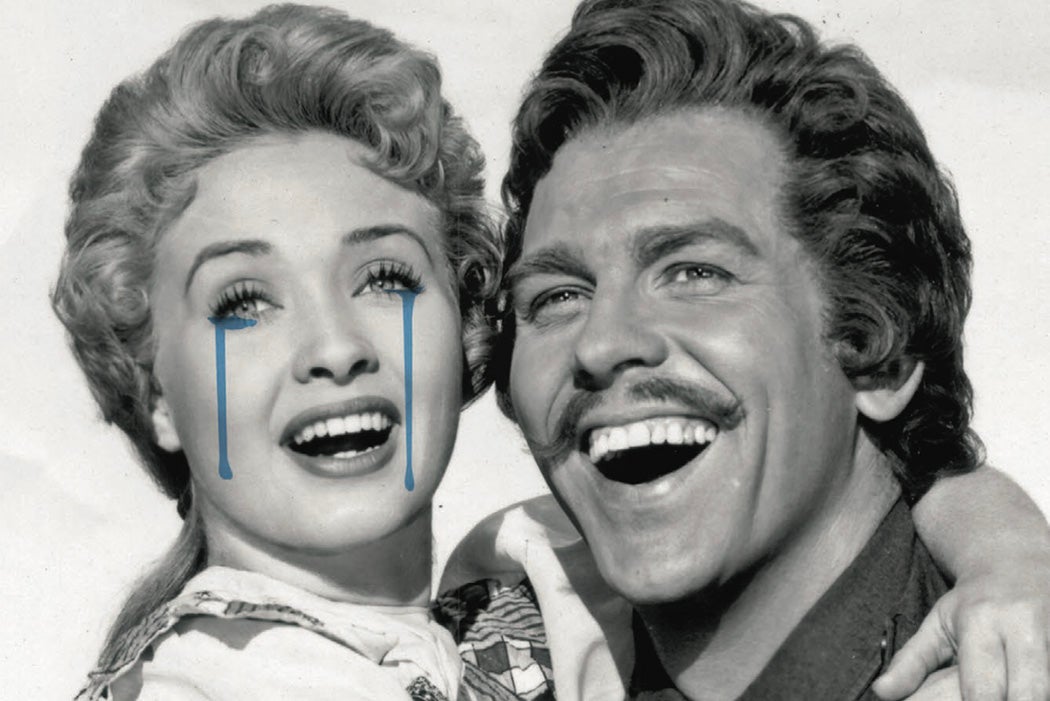
This is especially true for musicals produced during the ’50s and ’60s, a time when widespread social upheaval—from the trauma of the Second World War to the polarization of the civil rights movement, the Cold War, the Cuban Missile Crisis, and assassinations of John F. Kennedy and Martin Luther King, Jr.—gave rise to fears and frustrations so profound, their traces can be found in even that most escapist of artforms.
Drawing from a wide variety of sources—including philosophers, journalists, art historians, and musicologists—Johnson argues that both live and televised or “unstaged” musicals from this period contain hidden themes of pain and suffering, and can be loosely categorized according to Swiss-American psychologist Elisabeth Kübler-Ross’s five stages of grief (denial, anger, bargaining, depression, and acceptance), whose critical work On Death and Dying was first published in 1969. In-depth literary and musical analysis, paired with references to the likes of contemporary tastemakers such as John Lennon, Mark Rothko, Norman Rockwell, and Edward Hopper, show that this categorization isn’t arbitrary—that grief and the complex, contradictory emotions through which it manifests really were an integral if repressed part of the cultural zeitgeist.
While the ’50s and ’60s fall squarely within the so-called Golden Age of American musicals, they also constitute that age’s impending end, with the tried-and-tested literary devices, traditional values, and mass appeal of composers like Richard Rodgers (Oklahoma!, The Sound of Music) and Oscar Hammerstein (South Pacific, Cinderella) giving way to Andrew Lloyd Webber’s and Stephen Schwartz’s countercultural rock operas and Stephen Sondheim’s concept musicals, only to resurface in our own, similarly uncertain, day and age by way of productions like La La Land, Mary Poppins Returns, and Wicked, to name a few.
What made midcentury musicals such an improbably popular vehicle for processing grief? Why did the style and substance of these musicals fall out of fashion, and in what capacity have they returned today? Johnson shares his thoughts.
When and where did your interest in screen musicals—arguably a niche, dying form—first originate?
I was raised in rural America. Musicals were a big part of my childhood, both in local amateur productions but most importantly in the film and television musicals we kept at home. I loved their commitment to reconciliation, to swelling moments of beauty and fun, to making sure we continued to believe in something. Never mind that I didn’t see a Broadway show until I was in my 30s: musicals were always telling a story big enough to include me and the community I came from.
This was the 1980s and ’90s. Most of the shows I consumed were well past their expiration date, but that didn’t matter. Shows like Seven Brides for Seven Brothers, The Unsinkable Molly Brown, Chitty Chitty Bang Bang, and almost every Rodgers and Hammerstein production coursed through my bloodstream and wove into the fabric of the worlds I lived in. I knew I wanted to tell part of that story in this book, about how musicals stubbornly hold onto us and cheekily keep us coming back to them again and again.
Many musicals, as you describe, seem outwardly cheerful while hiding grief beneath their surface. To what extent do you think this subtextual grief was an intentional creative decision as opposed to a retroactive attribution on the part of contemporary audience members such as yourself?
I don’t believe grief or sadness were on the minds of most musical creators other than as something that moves the story forward. At the same time, while I approach this topic with a set of interpretive tools in hand, I don’t believe my charting of grief in these shows can simply be chalked up to interpretation. Something I’m teasing out in this book is how works of art carry stowaway messages. I’m interested in how the grief of an era might have been lodged in the fabric of these shows, even as the genre of musical theater as a rule remains deeply allergic to unresolved problems. This very aversion to grief, in fact, gives musicals a kind of camouflaged protection for grief. As I say in the book, if I were a monster called Grief I’d probably hide behind a musical too.
You describe musicals as “grief hides.” Do you think they primarily serve as a mirror of societal anxieties, or do they act more as an escapist tool to soothe audiences during times of upheaval? Are the two necessarily exclusive?
They can be and are both. I don’t see those functions as exclusive. Escapism is never devoid of the anxiety it’s running from, and of course lots of things beyond musicals can help us run from our problems. But musicals are unique in their brazen unreality. The genre is silly even when it’s trying to be serious! So even if musicals problematically show us how to run away from trouble with their song-and-dance routines, something in their very nature—the very fact of them, actually—admits they are at heart concerned with grief.
Why do you think the American musical has, as you write, such a fixation with the “middle”—both geographically (Iowa, the Midwest) and metaphorically (middle class, middle of life)? How does this recurring motif tie into broader themes of grief, hope, and cultural identity in your analysis?
The double-edged sword of musicals is that they’re middlebrow. On the one hand, this makes them terribly unserious, and most people don’t think twice about them. On the other hand, they go down easily. Few people take them seriously, in other words, which means musicals have a greater chance than, say, film or opera or theater, of those stowaway messages being intercepted.
What this middle-ness means to me is that musicals (and especially film and screen musicals like those I engage in this book) are everywhere and nowhere at the same time. They may be designed for elite liberal audiences in New York but the blue-collar worker in rural Iowa is still going to see his kid’s high school production of Grease. Musicals reach a far broader swath of Americans than any other genre of music. They may be unserious but there’s no denying musicals hold a powerful hand in shaping American life. They sit squarely at the center of it, actually. How could they not be in the middle of almost everything we do and think about and believe about ourselves?
Do you think that screened musicals naturally lend themselves to cultural analysis of current events like the JFK assassination, the bombing of Hiroshima, and dwindling church attendance precisely because they aired on TV for national audiences when compared to live musicals? What distinguished the two in form and content?
Musicals are an everywhere genre, as I describe in more detail in my book Lying in the Middle: Musical Theater and Belief at the Heart of America. This is even more the case for screen musicals, which of course can spread a standard production forever. In this way, screens can make for an easy comparison between the politics and social values coming through the news and those coming from Hollywood. This book is a media-rich book, one where I pit images against images in a way that I simply could not do if I were limited to live musicals. On the other hand, liveness is a key part of how a musical works and musicals adapted for screen often have to be restructured to make sense of the pacing and genre expectations audiences bring to film. That’s one reason why I was particularly interested in covering only unstaged musicals in this book—meaning, musicals that were designed to be films first and live productions only sometimes decades later. I was curious what to make of musicals that, in being made for film first, betrayed the key quality of a live musical. What I found is that the screen helps capture and draw attention to the grief latent in musicals of all kinds.
Kübler-Ross’s stages of grief form the theoretical framework of your book. It’s a popular and enduring theory, but one that has also received its fair share of criticism, especially in recent years, with commentators arguing against conceiving of grief as linear or sequential, among other talking points. How do you reconcile these criticisms as they relate to your research on musicals?
I toyed with a more expansive coda to this book that took into account the afterlives of Kübler-Ross and her theory on grief. But I ultimately decided to keep this story within the zeitgeist, to not allow the book to be aware of what came after the 1960s. This was my strategy throughout the book and informs my citational practices as well. To put into play my idea of stowaway messages and art unaware of (or in denial of) what it’s actually saying, I needed to keep the book more or less stuck in this era. And I think this works for the most part. It’s true that many more accurate and helpful studies of grief have emerged since then (and Kübler-Ross herself continued to tweak her previous thinking), but I was okay leaving the five stages otherwise without critique since audiences in the 1960s likely wouldn’t have yet imagined them.
Weekly Newsletter
"*" indicates required fields
The Golden Age of musicals ended in the turbulence of the 1960s. How do you see the shift from musicals like State Fair and Seven Brides for Seven Brothers to those by Sondheim or Webber reflecting the American attitudes towards dealing with grief during this period?
One of the centerpieces of this book is that Kübler-Ross’s language about grief emerges precisely when the Golden Age of musical theater ends. I think this passing of ships is significant. Golden Age musicals take for granted a number of assumptions about midcentury America—that Americans believe in God, that American children grow up with married parents, that Americans believe in America—that by the end of the 1960s were being challenged on many sides. For musical theater historians, this shift could be summarized as a handoff from Rodgers and Hammerstein to Stephen Sondheim, whose postmodern cynicism and fractured narratives better match the tenor of the times. What I find interesting, though, is that Sondheim continues to use the midcentury musical as his foil. In reacting against the values of midcentury America, Sondheim’s musicals in essence continue to give Golden Age musicals their lasting power. So, while Sondheim and other composers and lyricists of his generation may seem to tackle sadness and disruption more head-on, they tend to do so in a way that continues to allow the grief hidden in State Fair or Seven Brides for Seven Brothers to remain at play.
You note the recent popularity of screen musicals like La La Land, The Greatest Showman, and others. Do you see these modern musicals addressing contemporary grief in ways that echo the patterns you identify in midcentury musicals, or do they represent a new phase of cultural processing?
I do see grief still at play within modern screen musicals largely because shows like La La Land and The Greatest Showman are modeled on the structure and themes of the Golden Age. If anything, these more recent shows make the grief more obvious. For instance, La La Land ends with a dream ballet, which is a common feature of many Golden Age musicals. But instead of using the dream ballet to propose a solution to a problem introduced early in the musical the way Rodgers and Hammerstein do for Laurey in Oklahoma!, La La Land uses the dream sequence to process the grief of a failed relationship. It works beautifully in La La Land precisely because audiences were set up to expect a certain outcome from musicals. And for an even wilder re-casting of grief and the American musical, readers should check out Charlie Kaufmann’s 2020 Netflix film I’m Thinking of Ending Things, which imaginatively cross-examines the sadness and misery at the heart of Golden Age musicals.