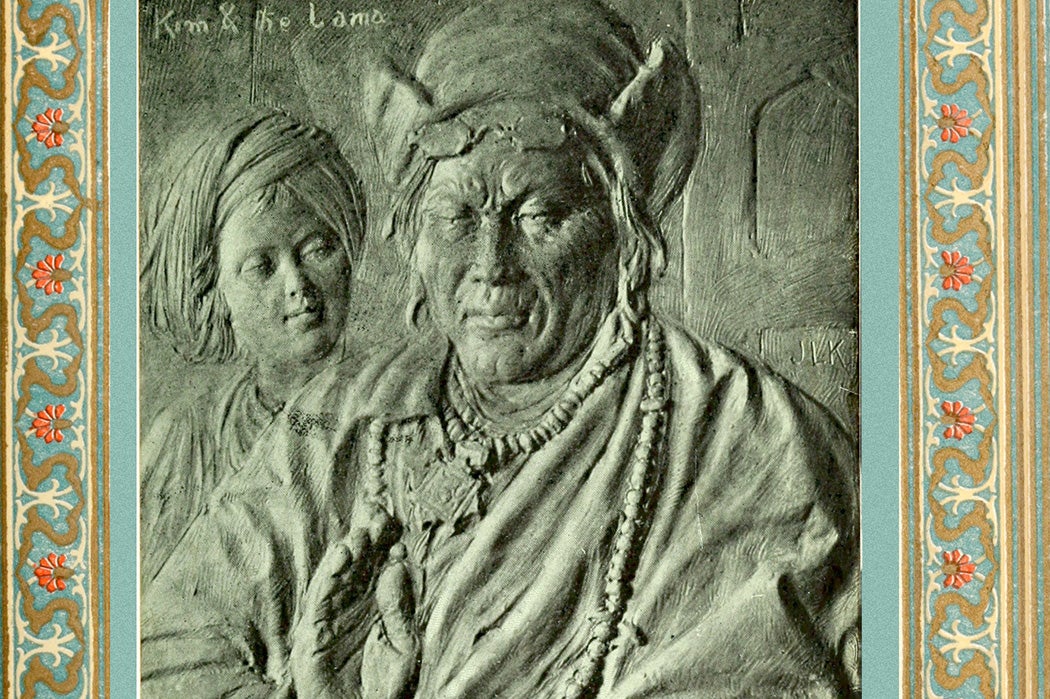
Writer Rudyard Kipling, known among other things for the now-infamous poem “The White Man’s Burden,” was one of the most prominent cheerleaders for British imperialism. His 1902 novel, Kim—about an Irish boy who grows up in India, studies with a Tibetan lama, and is recruited as a British intelligence asset—is often interpreted through that lens. But, as literature scholar Deanna K. Kreisel writes, Kipling’s approach to Buddhism also reflects a growing respect for that religion among late-Victorian British intellectuals.


Early in the Victorian era, Kreisel writes, Brits and other Europeans who studied Buddhism did so mainly in an effort to understand how to convert Asians to Christianity. Their ideas about it were often steeped in stereotypes suggesting that Buddhists were irrational and childish in their thinking. Some claimed that Buddhists, like Asians generally, were passive and lazy, and that their religious rites reflected a dull, monotonous approach to life.
But, in the second half of the nineteenth century, many British commentators began to view Buddhism as a potential force for progress in Asia—which men like Kipling claimed the British Empire was facilitating.
More than that, Kreisel writes, some viewed it as a tool to mold spirituality back home into a form that would not conflict with modern science. In a society grappling with Darwinian evolution and the new discipline of psychology, some Westerners admired Buddhism’s long history of studying the mind’s activities. In 1897, German-American philosopher Paul Carus claimed Buddha as “the first positivist, the first humanitarian, the first radical free thinker … and the first prophet of the Religion of Science.”
More to Explore
From Imperialism to Postcolonialism: Key Concepts
Many in Europe and the US were also fascinated by the exceptional states of consciousness discussed in some Buddhist teachings, such as trances, visions, and telepathy. Some linked them to occult and spiritualist practices, and some believed they reflected undiscovered natural phenomena that more research into physics or psychology might reveal.
Weekly Newsletter
"*" indicates required fields
All this went along with a view of Buddhism as the polar opposite of the Orientalist image of the passive Asian. Some British observers claimed that skilled Buddhist practitioners could achieve feats such as flying through the air or shape-shifting through a pure, intense force of will unknown in the west.
Kreisel argues that this is very much the attitude Kipling took in Kim. Certain apparently magical happenings in the novel are treated ambiguously, but either way, the titular character’s study of Buddhist practices is an asset in his journey. Kim eventually develops the ability to enter into a trance state, which Kipling portrays as a source of willpower and focus.
Kreisel argues that, while Kipling certainly believed in white superiority over colonized Asian people, Kim’s strength is shown to come not from his racial identity but from a will strengthened by esoteric spiritual practice.