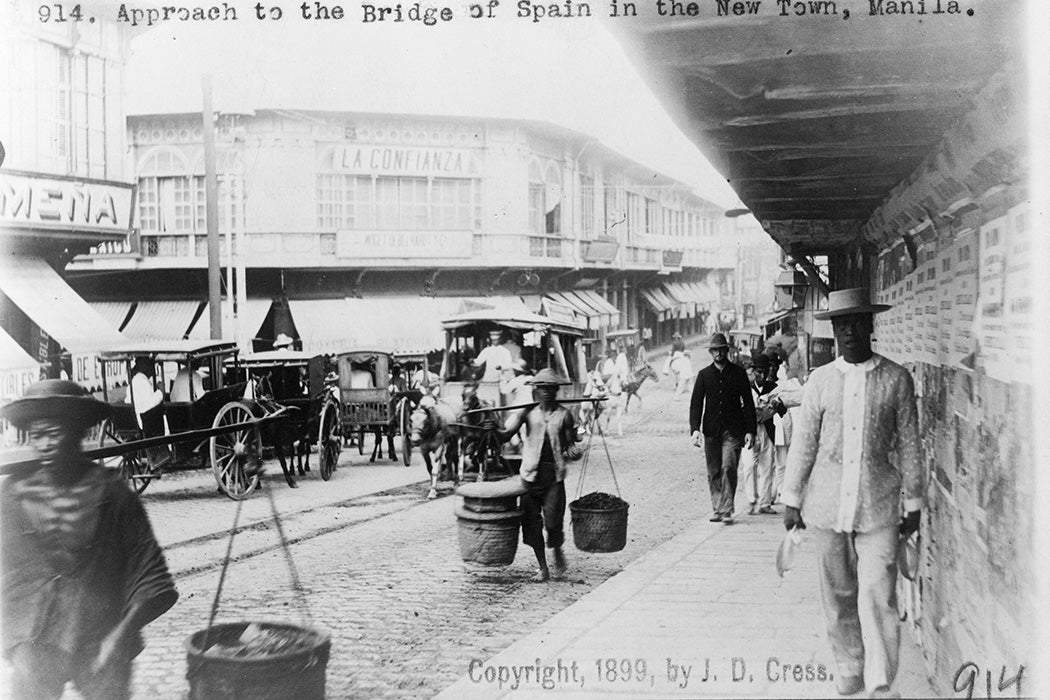
In 1905, Manila resident Pablo Trinidad was convicted of practicing sodomy. But, because American administrators in the Philippines were reluctant to explicitly criminalize same-sex sexual acts, he was prosecuted under an ordinance that made “vagrancy” a misdemeanor.


The court’s attitude contrasted with how the law was enforced in the United States at the time. Scrutinizing this discrepancy, Victor Román Mendoza suggests non-normative sexual behavior in the Philippines was treated by the colonial administration as racial deviancy.
Even as lawmakers in the United States unleashed a slew of sodomy laws from the 1880s to the 1920s, the Philippine Supreme Court cited legal opinions that held “it is necessary to dismiss” prosecutions in the Philippines “as, for example, those for sodomy.”
On the other hand, Mendoza argues that Trinidad’s case—which went all the way to the Philippine Supreme Court—shows that colonial laws against so-called vagrancy “enabled a range of umbrella charges to criminalize anyone who threatened social order.”
Ordinance 27, passed by the Municipal Board of Manila in 1902, defined an illegal vagrant as an individual who, in general, was “not giving a good account of himself; or who habitually accompanies prostitutes or other persons of notoriously bad repute.” Next up, Ordinance 28 outlawed not just public drunkenness but also “boisterous, rude, or indecent” conduct.
“Purposefully vague” laws against “vagrancy, indecency, drunkenness, or the corruption of youth” were used to target not only poor residents of Manila but also civilians engaged in same-sex acts, Mendoza observes in their book on colonial governance of the Philippines.
The colonial government understood same-sex relations and other “morally deviant behaviors” as “commonplace among what they regarded as the more primitive populations” in the Philippines, such as laborers in provinces away from Manila, the capital. But administrators, already aware that the Philippines was perceived as akin to Sodom and Gomorrah, were eager to downplay negative views of their prized new American colony.
“Explicit legislation of sodomy would have risked insulting Philippine elites … or admitting that colonialism engendered, imported, or facilitated unnatural relations,” Mendoza explains—consequences that would also have injured the colonial masters’ prestige. In this view, “[w]hile sodomy was a social problem in the metropole, it was not, as colonial administrators would have it, a problem in the Philippines,” they write. “There was nothing, to wit, unnatural, immoral, or degenerate about U.S. colonial relations.”
More to Explore
Postcolonial Pacific: The Story of Philippine Seattle
To uphold this position, American troops came in for more than their fair share of discipline. Following the conquest of the Philippines, hundreds of American veterans were charged under the vagrancy laws as civilians and deported back to the United States.
Yet, unlike the civilian legal system, military law explicitly barred same-sex relations. Just one year after Trinidad’s vagrancy trial, the U.S. War Department moved to codify “sodomy” and “bestial offenses” as proof of “bad habits” that could be grounds for courts-martial.
The U.S. Army tried an average of 51 sodomy cases a year in the Philippines in the 1910s—comparable to the number of sodomy arrests in New York City.
The hard line taken against sodomy in the ranks arose in part from colonial biases. “Significantly, administrators sought to brace this regulation of both sodomy and the vagrant against imperial fantasies of the sexually available, disease-carrying, degenerate, and thus perverse figure of the Philippine native.”
Even though many U.S. soldiers had been infected with syphilis and gonorrhea before their arrival in the Philippines, military administrators ignored the public health risk they posed to Filipinos, while local “lewd women” were seen as potential carriers of venereal disease.
Weekly Newsletter
"*" indicates required fields
U.S. Army officers like Captain Edward Munson, who penned a reference book for West Point’s Hygiene Department, even claimed that the tropical climate could cause genital swelling that could be satisfied with a “native population” predisposed to fornication.
Still, administrators could deny the problem more widely, because civilian laws governing sodomy restricted legal enforcement to public spaces that the state policed as “immoral” or “abnormal”—such as water closets, brothels, gambling dens, wharves, or markets.
In this way, “[c]olonial administrators in the Philippines imported from the U.S. metropole the capacious crime of vagrancy to regulate, on local and national levels, a range of nonnormative, unproductive, and habitually immoral bodies,” Mendoza writes. But as they search for records of what we might call queerness in the colonial Philippines, Mendoza finds that those records are difficult to isolate: “[u]nder vagrancy’s capacious cover, sodomy charges against individuals have become all but undetectable in the colonial legal archive.”