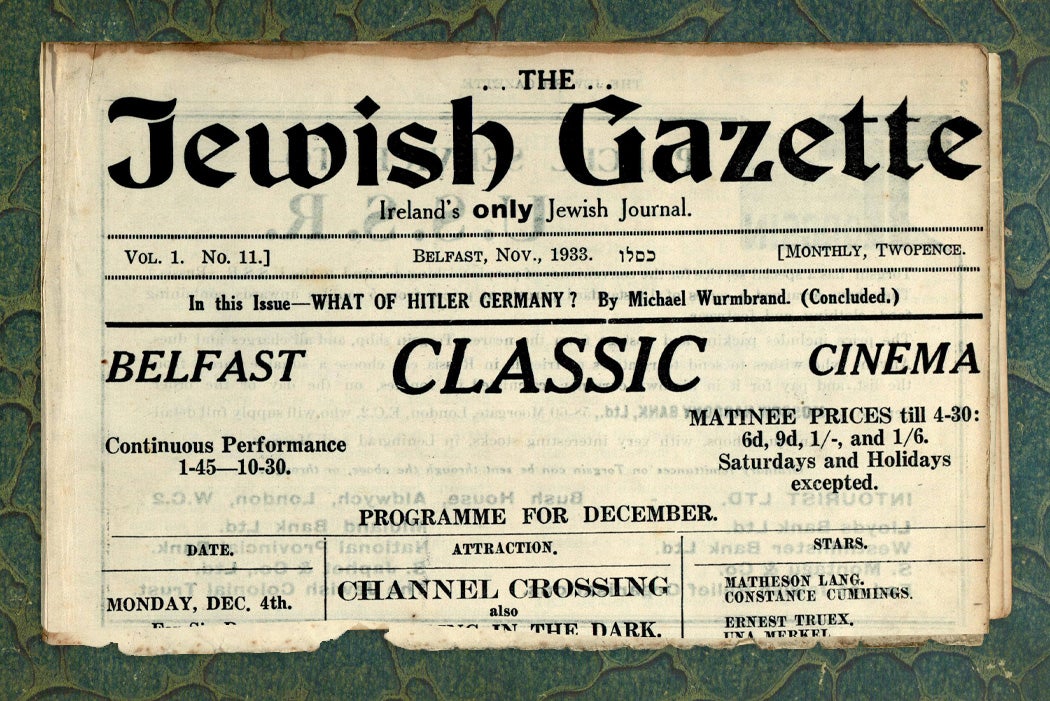
The Jewish population in Ireland has historically remained small. In the 2023 census, just 2,700 people identified as Jewish, and scholarship on Jewish Ireland is correspondingly limited. Only a few historians have dedicated themselves to tracing the evolution of such a small population in a small country. For that reason, documentation that sheds light on Jewish life in Ireland is at once rare and illuminating.


The archive of The Jewish Gazette, created by Queen’s University Belfast and shared via JSTOR, offers a rare glimpse into Jewish life in Ireland during a pivotal period in the twentieth century. The collection contains the thirteen issues of the newspaper, taglined “Ireland’s only Jewish journal,” that appeared between January 1933 and February 1934. (The Gazette is not to be confused with the Jewish Chronicle, which is the longest running Jewish Irish newspaper.) The archive preserves a prolific record of the ideas, art, and culture that circulated within Ireland’s Jewish community during a critical time in Jewish history.
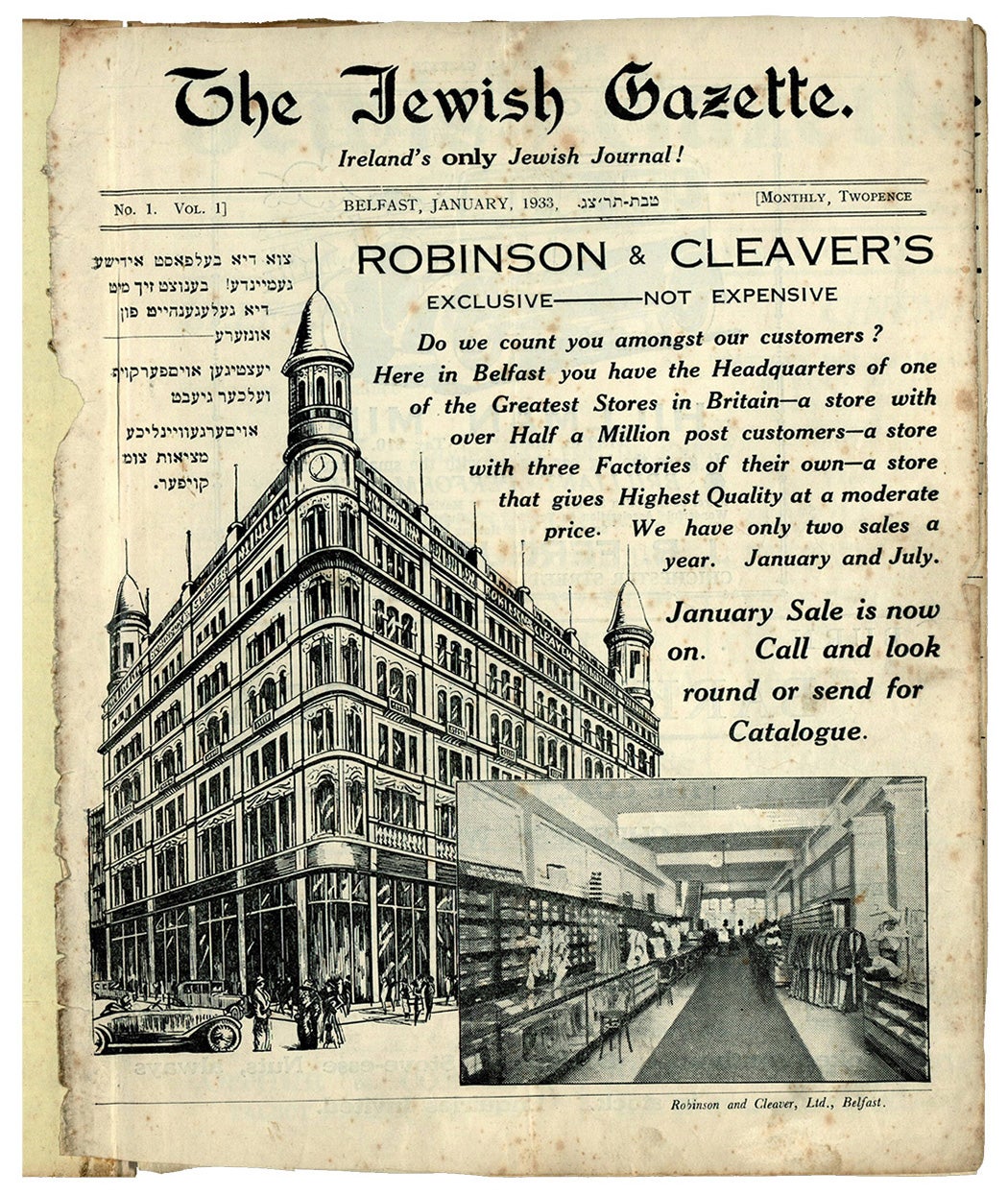
Past scholars such as Leon Hühner have traced a small but steady Jewish lineage in Ireland dating back to the eleventh century. In a 1905 report to the American Jewish Historical Society, he traced the first mention of Jews in Ireland to 1079 and notes the gradual growth of Dublin’s Jewish population over the next few centuries. It was not until the mid-nineteenth century that Jewish populations were documented beyond Dublin, most notably the Jaffe family of Belfast—the city that later headquartered The Jewish Gazette.
According to historian Rory Miller, nine out of ten Jews in Ireland lived in Dublin, Belfast, or Cork by 1914. Even so, in 1905, Edward Raphael Lipsett wrote in the Jewish Chronicle, “You cannot get one native to remember that a Jew may be an Irishman … There is undoubtedly a mutual estrangement between the Jews and the Irish.” Despite their long-standing presence in Ireland, the relatively small size of the Jewish population and its concentration in a few urban centers contributed to a perceived divide between Jewish and Irish identity. The archive connects readers to the voices of Irish Jews, demonstrating how earlier generations reconciled those two identities.
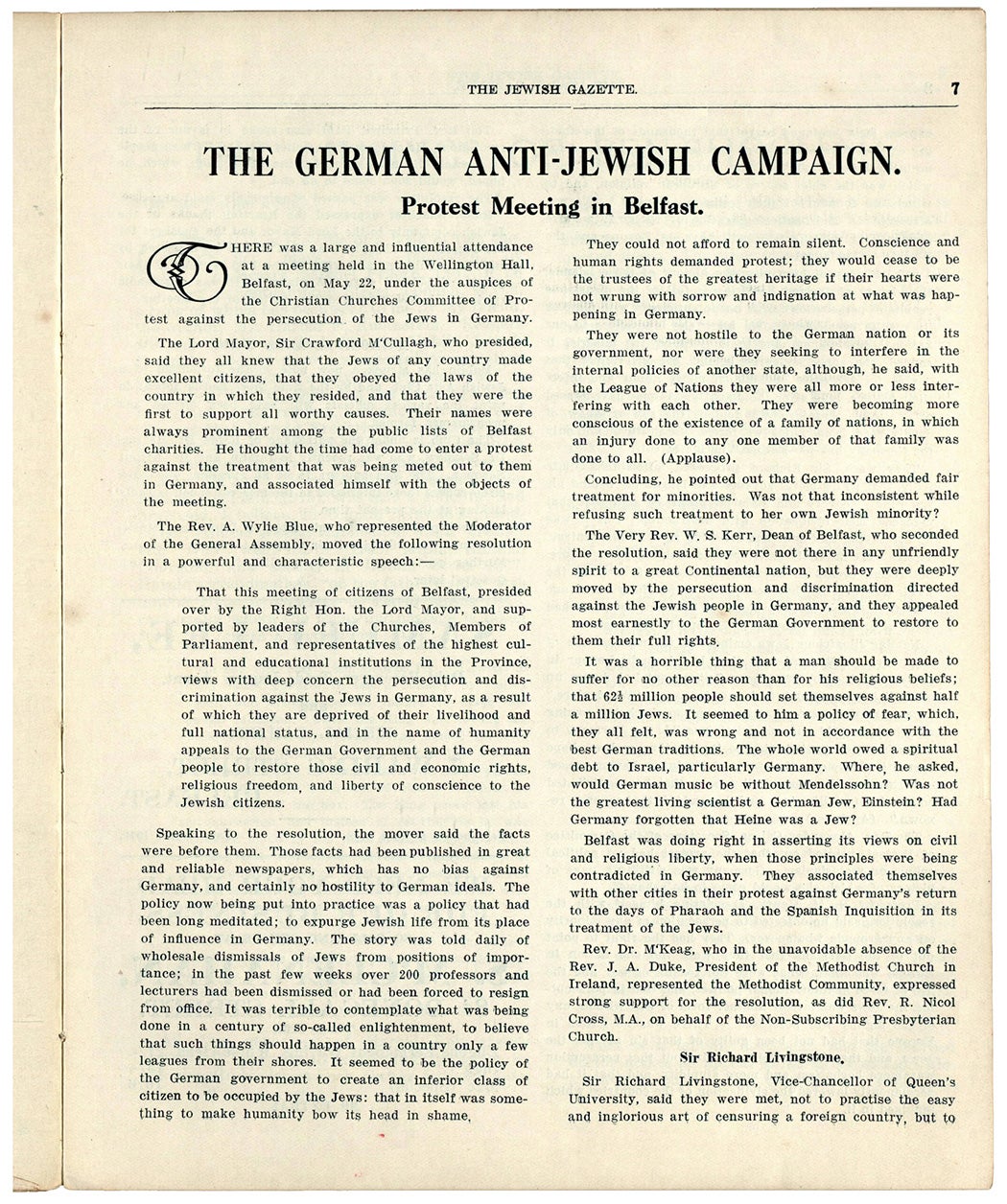
The Gazette’s coverage did not focus solely on Irish issues. Many pieces engaged with larger debates unfolding across the Jewish world, including the rise of Hitler and the consequences his growing power might have for Jewish communities in Ireland and abroad. Because The Jewish Gazette began publication in 1933, the same year Hitler came to power, its political commentary offers a rare record of how Jews in Ireland responded to his rise in real time. An article headlined “The German Anti-Jewish Campaign” describes a protest meeting in Belfast, where attendees discussed ways to stand in solidarity with the Jews facing persecution across Europe. The reporter comments, “It was terrible to contemplate what was being done in a century of so-called enlightenment, to believe that such things should happen in a country only a few leagues from their shores.”
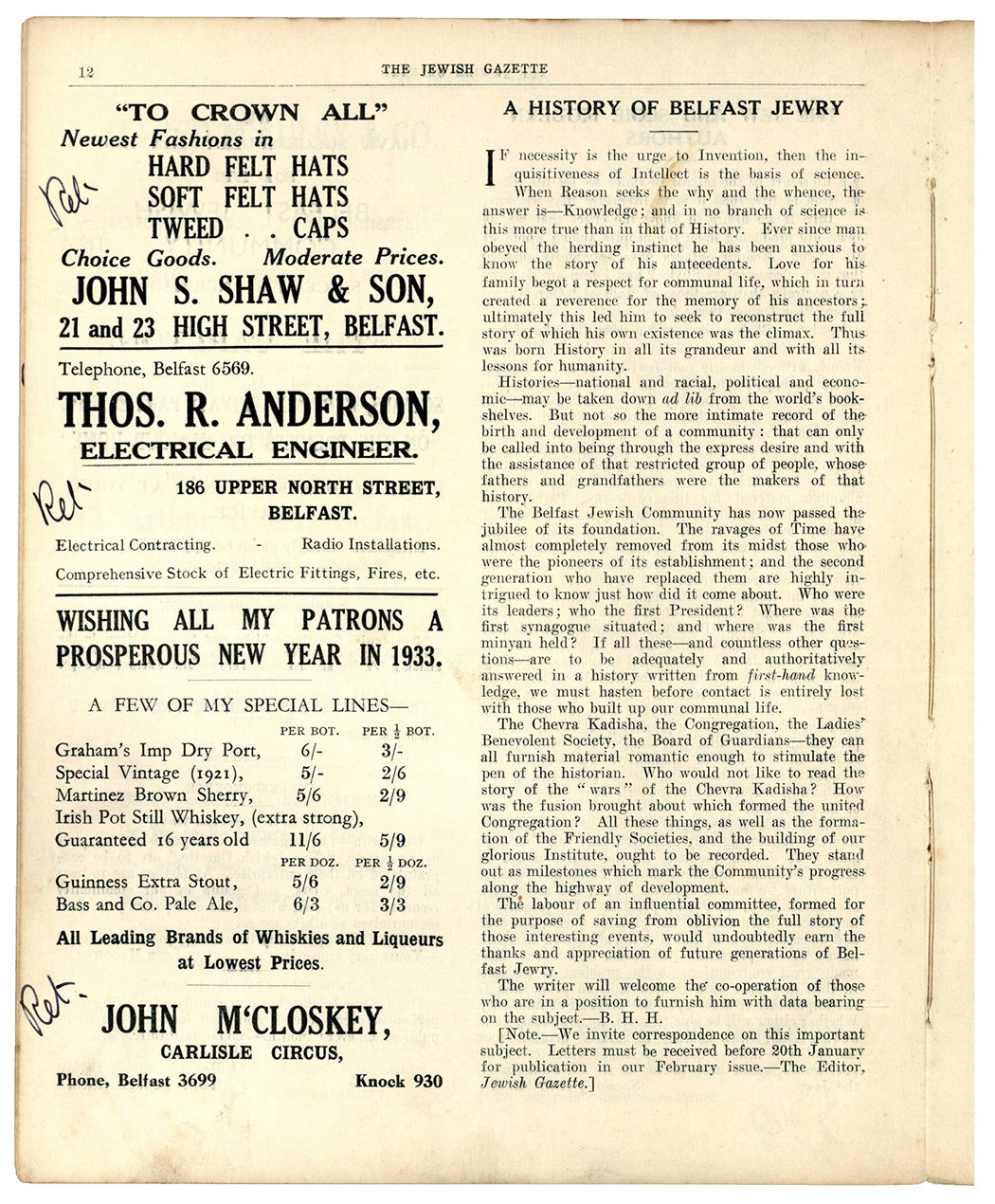
Yet the Gazette was not only a record of crisis. Its pages also show Irish Jews looking backward, inward, and culturally outward as they tried to understand their own history and place in Ireland. The Gazette’s first issue presents a recurring column called “A History of Belfast Jewry” that sought to explore the origins of Ireland’s Jewish community. The editors seem unsure of their community’s history, claiming that the “ravages of Time have almost completely removed from its midst those who were the pioneers of the establishment,” and seeking “the co-operation of those who are in a position to furnish him with data bearing on the subject.” By publishing their history and preserving communal knowledge, the Jews of Belfast sought to better understand their place in Ireland.
Weekly Newsletter
"*" indicates required fields
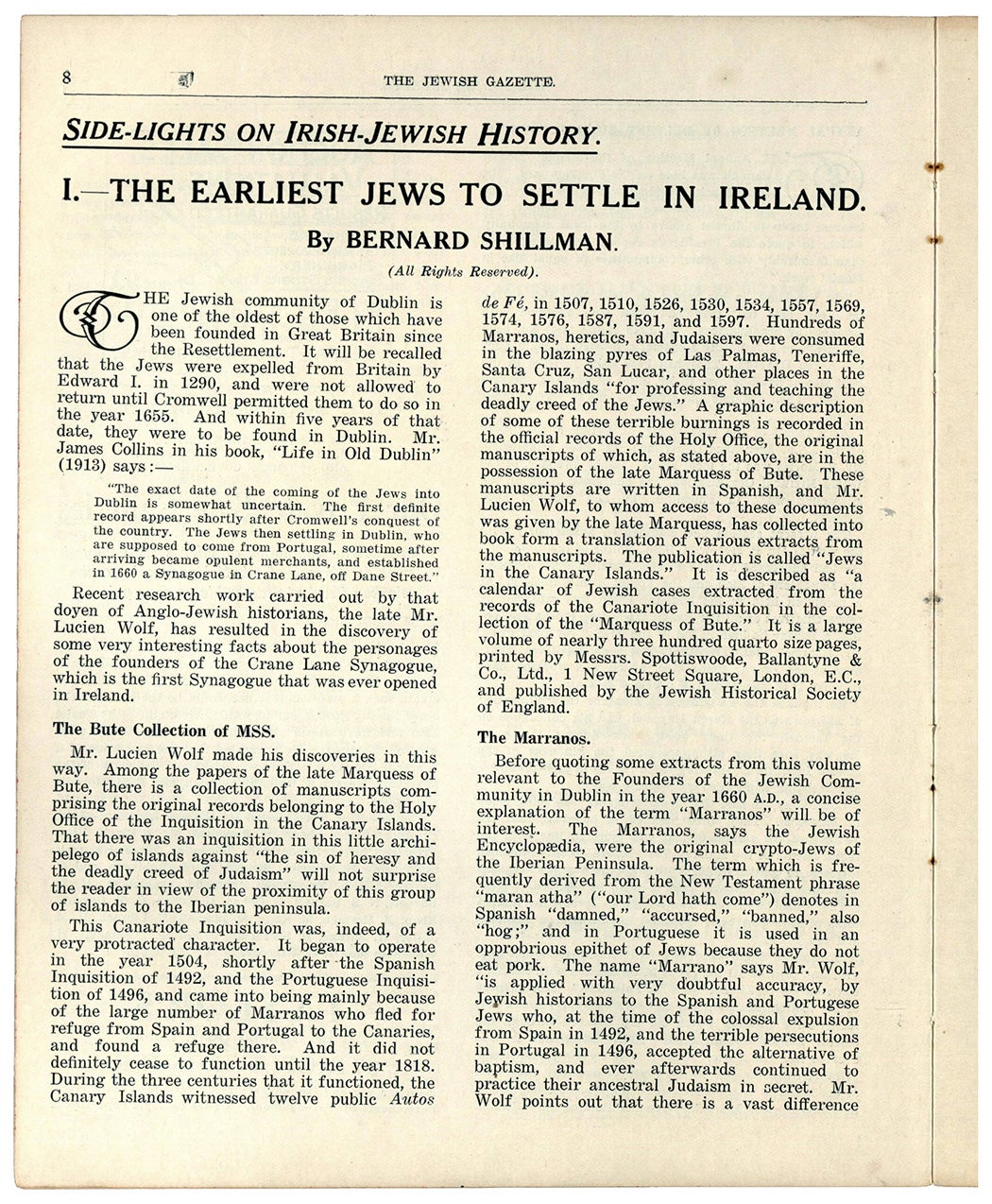
That search continues throughout the newspaper’s pages. In March 1933, Bernard Shillman wrote an article titled “The Earliest Jews to Settle in Ireland” under the column heading “Side-Lights on Irish-Jewish History.” He records the names of the earliest known Jews in Dublin, providing details about the earlier generations that previous issues had only begun to uncover. This quest to understand the origins of Jewish life in Ireland unfolds throughout the pages of the Gazette.
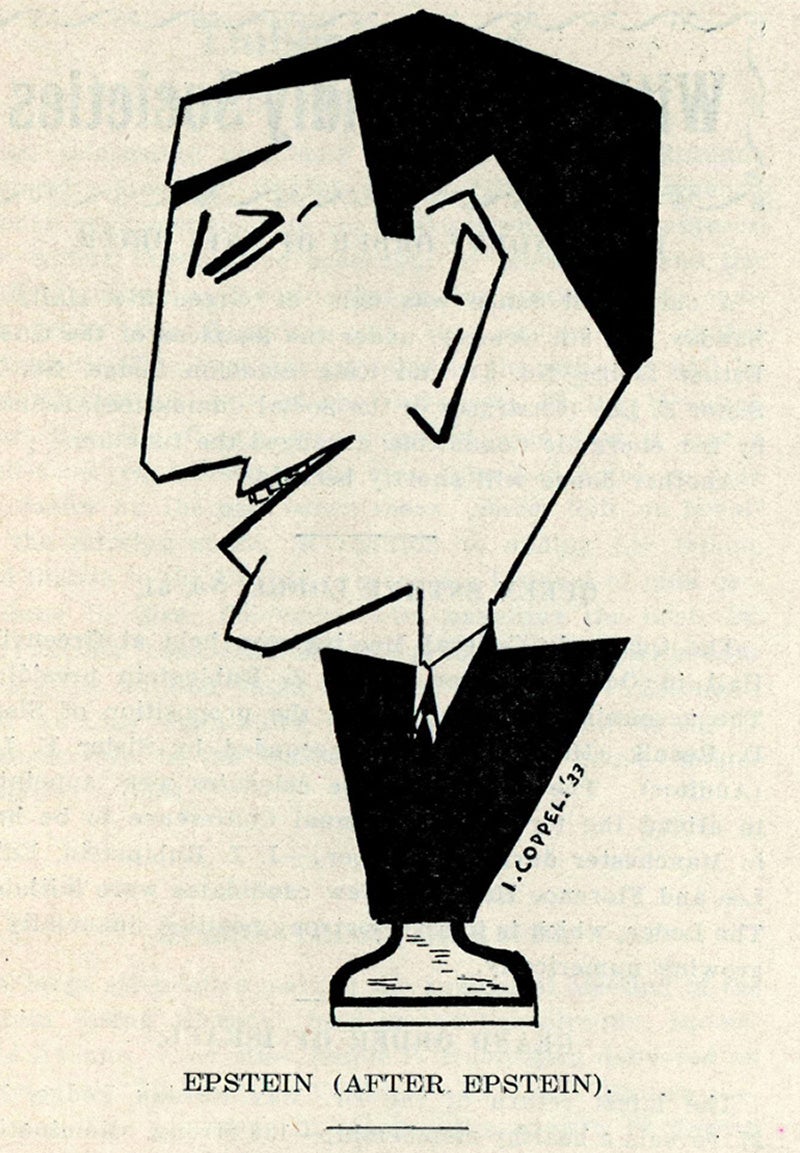
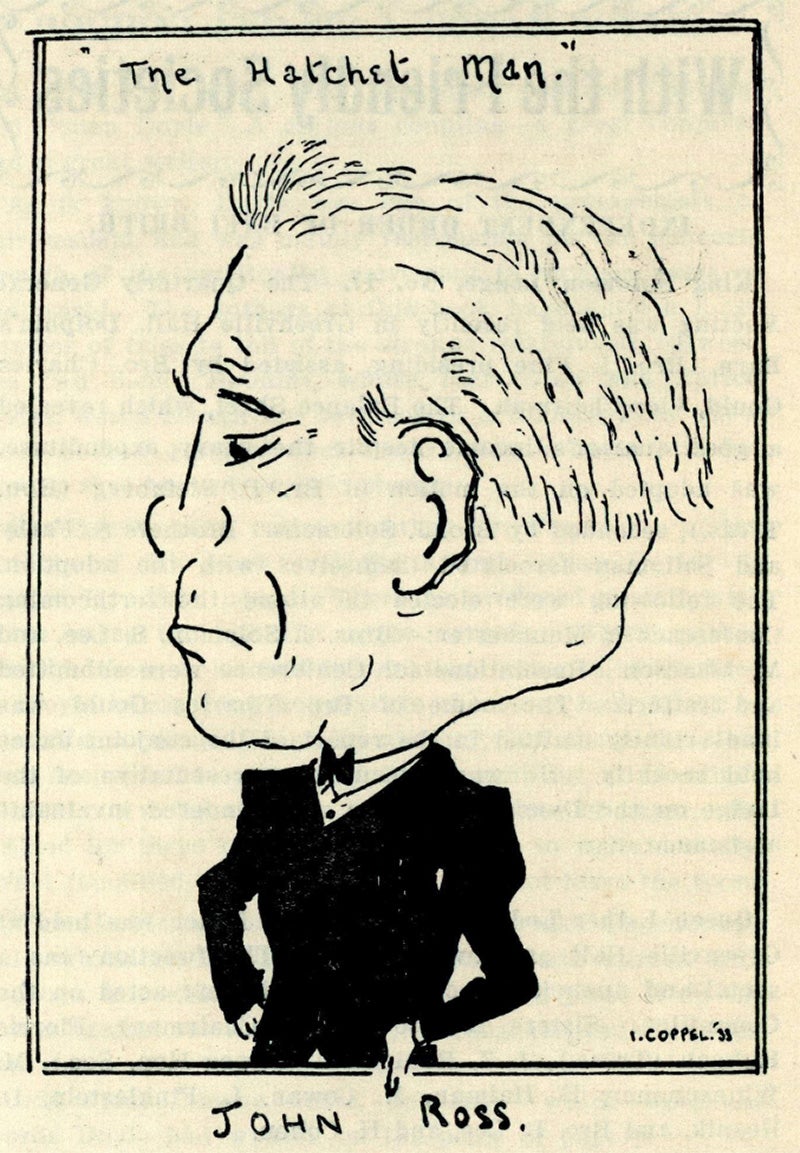
In its first issue in January 1933, the Gazette stated its goals to “stimulate the literary and artistic talent which lies dormant in our midst, and, when possible, find an outlet in our paper for such talent.” Although the Gazette covered the arts extensively, visual art appears mostly in advertisements and a series of caricatures by the artist I. Coppel. The rest of its artistic content takes the form of personal essays, poetry, theater reviews, and short stories.
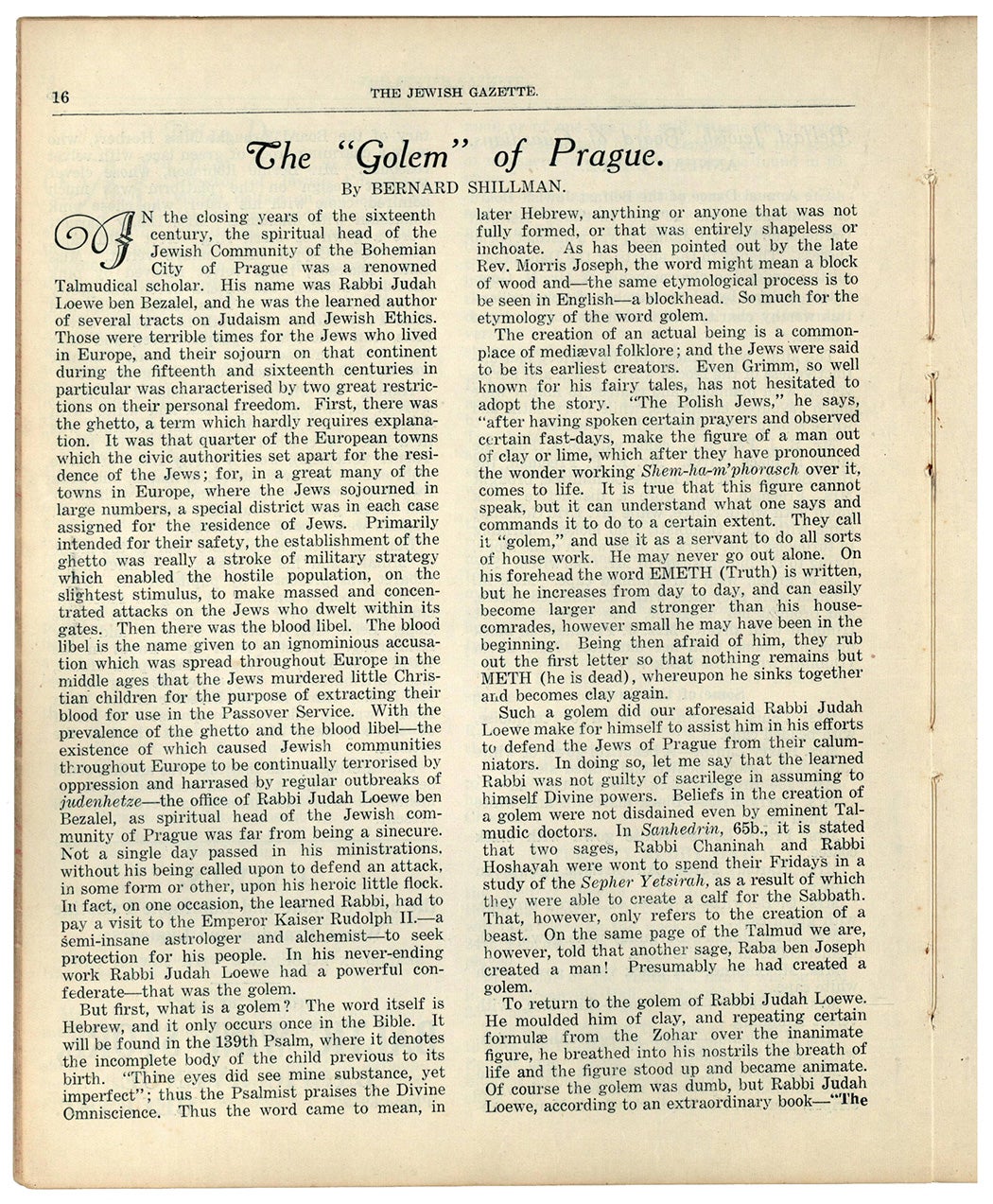
This emphasis on culture is particularly striking. With Nazism on the rise and Ireland’s Jewish population still small, one might expect the community’s only newspaper to focus primarily on questions of Jewish identity and belonging. Those concerns were present, but the editors also devoted substantial space to art, culture, and legendary tales such as “The Golem of Prague.”
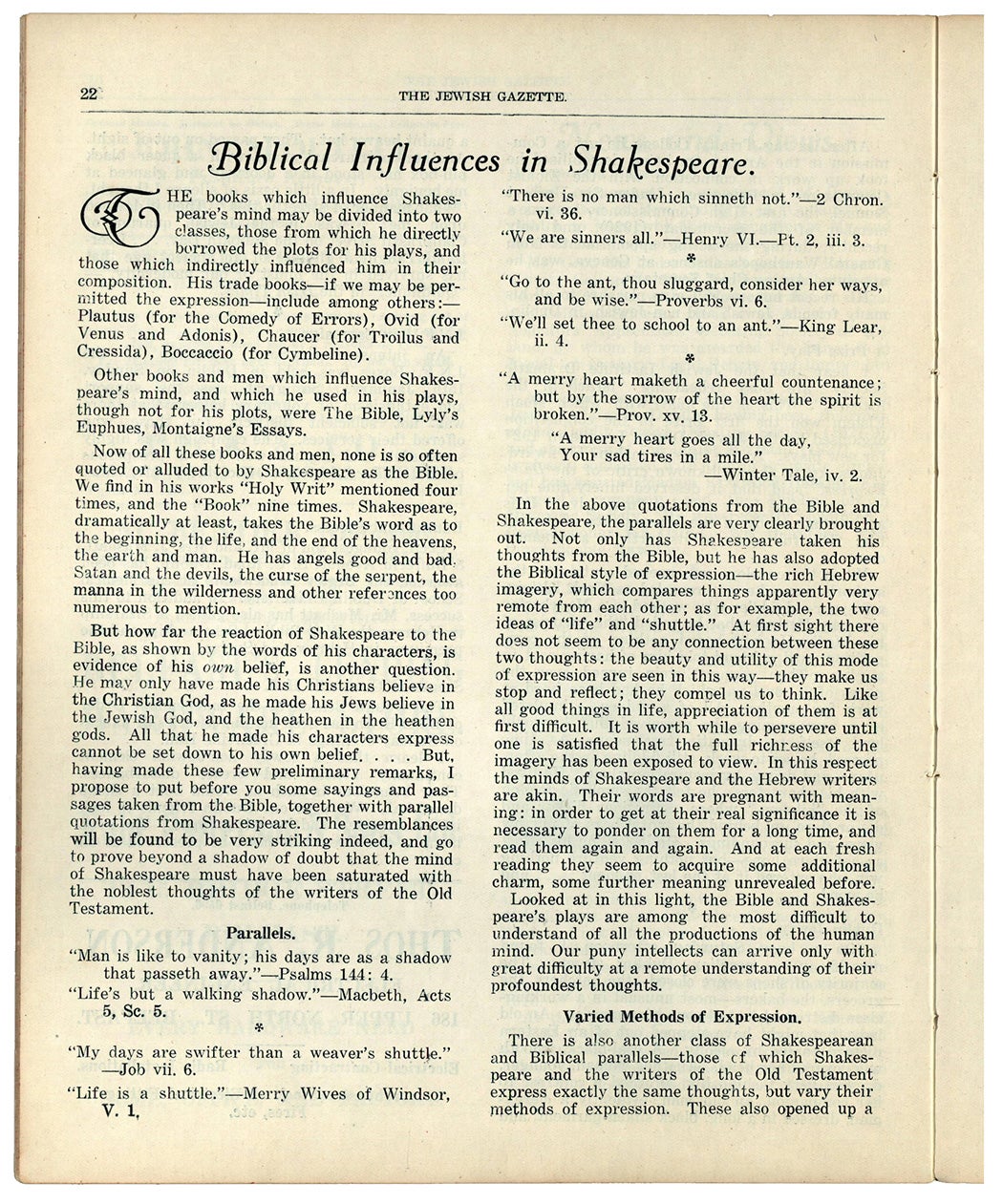
In one article, readers can find an essay analyzing Biblical Hebrew’s influence on Shakespeare. As the author writes, Shakespeare has “adopted the Biblical style of expression—the rich Hebrew imagery, which compares things apparently very remote from each other.” Other articles review plays by Jewish theater groups, like The Yellow Ticket, which tells the story of “a beautiful and innocent Jewish girl, who, in order to visit her dying father, has been compelled to accept unwittingly the infamous Russian ‘yellow ticket,’ which is issued only as a passport to women of ill-fame.” Taken together, these essays and reviews show how the Jewish values and stories discussed throughout the journal informed artistic and cultural life.
The Jewish Gazette’s brief run offers something that longer-running publications cannot: a rare snapshot of Jewish life in Ireland during a pivotal historic moment. Within its pages are political debates, literary ambitions, cultural commentary, and moments of humor and celebration that together reveal how Ireland’s Jews understood themselves and their place in the world. In doing so, the newspaper preserves a record not only of a community, but of an ongoing effort to define what it means to be both Jewish and Irish.