Many histories of invasive species concern the life-forms that have been intentionally or accidentally introduced from Europe. But animals, plants, and pathogens have also gone the other way. Sometimes the European metropole has become the frontier. Environmental historian Peter Coates details one such case of “faunal imperialism in reverse.”


Muskrats (Ondatra zibethicus) are mammals native to the wetter parts of North America. They were introduced to Europe to be farmed for their fur, a cheaper alternative to mink. But the semiaquatic rodents are only reluctantly domesticated. They determinedly burrowed and swam their way to freedom. As escapees, they spread into what was for them “virgin” landscape, as Europeans had spread into the “New World.”
The first documented introduction of muskrats to Europe was in 1905, when a Czech landowner brought five of them, three females and two males, back from Alaska. He was hoping to boost his estate’s income. Less than a decade later, Bohemia had an estimated two million muskrats.
To this day, naturalized populations of muskrats are found across northern Europe into Siberia, where the Soviets introduced them in the 1920s. They are considered a problem especially in lowland areas of France, Belgium, and the Netherlands. Coates calls the muskrat expansion a “non-human empire,” like that of the horse in Mughal India, dogs in Ottoman Cairo, and sheep in late nineteenth-century New Zealand.
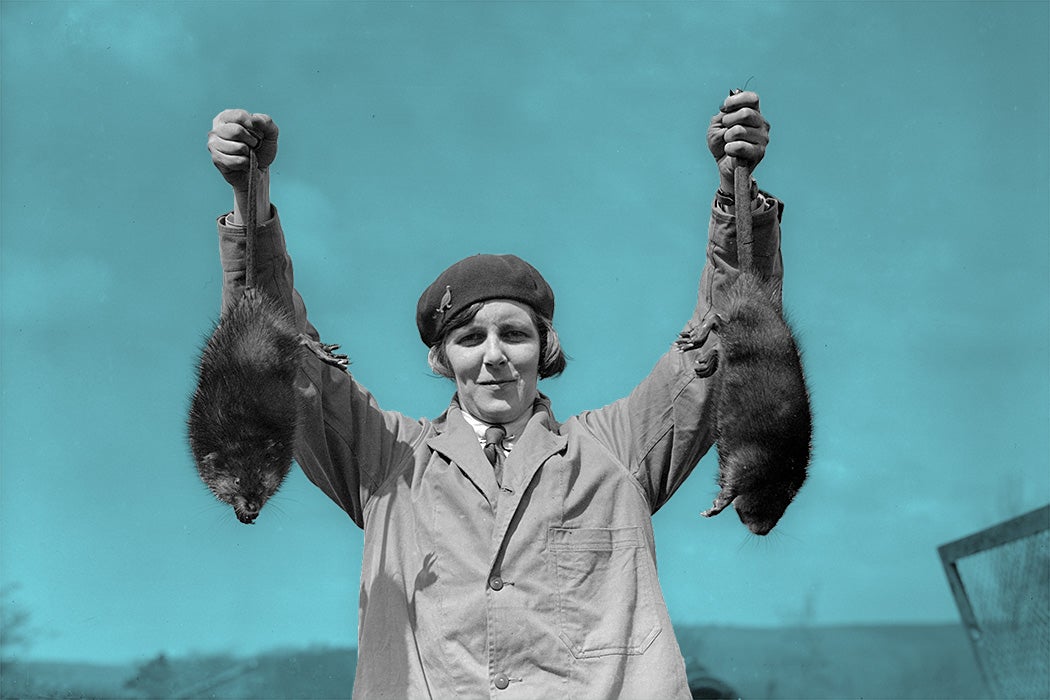
A notable exception to the muskrat colonization of Europe was Great Britain. There, something of a muskrat panic resulted in a war of extermination upon the animals starting in the early 1930s. It was a war the humans won, which is unusual when it comes to cases like this. As Coates writes, this was “an extremely rare instance of non-native invasive species eradication.”
Muskrats were introduced in England in 1929 to a farm in the Severn River watershed. This was after central Europeans were already loudly bemoaning the advance of muskrats into the vast Danube watershed. The animal farm had a two-meter-high fence enclosing it, half of it underground. The muskrats “escaped almost immediately.”
More to Explore
The Strange Career of the Lady Possum of the New World
In just a couple of years, the “Muskrat Menace” was the talk of Parliament and the newspapers. Politicians and journalists, writes Coates, “whipped up an apocalyptic vision of dams and riverbanks bursting, city water supplies sabotaged, lowland tracks inundated, and villages swept away.” Less than four years after their introduction, it was estimated that there were more than a million muskrats on the loose from Wales to Lowland Scotland, prodigiously reproducing and threatening “the embankments of rivers, canals, ponds, dams, roads, and railways.”
This was because, seemingly, “a muskrat’s life was better in Shropshire than in Saskatchewan.” At home in North America they “faced seventeen significant predator species.” In Britain, all the large predators had long since been exterminated and the smaller ones (like foxes) were ruthlessly persecuted. With little competition, a mild climate, and ample resources, Britain was optimum habitat for the highly fecund burrowers. In fact, it seemed that nothing would stop the “muskrat frontier” until they hit the surrounding sea and/or the heights of the Scottish Highlands.
The virtual hysteria over the muskrat invasion resulted in Britain’s first legislation to target a non-native invasive species. Not even the mess of the introduction of the gray squirrel (Sciurus carolinensis) into Britain in the last quarter of the nineteenth century had sparked that kind of response.
The initial effort to rid Britain of its muskrats, led by Canadian trappers, was unsuccessful. Gassing of the muskrat runs, or burrows, was also tried. Then “Bavarian master trapper Adam Roith” arrived on the scene in January 1933, bringing the technique of trapping them in their burrows. The very last muskrat was killed in 1936, the campaign declared over in 1937. The total body count was… less than 4,500.
Weekly Newsletter
"*" indicates required fields
In other words, there were far, far fewer of them than supposed, many fewer than were actually being seen in continental Europe. “The muskrat in Britain turned out to be resistible, and its colonization reversible,” notes Coates, because it was caught early and really hyped.
The “rat” in their common name comes from muskrats’ superficial resemblance to rats, but in fact the animals are more closely related to lemmings and voles than they are to rats. The “water rat” immortalized as Ratty in Kenneth Grahame’s The Wind in the Willows (1908), is the European water vole (Arvicola amphibius). The water vole was nearly wiped out in Britain by the 1990s via habitat destruction and the introduction of American minks (Neogale vison). The minks were also introduced to Britain for their fur.