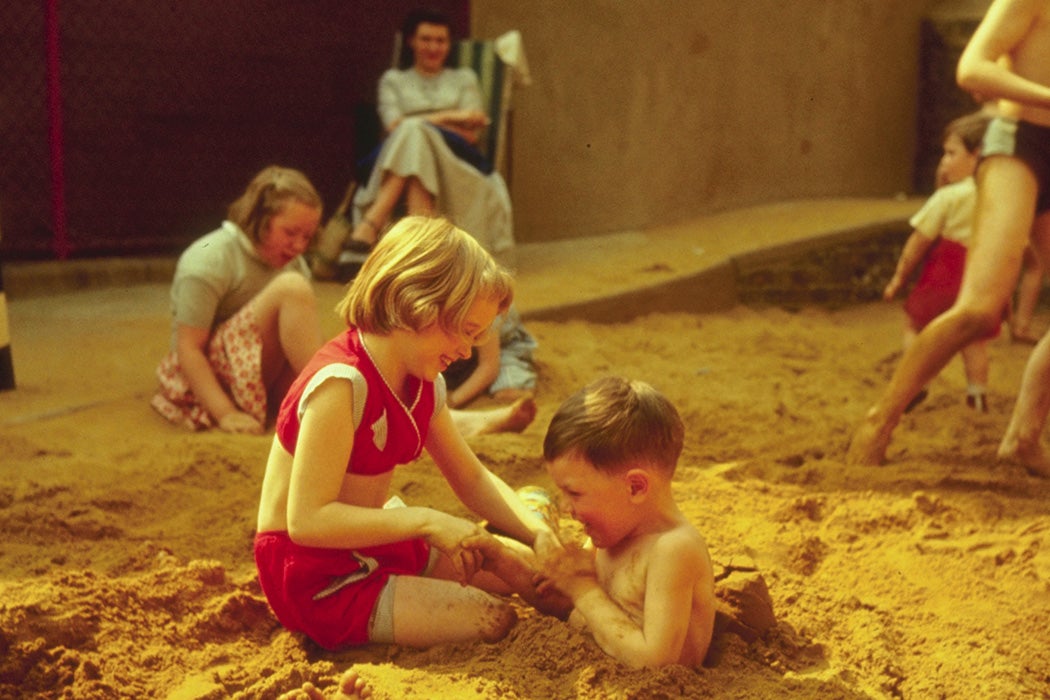
Playing in the sand is probably as old as the first humanoids to wander onto a beach. But bringing sand indoors for children to play with appears to have been an innovation of the nineteenth-century German kindergarten movement. From there it moved outdoors, to sand piles, sand hills, and sand gardens, culminating in the readily-contained sandbox, which could be set up anywhere.


As scholar Tamar Zinguer details, women brought the sandbox to the US in the 1880s and made it public as a women-centered space in an era when there were very few such spaces.
“Women doctors, benefactors, women educators, and mothers took part in this experiment to claim a public space for working mothers and children in city life. The sandbox, considered to be the direct precursor of the play-ground, built communities through play.”
During an 1884 trip to Germany, Boston physician Marie Zakrzewska, one of the very few women doctors in the US, witnessed children having a whale of a time on the sand hills in Berlin’s parks. She wrote home with the news. Alongside the Massachusetts Emergency and Hygiene Association (MEHA), an offshoot of the Boston Woman’s Education Association, Zakrzewska was instrumental in establishing sand play in Boston. German women who had trained as kindergartners and then immigrated to the US helped spread the sand around elsewhere in the US.
Zinguer calls sand play “‘tacit’ knowledge, requiring no explanation or special understanding.” The sandbox was a space where “an attitude of respect, collegiality and participation prevailed, in a rare place with universal appeal.”
Pioneering psychologist G. Stanley Hall—he would later be noted as the only American university president to invite Sigmund Freud to lecture in the US—disagreed. Regardless of the emerging reality in Boston, his 1888 study of two boys at play in the sand argued that girls should be excluded from such play: “Most destructive in the ‘sand-pile’ are little girls, who quite fail to appreciate it.”
Disregarding the patriarchal voice of academia, Boston already had 17 MEHA-run playgrounds with sandboxes before the city opened its first public playground in a city park. This was Charlesbank, which opened in 1891 and was designed by Frederick Law Olmsted as a satellite to his Emerald Necklace chain of parks in Boston and Brookline. Charlesbank included a “sand court” run (and funded) by an all-women committee, rather than the all-male parks commission. It also hosted a women’s and men’s open-air gymnasia, with a running track around the men’s gymnasium, a design that would prove highly influential. (The women’s gymnasium and the sand court were surrounded by tall hedges.)
More to Explore
Changing Playground Design, Changing How Children Play
The apotheosis of the sandbox was probably its inclusion in the 1904 World’s Fair in St. Louis, which helped put sandboxes on the world’s map. The sandboxes at the Fair were part of the Model Playground in the Model Street exhibit, which also included a “town hall, a municipal museum, an emergency hospital and drugstore.”
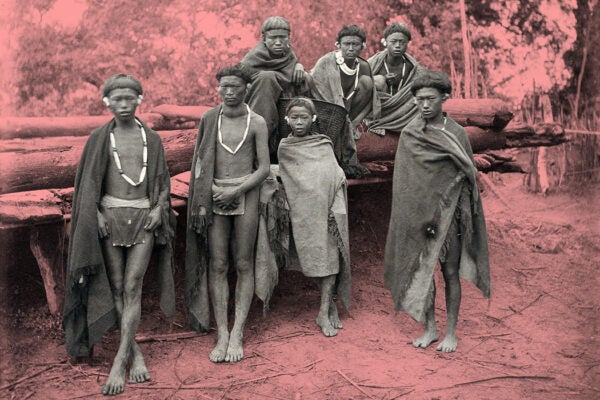
“The Model Playground, occupying three quarters of an acre, was considered the more modest of these exhibits, yet the most successful,” writes Zinguer. The matron-supervised playground acted as a nursery, day care center, and “lost children” collection point for the over 1,000 kids who misplaced their parents over the run of the fair. “Native” children, among the 3000-strong indigenous peoples on exhibit from around the world, were also included in sandy playtime.
“Increasingly recognized as a ‘community builder’ throughout the beginning of the 20th century, a sandbox appeared to imply ‘normalcy,’ if only by allowing children to play freely and be engrossed in their own alternative reality.”
Weekly Newsletter
"*" indicates required fields
Sandbox use continued through the mid-century, but the tide turned later in the twentieth century. Once celebrated as sites of creative play, sandboxes came to be “considered a breeder of disease and infestation.” This is because sandboxes can become infected with fecal microbes and parasites from wild and domesticated animals—including millions of free-roaming cats.
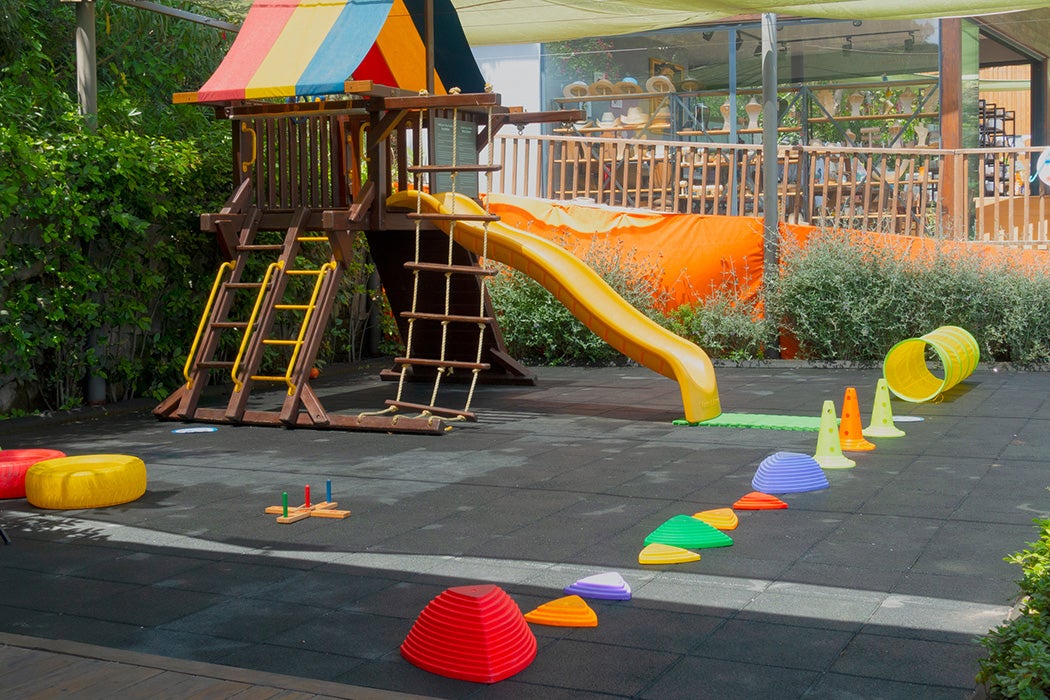
While sandboxes haven’t disappeared, they have become hard to find, and public ones, the whole point of the original sandbox, now seem largely a thing of the past.