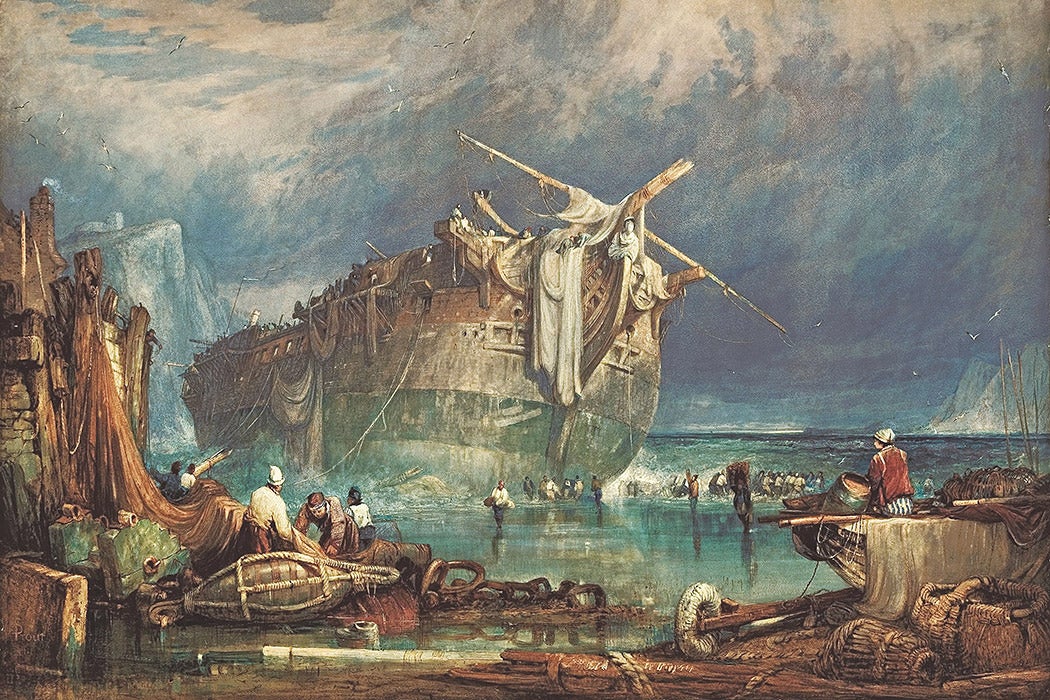
In 1627, treasures started to wash up on the beaches of France: diamonds, ebony, precious porcelain, spices, ivory, ambergris, and bezoars. Two Portuguese ships, so huge they were referred to as “floating cities,” had shipwrecked off the coast of Bordeaux, spilling luxury goods into the waves.


The disaster quickly threatened to become an international incident. The owners of the cargo (unsurprisingly) wanted their goods back—but the coast dwellers claimed that anything that washed up on shore was theirs by the ancient droit du naufrage, the “right of wreck.”
It’s easy to understand why a beachcomber who found a diamond in the sand might want to hold onto it, but there was a legal basis for their claims. The “right of wreck” was a long-lived and widespread custom, one that shaped the very architecture of seaside towns: in his travels through Norfolk, Daniel Defoe wrote that the “country people had scarce a barn, or a shed, or a stable…but what was built of old planks, beams, wales and timbers, &c. the wrecks of ships, and ruins of mariners and merchants’ fortunes.”
That said, in legal terms, the right of wreck was a little more complicated than “finders keepers.” In many places, it wasn’t actually the person who stumbled on the shipwrecked goods who held the right to them; rather, they became the property of the local lord. In the earliest iterations of this idea, poor shipwreck survivors could find themselves roughly stripped of all their goods—as King Richard I of England found when his fleet was unlucky enough to wash up off the coast of Cyprus, circa 1191. His fiancée and his sister were taken as captives by the emperor of the island, who also helped himself to all the treasure they’d been traveling with. (This didn’t end well for the emperor, who lost his throne in the ensuing war.)
Neither wealthy merchants nor traveling kings were particularly enthusiastic about the idea that an accident at sea could mean forfeiting all their cargo. On the other hand, powerful landowners were eager to preserve their right to the occasional random windfall. As international trade increased, the right of wreck was slowly reshaped by centuries of legal wrangling. Courts battling over who could keep what ended up creating, for instance, highly specific legal definitions for terms like “flotsam” (goods that just happened to float to the surface after a wreck) and “jetsam” (goods intentionally tossed from a ship to make it lighter).
More to Explore
Lonely Diarist of the High Seas
The resulting patchwork of rules meant that every shipwreck was a complex negotiation between competing interests. Usually, the owners of the shipwrecked goods were entitled to their property back, in exchange for some kind of fee. Whether that was a ransom or a fair reward for helping salvage the goods is a matter of perspective.
In 1236, King Henry III of England issued an edict stating that if “man, dog, or cat” escaped the shipwreck alive, finders were obligated to hold on to the wrecked goods for three months, allowing the survivors to claim them in that time. There is a bit of an issue with that rule: it’s easy to see how it could create an incentive for shore dwellers to do away with shipwreck survivors in order to claim their goods (whether those survivors be man, dog, or cat)
Legends of these dark deeds swirled for centuries, but there’s little evidence they really happened. Still, people could be rough in their efforts to “salvage.” In Estonia, for instance, where the local lords were entitled to rewards if they helped to save ships in distress, people developed a habit of launching into enthusiastic “rescue” operations, whether or not there was any real danger.
Weekly Newsletter
"*" indicates required fields
A particularly good wreck could spark a feeding frenzy. An account of the wreck of the Golden Grape in 1641 gives a sense of the chaos:
The first arrivals on the beach contented themselves with staving in barrels and filling linen bags and pockets with raisins or, stripping off their waistcoats, used the sleeves as bags. But soon bands of men appeared from the various villages… Some gangs or men took away a score or two of barrels of raisins or the same number of jars of oil, but they were lucky if they did not have to share their booty with a stronger gang before they could gain a place of safety.
Not everything washes ashore, of course; many of the treasures lost in wrecks sank under the waves. There were fortunes to be made, but in a time before diving equipment, the trouble was how to reach it. In the early modern era, for the most part, even European sailors could hardly swim. But Africans living by the sea in Senegambia and the Gold Coast were highly skilled swimmers and divers—leading them to be targeted by enslavers, who knew their specialized skills could be turned to the recovery of underwater riches. As historian Kevin Dawson writes in “History Below the Waterline: Enslaved Salvage Divers Harvesting Seaports’ Hinter-Seas in the Early Modern Atlantic”:
The African-honed expertise that enslaved underwater divers carried throughout the Atlantic world allowed them to quickly recover several tons of gold, silver, and other items from shipwrecks, especially old Spanish treasure hulks. Possessing proficiencies held by few in the world, divers exchanged their unique ability to rapidly produce capital for semi-independent lives of privileged exploitation.
Their skills were so irreplaceable that they were able to negotiate for better treatment than most enslaved people, including a share of what they salvaged. Though, of course, a share isn’t much when you’re doing all the work.