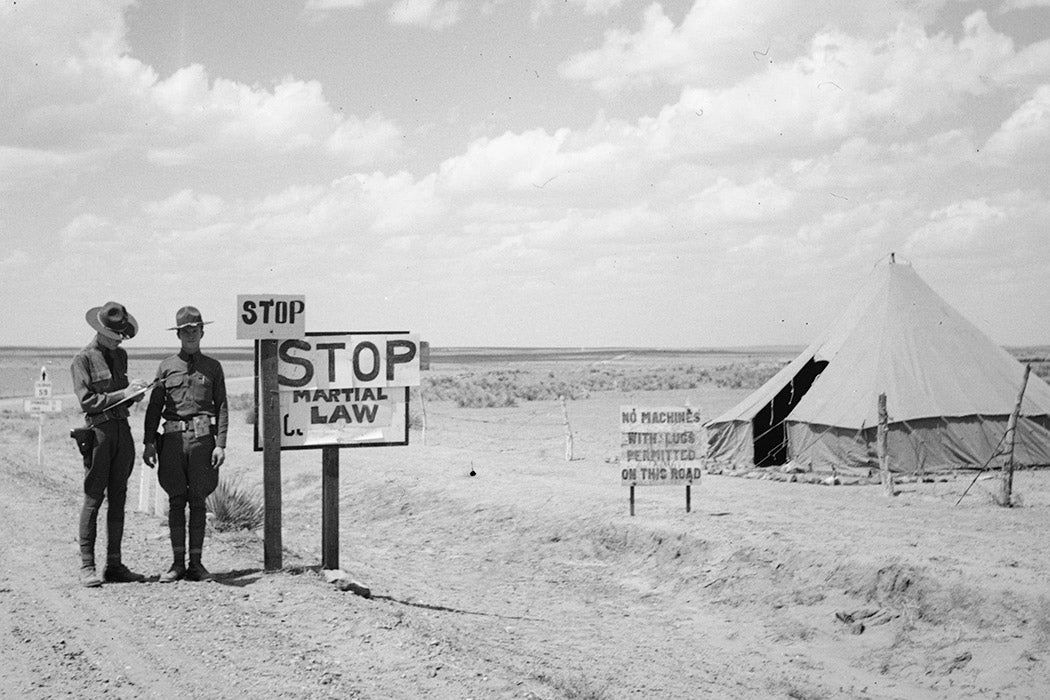
By the 1930s, the federal government was in charge of immigration, having centralized and formalized the ad hoc immigration regimes cities and states had developed during the nineteenth century. So it was news in April 1936, when Colorado Governor Edwin C. “Big Ed” Johnson declared martial law along the border with… the neighboring state of New Mexico. Johnson publicized his action as a blockade to stop a supposed “invasion” of “alien and indigent persons.”


When his earlier proposal to set up concentration camps for Mexican immigrant workers, who were pressing for higher wages in the sugar beet industry, came to naught, he hit upon the border blockade gambit. Political scientist Monica W. Varsanyi writes of Johnson’s “classic example of political entrepreneurship”:
Although his plans had little actual impact on Colorado’s agricultural labor market or welfare relief load, they resulted in an outpouring of public support, which he exploited in his successful run for the US Senate later in 1936.”
Beyond yet another precedent for the political benefits of racism and nativism, Johnson’s actions present a case study of racialization, the political and ideological process of race-making and the creation of color lines. The militarized race border between two US states, continues Varsanyi:
created circumstances in which the social boundary between who belonged and who fell outside of citizenship and belonging was both heightened and vigorously contested in this uniquely multi-ethnic region populated by Anglos, native-born Hispanics, Mexican immigrants, and Native Americans.
American citizenship had originally been granted to “free white” persons in the Naturalization Act of 1790. The territory conquered in the Mexican–American War added at least 80,000 people to the rolls of American citizenship in 1848. These Mexican Americans and their descendants therefore were considered white in federal law. But this was a precarious whiteness. In the Southwest, Mexican Americans were second-class citizens. Regardless of de jure law, Anglos did not see them as white and treated them accordingly. “Juan Crow” segregation covered housing, education, and employment.
Varsanyi quotes Colorado resident and US citizen Filigonio Arellano, “During wartime and when they need my vote, white people call me an American. If I need a loan, I am Spanish. And if I’m applying for a job they call me Mexican.”
Nonetheless, Johnson’s blockade received a good bit of support from native-born Hispanics. These US citizens tried to distinguish themselves as “Spanish Americans” or “Hispanos” in opposition to Mexicans. “Spanish-speaking New Mexicans, elite and impoverished alike, rebuffed claims of mestizo, ‘impure,’ or ‘mixed’ blood by tracing their lineage back to Europe and Spain, not Mexico.”
More to Explore

Birth of A National Immigration Policy
There was some “solidarity between Hispanic and Mexican workers, mainly within the labor movement and religious communities,” but otherwise little sense of a “pan ethnic/pan-Hispanic solidarity or ‘Mexicanness.’”
Of course, to a racist, birthplace or citizenship hardly mattered. New Mexico residents who were US citizens who tried going north for work in Colorado’s sugar beet, railroad, mining, and sheep-herding industries, as they had for decades, found that they were classified as “aliens” and “Mexicans” and turned back.
Weekly Newsletter
"*" indicates required fields
The blockade only lasted eleven days. Pressure from the powerful sugar beet interests—who could not get white Coloradans to work under the industry’s brutal conditions—and rising tensions with New Mexico likely led Johnson to call it off. A marked increase in racism persisted long after, however.
Johnson himself would go on to serve three terms in the US Senate before becoming Colorado governor again in 1955. On both Wikipedia and the Colorado Virtual Library, only a single senatorial achievement is highlighted: on the floor of the US Senate in 1950, he denounced Hollywood star Ingrid Bergman as “a powerful influence for evil” and an “apostle of degradation” because of her extramarital affair with director Roberto Rossellini.