In the nineteenth century, entertainers began dazzling audiences with the “magic lantern.” Operators used these projection systems to bring marvelous images to large crowds. They even performed tricks on the eye, conjuring “ghosts” onto the stage using reflections or transparent screens. But some at the time saw scientific possibilities in those ghostly images.


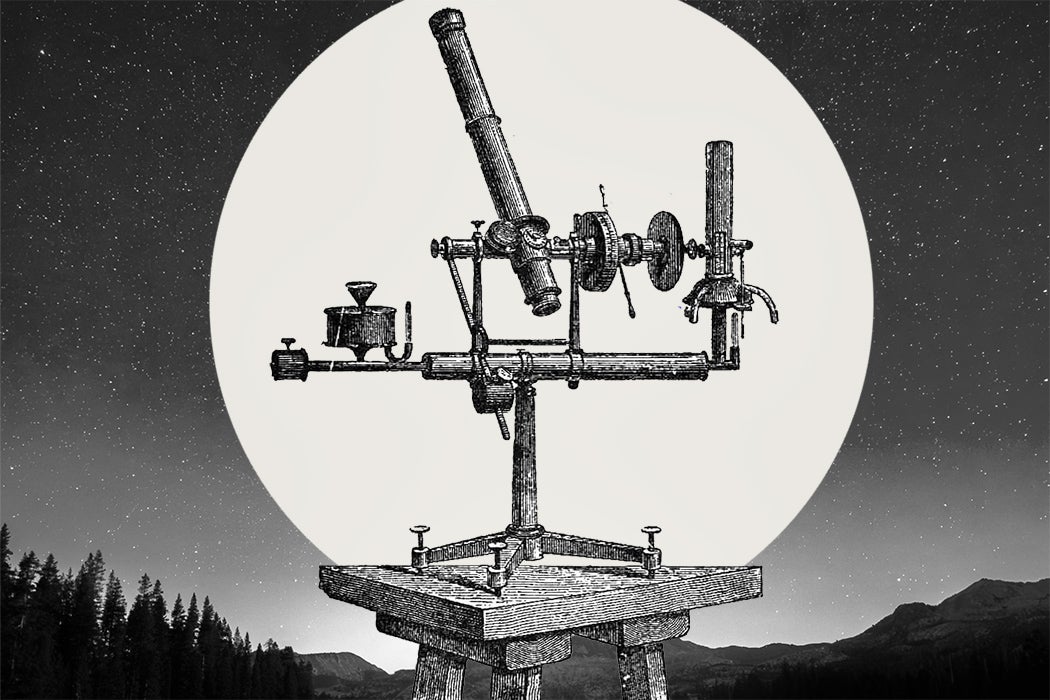
The rise of projection culture coincided with an increasing effort to mechanize astronomy. Astronomers had been precisely charting the positions of stars and other objects, and the next step was to study their color and brightness. German projectionist Karl Friedrich Zöllner realized that magic lanterns might help astronomers in this effort, explains historian Klaus Staubermann. He argues that Zöllner’s new scientific instrument, an astro-photometer, harnessed the subjective perception created by the magic lantern for scientific purposes.
The principles behind the “magic lantern” have a deep history, but improvements by Christiaan Huygens and others in the seventeenth century led to more widespread use. Staubermann describes how magic lanterns became popular lecture aids by the eighteenth century, as improvements to lighting and mirrors made them suitable for larger theaters. Projectionists learned new ways to control brightness and create visual effects using a variety of filters and lenses. Meanwhile, scientists were experimenting with optics, prisms, and mineralogy.
It was in this milieu that Zöllner became a projectionist and a student of photometry. He began studying illusions, trying to understand how we distinguish them from reality. He thought of the retina itself as a projection screen, Staubermann explains. To Zöllner, “The mind was the spectator,” he writes, “looking at the image and deciding what of that which was seen was illusory and what was real.”
More to Explore

The Hidden Aesthetics of Early Astrophotography
It was the interplay between reality and illusion that enabled Zöllner’s photometer. The instrument employed techniques similar to those used to conjure ghosts on the stage to create artificial stars. A gas burner provided intense and steady light, which was projected as a point of light on a semi-transparent glass screen using lenses and prisms.
“For the observer with a Zöllner photometer,” Staubermann writes, “it appeared as if both stars were actually in the sky, having the same background.” The operator could control the brightness of the “ghost” star and compare it with a real one. Previously, astronomers’ perceptions of star brightness and color varied, sometimes significantly. But as they began experimenting with Zöllner’s photometer, they obtained results that agreed with each other.
Weekly Newsletter
"*" indicates required fields
The instrument became a best seller in Europe and the United States. Astronomers added it to telescopes like the one at Leipzig Observatory. By the 1870s, Staubermann explains, “of the observatories participating in international observing programmes almost half of them had ordered a Zöllner photometer.” Papers on astro-photometry proliferated, and Zöllner himself became the first German professor of astrophysics.
Staubermann argues that the photometer didn’t quite make astro-photometry a “mechanically objective” science, however. Using it meant refining observation skills rather than eliminating the need for them. “Through the use of Zöllner’s photometer,” he writes, “observers learned how to both control and improve their visual judgement.”