We live in an age of hardened borders and militarized frontiers. Particularly since the September 11, 2001 attacks and then the Covid-19 pandemic, the supposedly borderless world of globalization has seen significant retrenchment and “re-bordering,” including the rise of nationalist movements hostile to immigration.


It doesn’t require a stretch to understand why what scholar Andrew Gardner calls the “lived complexities” of the Mexico–US border has helped give rise to the interdisciplinary field of Border Studies. And it’s easy to see why Hadrian’s Wall, the imperial Roman boundary across northern England, has been taken up by the relatively new discipline. For even though Hadrian’s Wall is more than 1,900 years old, it presents a classic case for the study of the ideas and the practices of a frontier between us and them, a formulation that works on both sides of a divide.
Hadrian’s Wall is the place of continuing archeological discovery, even after all these years and explorations. As a UNESCO World Heritage Site, it’s also a famed tourist attraction, with thousands walking the entire 84-mile route of the wall’s National Trail every year, while hundreds of thousands visit sections of it. (See the Sycamore Gap.)
The wall also has, argues Gardner, “an even wider influence in popular culture, concomitant with its iconic status as a robust linear barrier.” He refers to its implicit use in Brexit and Scottish independence debates and, more benignly, its influence on the ice wall in George R.R. Martin’s epic A Song of Ice and Fire, a.k.a. Game of Thrones. Noting such absurdities as a movie Robin Hood walking the hundreds of miles between the White Cliffs of Dover and Hadrian’s Wall in an afternoon jaunt (Robin Hood: Prince of Thieves, 1991), Gardner also caveats that the wall’s “influence is frequently rooted in misconceptions.”
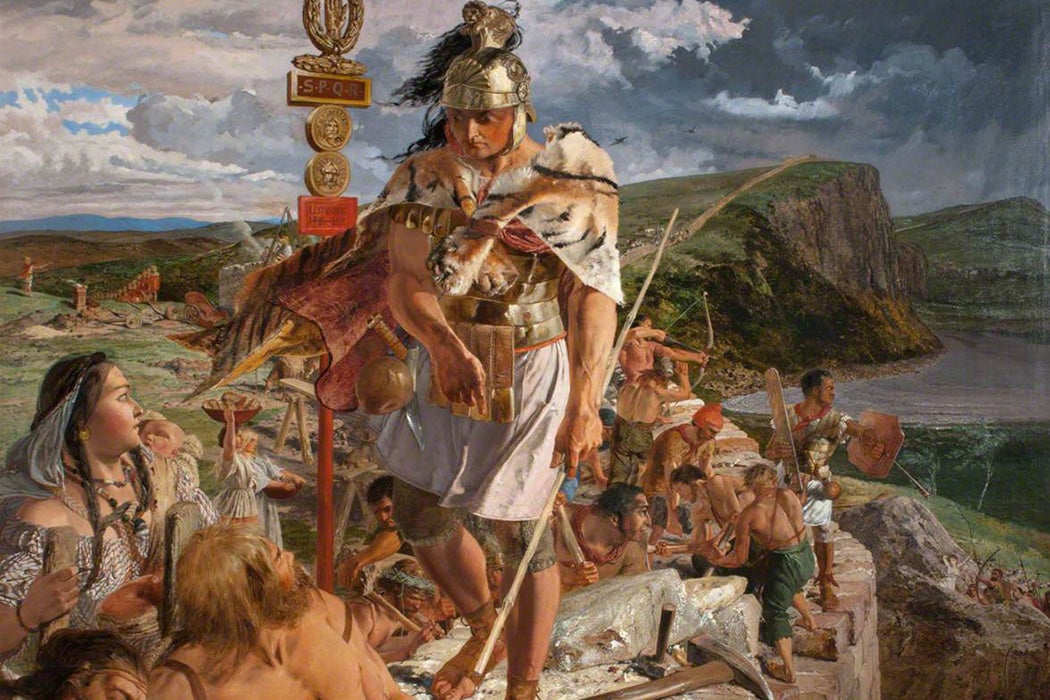
Construction of the stone wall began in 122 CE. It was named after the Emperor Hadrian, who toured the northern provinces of Germany and Britain in 121–122 to consolidate the empire’s frontiers. Hadrian himself likely inspected the wall’s ongoing work.
More to Explore
Ancient Rome: A City of Immigrants
It should be noted that the wall marks neither the English–Scottish border nor the furthest northern extent of Roman Britannia. One hundred miles further north, the Romans built the 39-mile-long Antonine Wall, begun in 142 CE. This structure, at the narrowest part of Britain, was named after Emperor Antonius Pius, Hadrian having died in 138. As an earthwork with a wooden palisade, however, much less of Antonius’s wall has survived the ensuing millennia. The Antonine Wall was abandoned after about twenty years, while Hadrian’s Wall remained the frontier for nearly 300 years, until the demise of Roman Britain in the early fifth century.
Much of the stone used to construct Hadrian’s Wall and its forts and milecastles was recycled over the centuries, but the stone footings largely remain, as do the flanking ditches. The turf construction of the westernmost thirty miles of wall is its least studied section.
“As we know well from the large-scale changes of plan during the construction period, through to the later blocking of some gates at milecastles and forts, the Wall did not have a singular purpose or meaning, perhaps even not for Hadrian himself,” writes Gardner.
Weekly Newsletter
"*" indicates required fields
It does not look forbidding today, but in its time the wall was a “robust boundary—within a broad militarized zone.” It caused significant settlement pattern changes both on the Northumbrian plain and further north into Scotland. “The complex interplay of accommodation and exclusion that is characteristic of borderlands,” was at play in the north of England (and the south of Scotland), just as it is in modern borderlands.
“The mixture of inequality, violence and interaction on the frontier creates local dynamics with far-reaching consequences,” writes Gardner of today’s world, but he is also speaking by analogy of ancient Rome and its far-flung frontiers. Rome defined the frontier, and the frontier defined Rome. The “continual duality of borders” is “not only dividing and fixing, but always also connecting and changing.”




_-_The_Romans_Cause_a_Wall_to_Be_Built_for_the_Protection_of_the_South_-_584365_-_National_Trust.jpg)