Big cities bring together peoples from near and far. Magnets for internal migrants and gateways for immigrants, such places tend toward heterogeneity, with spaces for marginalized communities—a pattern that is not just a characteristic of the modern era.


“Ancient Rome was a city of immigrants,” writes historian Ryan R. Abrecht, “a pre-modern metropolis of perhaps a million people at its height, most of them immigrants or the descendants of immigrants.”
Modern historians overwhelmingly agree that immigration profoundly shaped Rome’s demographics and history, yet some have argued that there was little sense of immigrant community at Rome. In this view, ties between foreigners in the city were weak and mostly ephemeral, even if they shared a common homeland, language or set of religious beliefs.
Abrecht goes on to argue that this was not the case at the neighborhood level, at least in Transtiberim. By the first century CE, the Roman district “beyond the Tiber” had become what we would now call an immigrant neighborhood, a veritable “Little Middle East.”
This district was the heart of Rome’s Jewish and Syrian communities, inhabited for centuries by generations of immigrants from the eastern Mediterranean and their descendants. These residents maintained traditions, languages and customs from home, and participated in civic institutions that helped foster community at the local level.
Founded in the 8th century BCE, Rome was initially confined to the Tiber’s eastern shore. The area west of the river only came under Roman rule in 396 BCE after the defeat of the Etruscans. The west bank was named for its location in relation to the city center. Four centuries later, Augustus incorporated Transtiberim as one of the imperial city’s fourteen administrative districts. In addition to being isolated by the river, Regio XIV was also beyond the pomerium, or religious boundary. This meant unofficial gods—including those of the Jews, Syrians, and later Christians—could be worshipped there. It also meant bodies could be buried there, an important factor for archaeology because of the longevity of funerary inscriptions.
Transtiberim was where “noxious or dangerous industries deliberately kept at a distance from central Rome” were located. These included tanning, glassmaking, potting, milling, brick-making and shipping facilities. All these made the neighborhood vibrant and utterly essential to the enormous city.
To elites, who provide almost all the written documentation except for funerary inscriptions, Transtiberim was dangerous, déclassé, and working class (to use later jargon). Strange gods were worshipped there—worship of the Syrian goddess Atargatis by “cross-dressing eunuch priests” who practiced ritual castration was banned more than once. The neighborhood was mocked in satires and condemned for its “panhandlers, prostitutes and desperate people with nowhere else to go.”
More to Explore
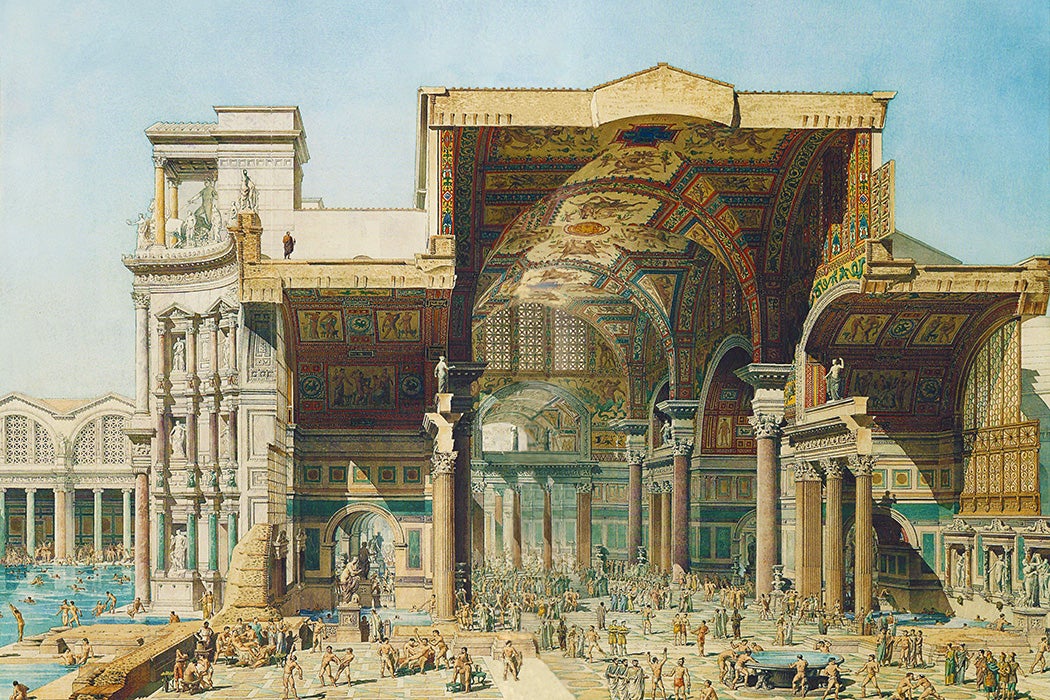
Bread, Circuses, Baths: Bathing in Rome, the Public Way
But the “wrong” side of the river was also home, a community.
Rome’s Jewish community “is one of the oldest in the world, likely originating in the second century BCE.” Unlike in later periods, Transtiberim wasn’t the place Jews were required to live (as in the medieval Venetian ghetto), but as Abrecht notes “there were undoubtedly advantages of living together.” There were also disadvantages: “targeting Jews would also have been especially easy if a large portion of the community was already clustered on the margins of the city.”
“Many Roman Jews came from Hellenized diaspora communities that used Greek for everyday speech,” writes Abrecht. Syrians were also often fluent in Greek. “Ties of ethnicity, language and religion helped the Jews and Syrians of Transtiberim forge social bonds.”
Abrecht explains that the Latin term Syrus was “ambiguous in ancient literature.” It could mean specifically those from the province of Syria (annexed by Rome in 64 BCE) and/or nearby Phoenicia, Palestine, or Arabia. These could be Semitic peoples or descendants of Greek settlers in that region. With intermarriage common, Syrian identity was “fluid and situational.”
Weekly Newsletter
"*" indicates required fields
“The immigrants of Transtiberim managed to carve out places for themselves and their children at the heart of the Roman Empire. In doing so, they helped to expand the idea of what it meant to be residents of the imperial city and, more broadly, to be Roman.”
Transtiberim is known as Trastevere today. Perhaps not coincidental to its history, Trastevere has long been Rome’s bohemian neighborhood. The energetic margins may be condemned by the masters of cities, but cities would not be the same without them.