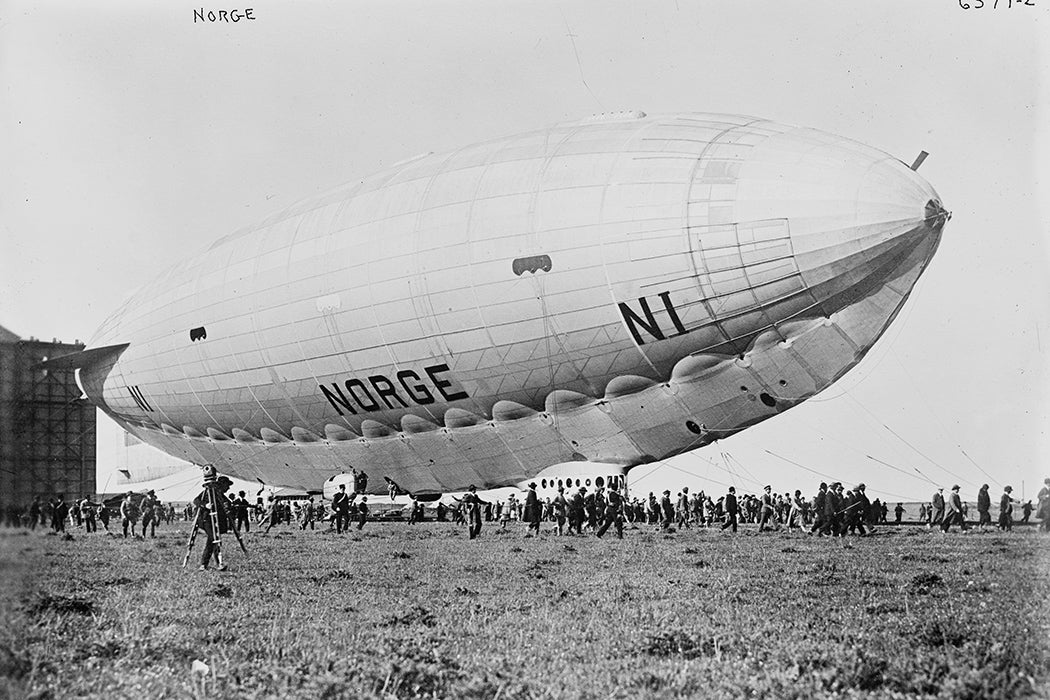
In May 1926, the American Richard Byrd and Norwegian Roald Amundsen both claimed to have reached the North Pole by air. Byrd had used a plane, and Amundsen an airship. Later that year, Russell Owen wrote that “in the short space of three days the mystery which has always surrounded this hitherto blank space on the map of the world was thrown away.” It was the end of an era in the history of exploration, and the beginning of a new, mechanized nationalism.


The harsh polar environment had helped define the “heroic explorer,” as adventurers tested their bodies against nature, seeking national pride and book sales. In the 1920s, they sought new “firsts” on an increasingly complete map. Aviation held promise, historian Marionne Cronin explains, but it also threatened ideas of heroic masculinity. Sitting inside a vehicle, explorers redefined heroism around mastery of machines and self.
Stewart Nelson describes how Amundsen embarked on his 1926 expedition in an airship designed by Italian engineer Umberto Nobile. Italian dictator Benito Mussolini had originally offered to donate the vehicle. Fearing that the Italians would seize credit, Amundsen teamed up with American entrepreneur Lincoln Ellsworth to purchase the airship. Renamed the Norge, it would fly under Norwegian and American flags, with Nobile as pilot.
As they readied the Norge in early May, they received news that Byrd’s plane had just returned from the pole. Amundsen doubted Byrd’s claim, so he and his crew took to the air on May 11, 1926. Early the next morning, Nelson writes, “after battling wind, cold, snow, fog, and frozen water in the engine fuel lines, the Norge reached the North Pole.”
Amundsen and Ellsworth dropped Norwegian and American flags to the ice below. But “Nobile, much to the irritation of the others, unfurled and dropped a much larger flag of Italy,” Nelson writes.
More to Explore
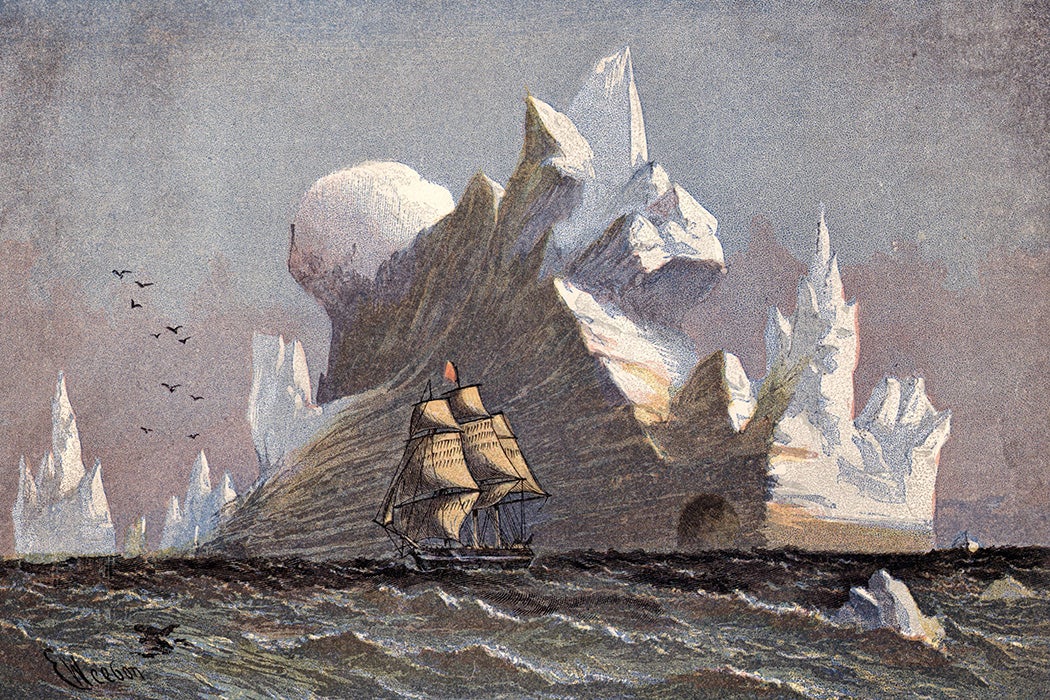
The Open Polar Sea: Myth and Science at the North Pole
Amundsen clashed with Byrd over priority, but he would also have to fight his own crew for acclaim. Nobile played up his role, earning a promotion from Mussolini and a meeting with President Calvin Coolidge. Amundsen was quite upset with his pilot. “In his autobiography,” Nelson explains, Amundsen “devoted 95 pages to attacking Nobile.”
Today, Amundsen’s claim is often recognized. But regardless of who was first, the attempts seemed to herald a new technological mastery over nature. Later in 1926, Owen wrote that “this year will probably be known among explorers as that in which the teeth of the Arctic were drawn.”
Weekly Newsletter
"*" indicates required fields
Sadly, this was not to be. In 1928, Nobile took to the Arctic skies in the airship Italia. Nelson writes that Nobile flew with the support of Mussolini, and with a gift from the pope: “a 2m long oak cross to be dropped at the North Pole.” But in the middle of the expedition, the Italia crashed, triggering a massive international rescue effort. Despite their rivalry, Amundsen joined the effort to rescue his old pilot. It would be his last expedition.
“Amundsen took off from Tromso, Norway in a French flying boat,” Nelson explains, “and was never seen again.”



_LCCN2014719376.jpg)