
Never more than seventeen thousand people, the Shakers are today best remembered for their handsome furniture. In their own time they were renowned for their homemade medicinal remedies. They might have had a dubious reputation for their outlandish dancing, celibacy, gender equality, and for believing that their founder, “Mother” Ann Lee, was a manifestation of Christ’s Second Coming, but their guarantee of purity in their botanical products was generally accepted as given.


So much so that as Shaker communities dwindled through the nineteenth century, others wanted the cachet of their name in the patent medicine world. Amid all the fakery and flimflam of the pre-regulated drug market, the Shaker brand was the best.
It was worth stealing, and defending.
The Shakers, or more properly the United Society of Believers in Christ’s Second Appearing, arrived in North America from England in 1774. They established their first communes in New York and New England, then farther into the continent as the European frontier expanded. Kentucky, Ohio, Indiana, Georgia, and Florida also boasted Shaker outposts, mostly shorter-lived than the original ones.
At first, Shakers funded their separation from the “world” by selling furniture and housewares to non-Shakers. But as the number of Shakers dwindled and America’s industrial capacity increased, Shakers typically turned to selling seeds, simples, and botanically-based remedies. These were easier to produce, and, imbued with the Shaker reputation for purity, were as good as gold.
Medical historian J. Worth Estes quotes an 1881 almanac advertising Shaker remedies on the basic principles of Shakerism:
innocence, temperance, virgin purity, love, peace, justice, holiness, goodness, and truth. The almanac further explained that Shakers are “just and honest in all [their] dealings with mankind,” and that they “eschew every species of falsehood: lying, deceit and hypocrisy.” Such statements helped “guarantee” the purity and high quality of Shaker-made drugs in the nineteenth century struggle for the American drug market.
Shakers provided ingredients for “worldly” producers, and, in some cases, they even provided start-up capital for non-Shaker manufacturers. The A.J. White company of New York, New York, made Shaker Extract of Roots and Mother Seigel’s Curative Syrup with Shaker-sourced botanicals and capital. This remedy was advertised as “a cure for impurities of the blood” and “a cure for dyspepsia and liver complaints.” A.J. White’s company successfully expanded overseas, and when he died in 1898, his English branch bought out his American branch; in various guises the company existed until 1957, when it was purchased by Smith, Kline & French, whose successor entity is today the world’s tenth largest pharmaceutical company.
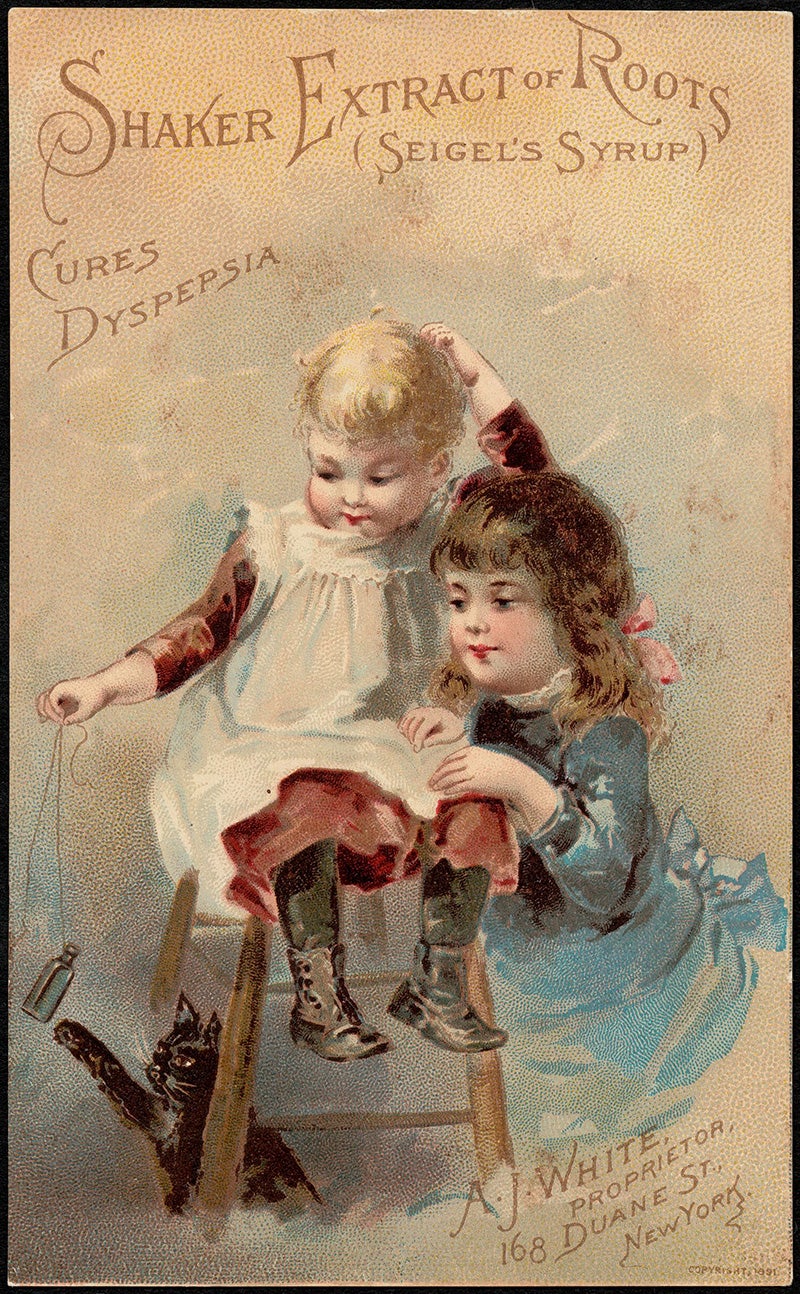
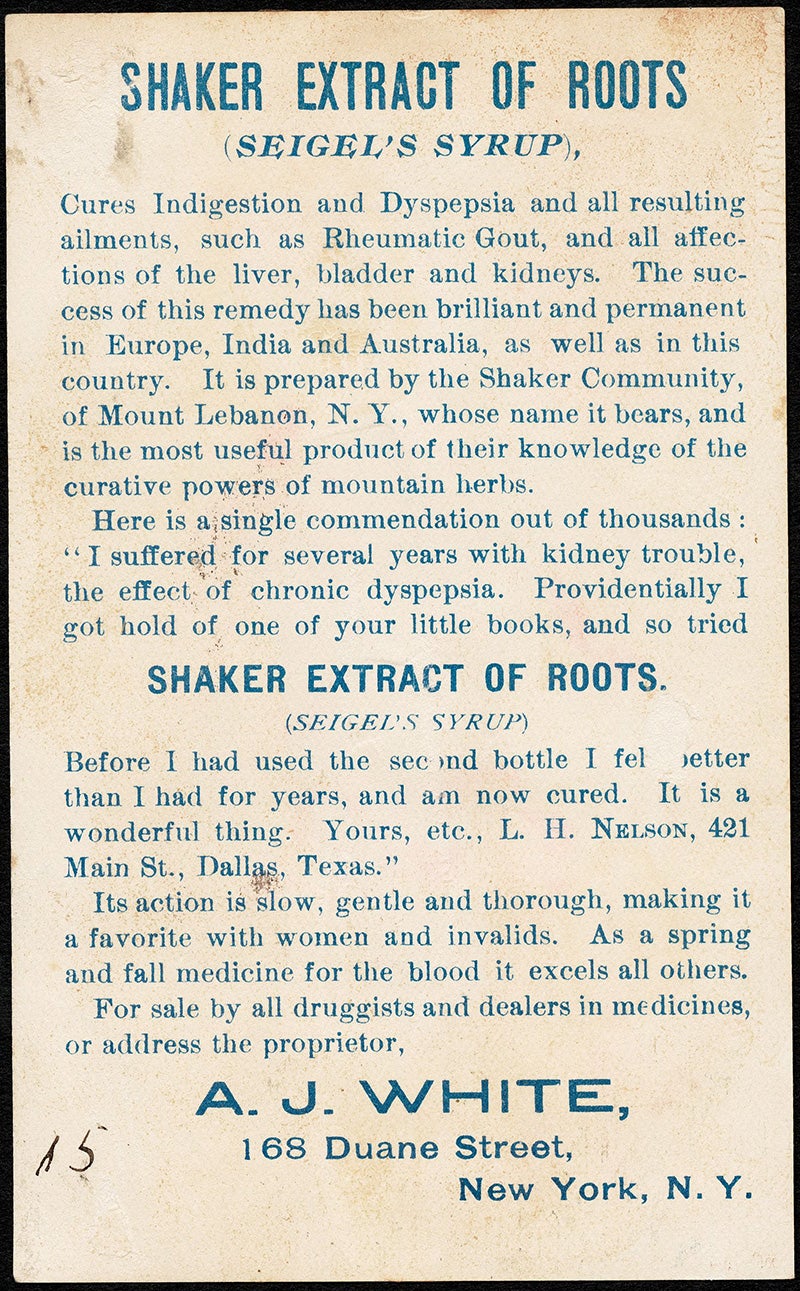
In the 1880s, Smith Bros. & Co. of Montreal started producing a product called Shakers’ Blood Syrup. This had a label similar to A.J. White’s Shaker Extract, except it said “Cures completely scrofula, cancer, rheumatism, catarrh, ulcers & skin & blood diseases.” The Shakers of New Lebanon, New York, sued for patent infringement and Smith Bros. agreed to stop pirating the Shaker name.
More to Explore
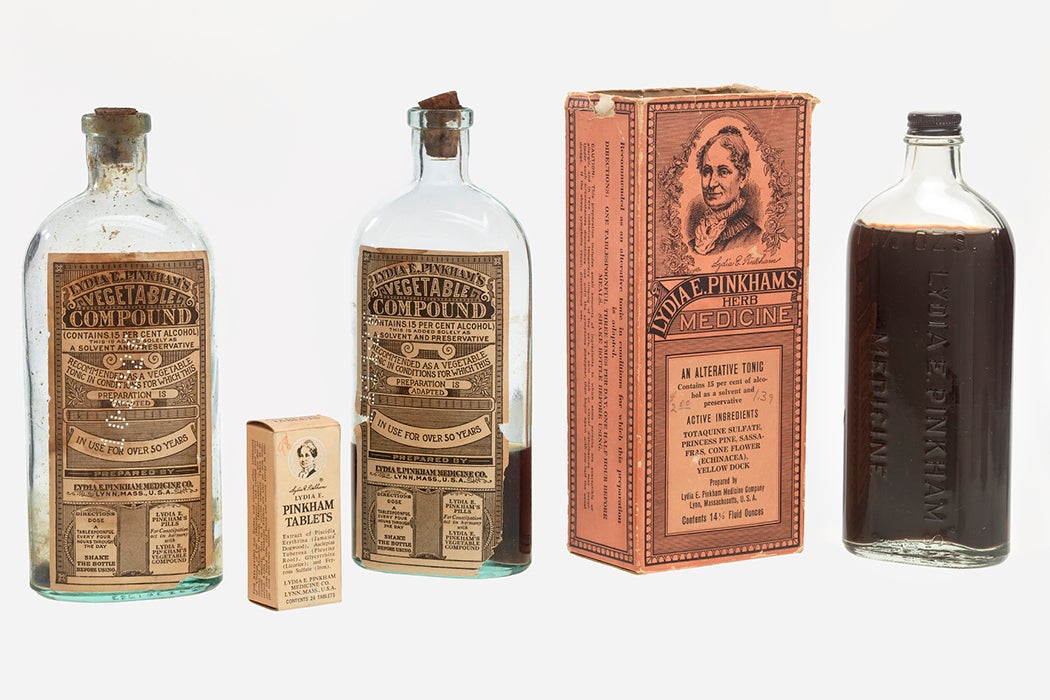
Was Lydia E. Pinkham the Queen of Quackery?
Shakers also produced their own remedies on their communes. Corbett’s Syrup of Sarsaparilla, for instance, was made in Canterbury, New Hampshire for about half a century until 1896. In 1886, it was one of the few Shaker products to be awarded a U.S. patent. Promoted as “a blood purifier and therefore, by implication, as a panacea,” it was made of “an aqueous mixture of sarsaparilla root, pipsissewa, yellow dock root, dandelion, thoroughwort, black cohosh, elder flowers, Epsom salts (magnesium sulfate), juniper berries, blue gentian, pokeweed root, sugar and alcohol.” At some point potassium iodide was added to “ensure the remedy’s ‘purity.’”
Weekly Newsletter
"*" indicates required fields
Estes provides a checklist of some 80 other proprietary medicines made in Shaker communities. The names are marvelous: Brother Barnabas Hinckley’s Compound Concentrated Syrup of Bitter Bugle, Eclectic Live Pills, Larus Eye Water, Vegetable Family Pills, Young Shakers’ Grand Catholicon. As Estes notes, more than a few of these products had active ingredients that were cathartic or purgative, a fact rarely noted on labels. Cathartics are generally defined as working faster than laxatives.
After the Food and Drug Act of 1906, products like the 75% alcohol (sanitizer strength!) Norwood’s Tincture of Veratrum Viride, made by non-Shakers with Shaker-sourced botanical ingredients, had to be labeled “Poison” on their instructions for use. Patent medicines, and the Shakers, didn’t survive the twentieth century.



_cures_dyspepsia_-_DPLA_-_707deda2550635bb6ebf97b8c510e996_(page_1).jpg)
_cures_dyspepsia_-_DPLA_-_707deda2550635bb6ebf97b8c510e996_(page_2).jpg)