In late 2025, word began leaking that progress on The Line, a futuristic project planned for northwestern Saudi Arabia, had stalled. This came as little surprise to many who had followed the wildly ambitious plans for the desert city. As urbanist scholar Federico Cugurullo and geography researchers Isobel Lee and Rebecca Weir found when speaking with people involved in The Line between 2022 and 2024, the project represented a strange mixture of western science fiction aesthetics and authoritarian ambitions.


The Line was planned by a state-owned company led by Crown Prince Mohammed bin Salman, known as MBS. As the name suggests, it was to be shaped like a line running through the desert, with high-tech city buildings extending for a 170-kilometer span and housing nine million people.
Cugurullo, Lee, and Weir place The Line within a tradition of extravagant architecture on the Arabian Peninsula. Starting in the 1930s, discoveries of massive oil resources in the Gulf provided the wealth for experimental projects, seen in the skylines of cities like Riyadh and Dubai. Developers treated deserts, which historically lacked large-scale urban development, as a canvas for new ideas. They often rejected plans incorporating local culture in favor of Western styles seen as more modern. The concept of a linear city goes back to the late nineteenth-century construction of such a modernist urban settlement near Madrid, Spain. Some of that project still survives as part of a suburb of the capital. In the early twentieth century, the Soviet Union attempted similar linear cities.
Cugurullo, Lee, and Weir write that The Line’s design “draws from an imaginary heavily influenced by Western ideals of urban modernity and an aesthetic preoccupation with geometric forms.”
More to Explore

The Politics of Our AI Overlords
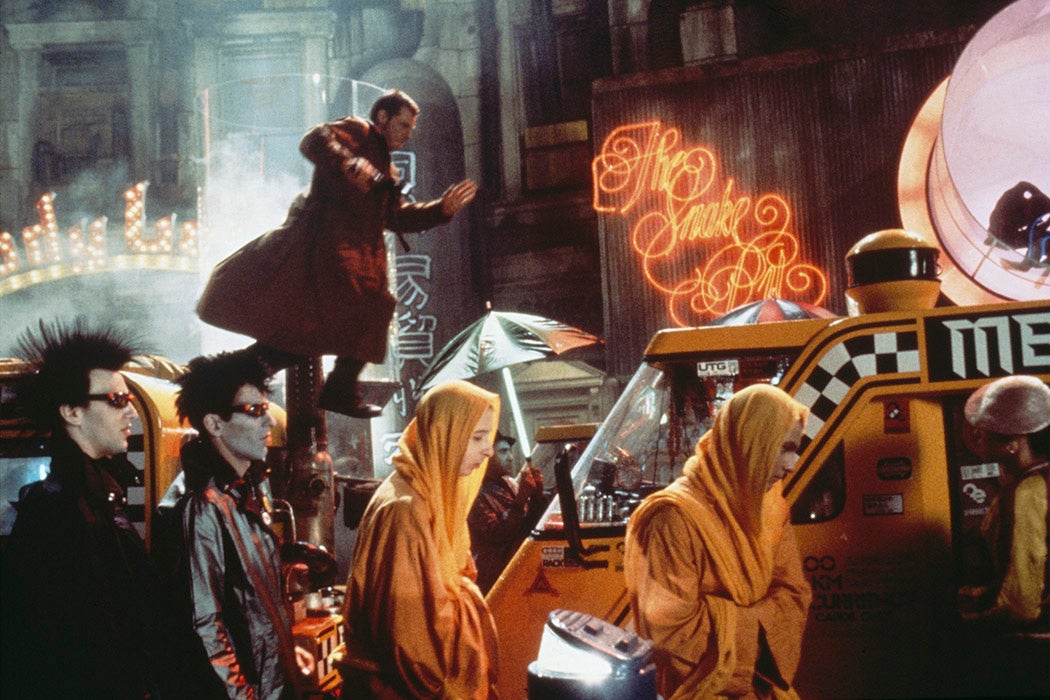
Another influence was cyberpunk fiction. MBS has cited the 1982 movie Blade Runner and its 2017 sequel, Blade Runner 2049, as references for the city’s architecture. Developers also identified the plans with aesthetics such as “desertpunk,” “dieselpunk,” and “solarpunk.” The authors point to the irony in the use of the word “punk”—once signifying countercultural, DIY revolt—for a state-run, centrally planned development that promises to seamlessly fulfill its citizens’ needs.
Plans included a network of robots and autonomous vehicles—such as helicopters designed by the German company Volocopter—all connected to a central AI system called Neos. Many consumer goods for The Line’s residents would be produced at another new city, Hexagon, run entirely by robots. Neos would also algorithmically predict and respond to everything from citizens’ changing meal preferences to criminal acts.
Weekly Newsletter
"*" indicates required fields
In an even more outlandish science-fiction-style plan, the authors write that The Line’s developers envisioned a future in which robots would become intelligent, rights-bearing citizens of the city. In fact, in a 2017 stunt, Saudi Arabia officially granted citizenship to a robot called Sophia. The authors note that this is especially strange since the country typically only allows Muslims to become citizens.
With the news that The Line is being largely abandoned, what remains of it is reportedly being repurposed for a more immediate technological need: a hub for data centers.