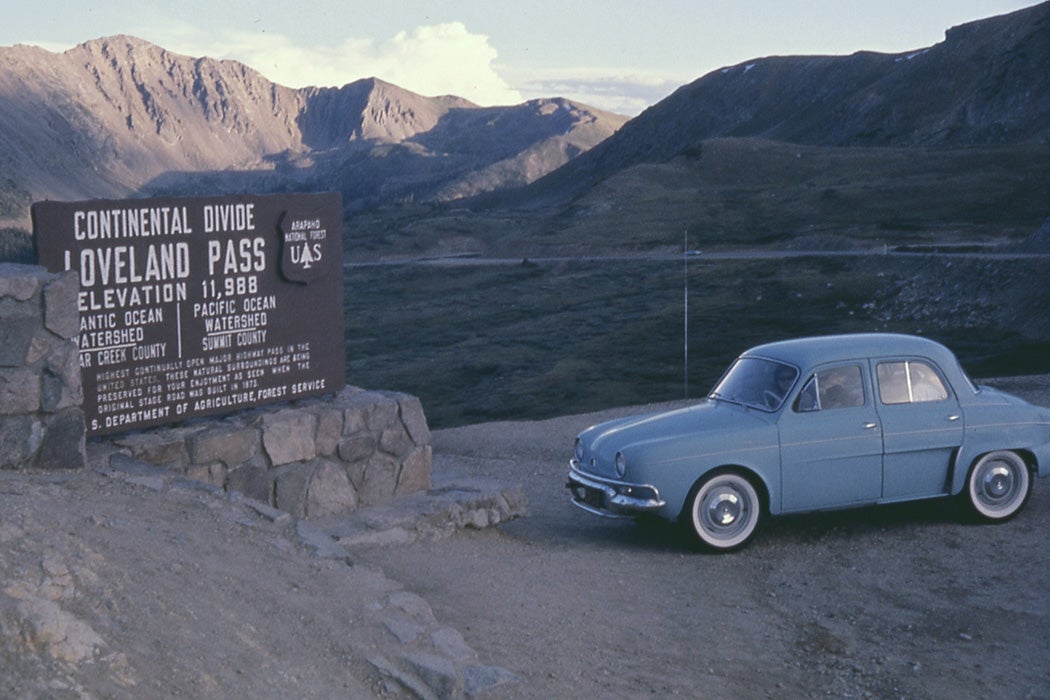
The Continental Divide is the hydrological boundary between watersheds that drain into the Pacific and those that drain into the Atlantic. It runs from the Bering Strait in Alaska to the Strait of Magellan at the tip of South America, dividing the west from the east along the mountainous (the Rockies, the Andes) spine of the Americas. And like so many things in the Americas, it’s the U.S. portion that gets most of the attention.


There are other hydrological divides in North America, including the Laurentian, the St. Lawrence, and the Eastern, but the Continental Divide is the famed one. This despite the fact that much of the continent’s fresh water drains north into the Arctic or south via the Mississippi. Decades before the Civil War, in fact, the continent was thought of either as a sort of pyramid, with rivers flowing in all cardinal directions from the center, or as divided between “two vast regions, one sloping toward the pole, the other toward the equator” as de Tocqueville put it in Democracy in America (1835).
Historians James D. Drake writes that another curious thing about the Divide is that “much of the water flowing off the west side of the Rockies simply has no chance of making it to the Pacific” because of the Great Basin sandwiched between the Rockies and the Sierra Nevada.
But it was the idea of a Continental Divide between the Pacific and Atlantic Oceans, between west and east, that became renowned. This, Drake argues, was not unintentional.
“The knowledge of western hydrology provided by John C. Frémont’s expeditions in the 1840s may have been revelatory,” Drake writes, “but it proved insufficient in creating the Continental Divide as a geographic icon known to most Americans.”
The divide became wildly celebrated in national lore only in the 1860s. It emerged as a monument to the memory of the Civil War; its creation was a molding of the natural world under unique historical circumstances into a political statement of rebirth and unity—a political statement that has since been naturalized and lost to visitors.
What is assumed to be a natural feature that “transcends human history” is actually a product of human history. “Human imagination is intrinsic to its existence,” writes Drake.
The national identity crisis precipitated by the Civil War led many Americans to see North America as having a natural divide, in contrast to an unnatural political division such as that which had just torn the nation apart.
Instead of North-South conflict, which had taken such a terrible toll, there would be a West-East divide that could be surmounted and conquered “to promote union.” Instead of a divided nation, a whole American continent—never mind that Canada is actually slightly larger than the United States or that Mexico is also a part of the continent.
More to Explore
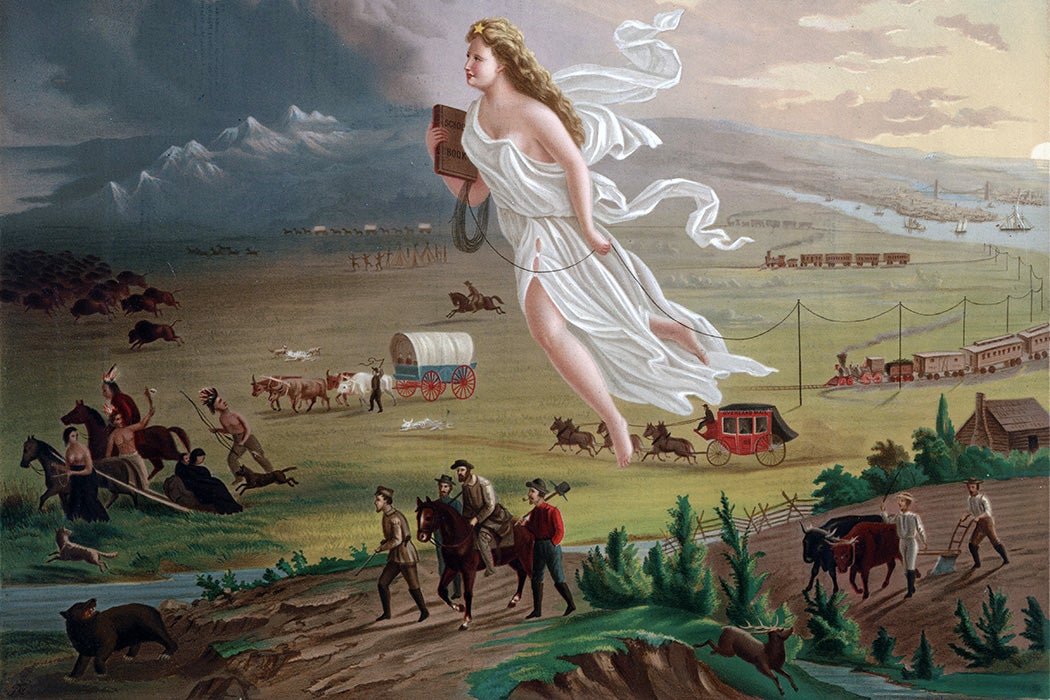
The Myth of Manifest Destiny
It was the railroad that symbolized the unification across the Divide of a nation “from sea to shining sea,” as Katherine Lee Bates put it in “Pikes Peak” (which became the lyrics to “America the Beautiful”) in 1895.
Weekly Newsletter
"*" indicates required fields
“An unprecedented engineering feat, the transcontinental railroad’s construction reflected and reinforced the healing process in the aftermath of the Civil War,” Drake writes. Nine months before the ceremonial spike was driven at Promontory Summit in Utah Territory, the Union Pacific Railroad ceremonially marked the spot where the tracks crossed the Continental Divide 164 miles west of Laramie, Wyoming. After this August 1868 event, use of the term “Continental Divide” “rapidly spiked.” (Drake cites a database of Rocky Mountain travelers’ descriptions, the Oxford English Dictionary, and a search through Google Books for the earliest mentions of the term.)
“As later with the West’s national parks, the Continental Divide served as a sacred site in the nation’s civil religion. Before Yosemite, it was a place to be visited and venerated, one that exemplified the trinity of God, nature, and nation.”
One modern version of this veneration is the selfie, often taken at the signposts marking the Continental Divide. Without those markers, after all, the boundary would be invisible. Like the idea of the Divide itself, its significance depends on being pointed out.