Farming is one of the great success stories of automation: over time, the need for manual labor has dropped dramatically. Yet, as historian J.L. Anderson writes, over the past 80 years, the dwindling need for muscle on farms has coincided with increasing depictions of masculine strength in advertisements targeting farm markets.


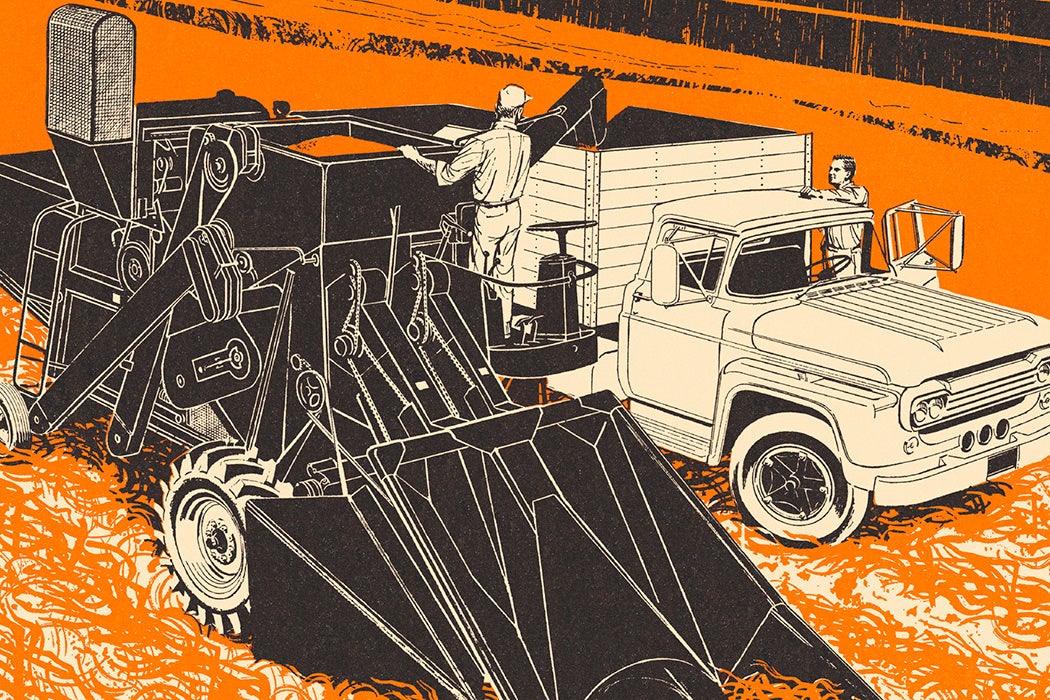
Anderson argues that rising automation following World War II produced two images of farmers. One, epitomized by cartoons in the farm press, used space-age imagery to depict a technologically savvy farm owner running the operations with the push of a button.
The second image was the “farmer in a business suit,” as described in Farmer in a Business Suit, a 1957 book co-written by an assistant secretary of agriculture in the Eisenhower administration. The book traces the fictitious Yeoman family’s evolution over generations from self-sufficient homesteaders to participants in global markets. In the new “Agribusiness Era,” farmers were expected to study accounting and management and focus on profitability.
These images were certainly male-coded in their depiction of technological and business prowess, but they downplayed physical strength.
Soon, though, advertisers and media shifted toward a brawnier form of male power. Anderson suggests that the shift coincided with a new Cold War-era masculinity characterized by “tough on communism” rhetoric and anxieties about physical fitness among the nation’s boys.
One 1960 International Harvester ad featured a giant man standing above a farm with the tagline “You’re a bigger man with an IH tractor.” Similar drawn illustrations of oversized, muscular farmers dominated ads for farm products through the 1970s, although Anderson notes they were often positioned alongside photographs showing real, life-size farmers.
The decades that followed brought new worries about masculinity related to the decline of the family wage and the male breadwinner. For farmers, meanwhile, the 1980s were a time of collapsing commodity prices and super-high interest rates, leading to widespread foreclosures and even more widespread fear.
More to Explore
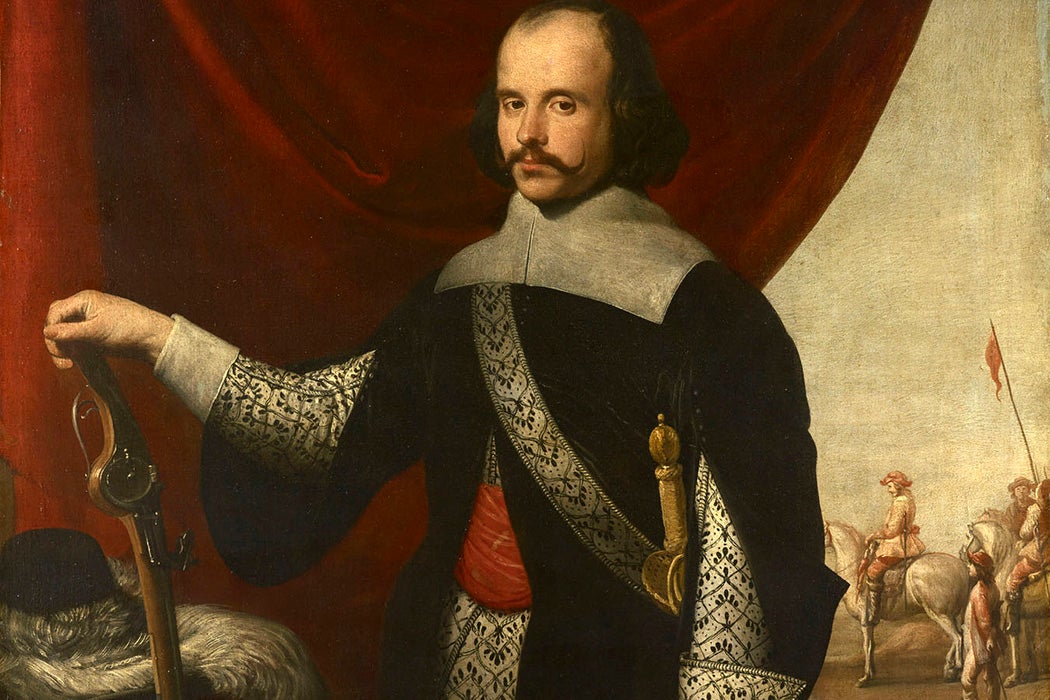
Nostalgia for Manly Men in Seventeenth-Century Spain
In this era, Anderson finds that photographs became more dominant, but now they often used models to portray idealized, physically strong farmers. A 1983 Lasso herbicide ad provides an example of the transition—one page shows a beefy model, while the facing page has photos of real farmers with testimonials.
“The real farmers were a mixed lot of size and shape, but clearly just folks,” Anderson writes. “By the millennium, it was difficult to find the everyday people of farm country in advertisements.”
Perhaps not coincidentally, by the millennium, the number of farms operated primarily by women was rising and women were increasingly active in everything from driving tractors to advocating for farmers’ interests.
Weekly Newsletter
"*" indicates required fields
“As the number of women in agriculture grew, they remained largely invisible in farm advertisements, and men’s bodies in those advertisements grew bigger,” Anderson writes.
Today, the reality of farming is very much about technology and business, just as postwar experts envisioned. And Anderson argues that it’s this movement away from physical labor that has encouraged the increasingly muscly images of farmers in advertising.