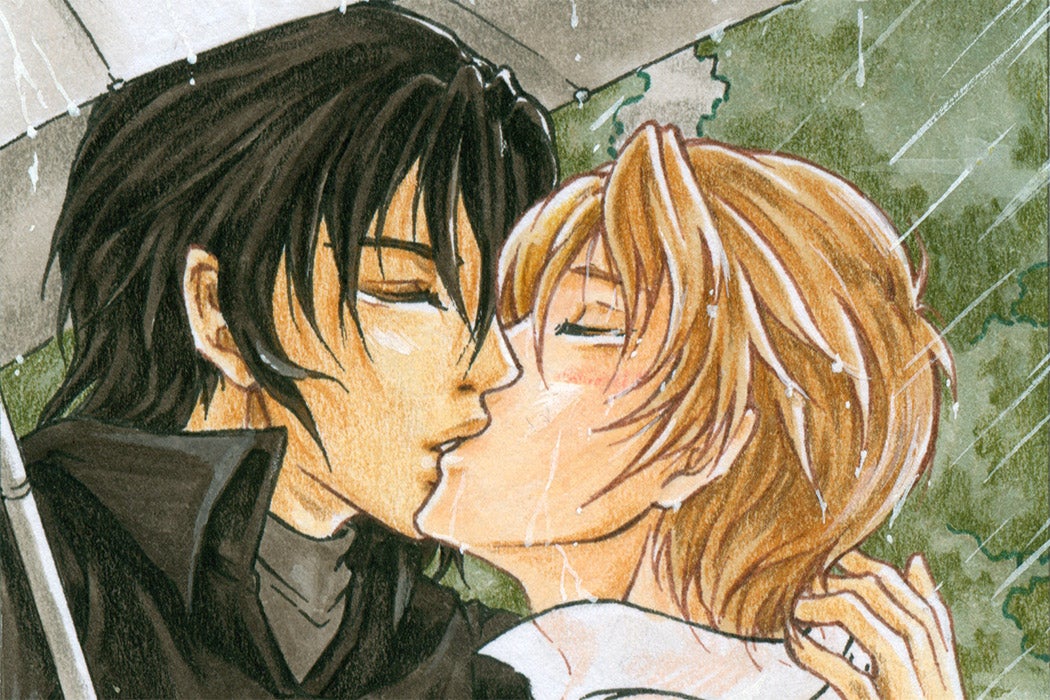
In Mexico, anime and manga aficionados (frikis, as they are known in Spanish) can browse multi-story malls with names like “Frikiplaza” and “Pikashop.” Yet fans of the homoerotic “boys’ love” genre often find these shopping centers less welcoming than they appear.


A Japanese publishing industry term introduced in the 1990s, “boys’ love” describes the male–male romantic fiction created by women for female audiences beginning in the 1980s. Other labels, including the catch-all yaoi and the subcategory shonen ai, are also widely used.
The genre is notable for originating in an almost exclusively female creative milieu, since women make up most of the writers, comic-book artists, readers, and editors.
While stores may carry books and other products in the boys’ love genre, the largely female fanbase does not always feel comfortable browsing this section. Researcher Mirna Montserrat Díaz López notes that, “due to homophobia, some… keep their tastes secret and are somewhat hesitant to speak about them.”
Even so, boys’ love fans have built thriving communities around the genre, hosting large-scale gatherings since the mid-2010s. The hundreds of booths at these events offer not just translations of Japanese manga like My Brother’s Husband, or sexually charged fan-made comics, but also original Mexican comics.
Such fan events, held in cities such as Monterrey and Mexico City, are just one example of how the genre has evolved both in and beyond its native Japan.
Despite criticism that yaoi exploits gay male storylines for commercial ends, critic Akiko Mizoguchi argues that the genre offers more than homophobic titillation. Instead, she compares it to a “‘lesbian separatist’ space,” especially as she herself “‘became’ a lesbian via reception, in my adolescence, of the ‘beautiful boy’ comics of the 1970s.”
Scholars have also pointed to the genre’s fluid depictions of gender and sexuality. As James Welker observes, the “beautiful boys” who populate many of these graphic narratives often occupy an ambiguous gender space.
“[I]t only takes an older boy or an adult male to enter the scene for either of the more masculine boys to be instantly feminized,” he writes. “Conversely, the rare presence of a female, particularly if she is decked out in a frilly dress with her hair in ringlets, emphasizes the masculinity of the beautiful boy.”
For Welker, such shifting presentations of gender help explain why boys’ love can function as a kind of lesbian storytelling, as “identification with the beautiful boy offered an opportunity to explore sexual and gender options.”
More to Explore
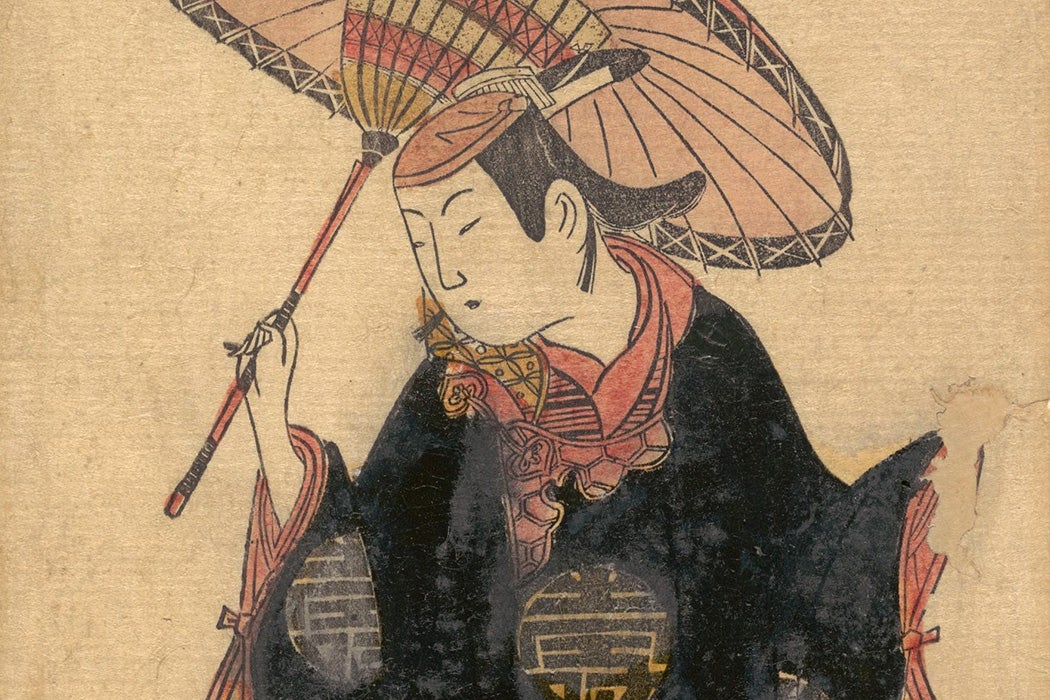
The Disappearance of Japan’s “Third Gender”
As the genre enters new fan spaces worldwide, its boundaries continue to shift. In Thailand—where cultural concepts of gender and sexuality do not map readily onto Western equivalents—the development of a boys’ love television drama marks a form of hybrid story that combines Thai and Japanese expectations, argues Thomas Baudinette.
Focusing on the relationship between two male high school students, the 2014 show Lovesick adapts the heterosexual norms of the popular Thai lakhon serial to create a new genre—dubbed “series wai,” from yaoi—that directly targets Japanese boys’ love fans.
Baudinette describes Lovesick as a “strategically ‘glocalized’ form of Japanese [boys’ love] that is rendered appropriate to the Thai mediascape.”
Even as it follows a blossoming relationship between two young men, Lovesick contains heterosexual sub-plots and features women in prominent roles. The series also breaks with boys’ love conventions by leaving the couple’s romantic dynamics deliberately ambiguous.
Such changes help accommodate Thai viewers who are familiar with lakhon but less accustomed to boys’ love narrative tropes. As Baudinette writes, “Lovesick’s specific education of its audience (especially young heterosexual women) to read male-male relationships in lakhon differently… represents a queering of the normative representations of sex and gender within lakhon.”
Weekly Newsletter
"*" indicates required fields
Thai women are not the only viewers whose perspectives have shifted through engagement with boys’ love narratives. At one yaoi-focused gathering in Mexico City, Díaz López overheard a female participant declare, “I want to dominate that boy” (quiero dominar a ese chico).
“This is the kind of open expression of female sexuality that runs counter to Mexican norms that spaces like this make possible, or at least easier,” Díaz López explains.
“In addition to demonstrating different forms of love and sexuality as normal, [yaoi fandom] empowers female fans in general by giving them space to share their emotions and desires, allowing for a kind of personal growth forestalled by the conservative Mexican patriarchy.”
Noting the central role of Japanese women in yaoi culture, critic Akiko Mizoguchi argues that “understanding the history and the different aesthetic conventions of each subgenre of yaoi and their interrelationships is crucial to a productive discussion of the phenomenon as a whole.”