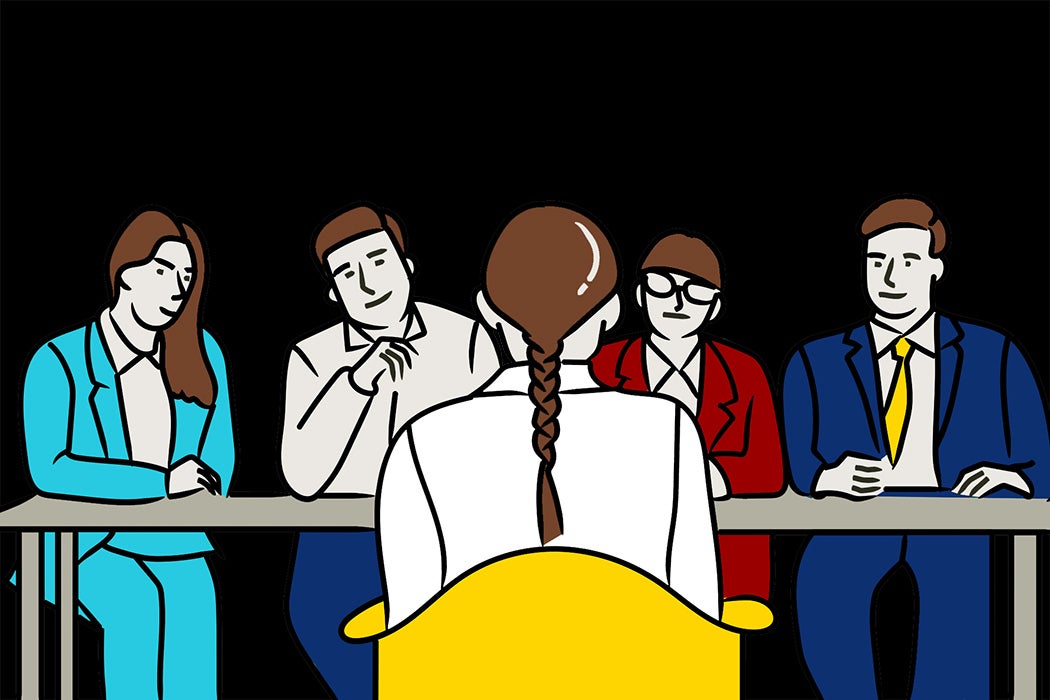
It’s peak graduation season in the US and much of Europe, which means only one thing: employment. If, like many, you’re a soon-to-be graduate, you’ve probably already started to battle with the employment market. Speaking from personal experience, there’s something intrinsically intimidating about being silently judged by an accomplished HR representative over a pixelated Zoom call.


Applicants may feel they have covered every base: using ChatGPT to make a CV “more professional,” buying an extra-special interview tie, even memorizing the boilerplate “company values.” They may present the perfect balance of substance and style. Yet some candidates still struggle to land a job. Is there something that’s not quite perfect?
Unfortunately it’s possible that there is. And it’s been staring back at them every time they look in the mirror: their face.
Many are familiar with “pretty privilege,” the idea that attractive people are perceived as more competent, intelligent, and responsible than those less facially gifted. Far from being an urban myth, the idea was already well supported by 1995, when a meta-analysis of over 100 studies found that pretty privilege is real (and, interestingly, even bigger for men than women).
To make matters worse, newer research suggests that this effect is global, suggesting that the bias is widespread across cultures.
A recent large cross-cultural study examined the “pretty privilege” effect across 45 countries and 11 world regions. Using a sample of almost 12,000 participants, researchers asked people to rate 120 neutral, passport-style facial photographs. Each face was evaluated on a scale from 1 (not at all) to 9 (very) for one assigned trait, both positive—caringness, confidence, emotional stability, intelligence, responsibility, sociability, trustworthiness, dominance and, crucially, attractiveness—and negative—aggression, meanness, unhappiness and weirdness. Importantly, the 120 faces were equally balanced across ethnicities and genders, with 30 Asian faces, 30 White, 30 Black, and 30 Latinx. In each case, half were male and half were female.
More to Explore
Love Is Blind … but Are Your Hormones?
The researchers found that faces that were rated as more attractive were rated more highly across all positive traits—not just competence, but intelligence, responsibility, and other traits—and were rated lower on all negative traits. So, it seems a pretty face really does make a candidate appear competent across a range of traits.
But what does that mean for graduates who can’t even get past the Zoom interview?
Unfortunately, the findings aren’t very encouraging: research indicates that before candidates have even opened their mouths, the interviewer has already unconsciously decided—at least partially—how intelligent, trustworthy, and responsible (among other traits) they are. The role of inherent genetic variation may be more influential than commonly assumed. Judgments are made quickly, making first impressions paramount. This might help explain why it can sometimes feel like some people get all the luck, while others see opportunities pass them by.
Weekly Newsletter
"*" indicates required fields
But don’t despair: even for those less advantaged by these biases, other factors remain significant. When we look at the traits most susceptible to the pretty privilege effect, attractiveness explains only around 60% of the differences between individuals in terms of their perceived intelligence, trustworthiness, and confidence. This indicates that substantial variation remains attributable to other factors within an individual’s control.
In addition to presentation, candidates should continue strengthening their résumés and building relevant experience. Whatever employers are looking for in these turbulent times, it’s not just a pretty face.