At the center of the bucolic French Atlantic commune of Moustey, nestled in the rolling green hills of Nouvelle-Aquitaine where the country abuts Spain, there stands a picturesque twelfth-century Romanesque church of Saint-Martin. Small and simple, the church’s red-tiled roof and whitewashed stone walls appear similar to those of any number of other charming sanctuaries throughout southwestern France.


Going around to the side of the Saint-Martin de Moustey, a visitor might find, beneath one of the stained-glass windows, an unremarkable arched doorway, bricked up centuries ago and painted over. It sits beside a yard overgrown with stinging nettle and creeping buttercup, but its former status as an entrance of sorts is still clear.
As distant from the central doors of the church as is possible, it would be easy to assume that this bricked-up passageway might have been an old receiving portal or service entrance. In fact, the door served neither purpose. Instead, it was a separate entrance for a hated and despised minority who dwelled in Moustey, as well as throughout the rest of the Landes region and into the Basque country of Spain. They were known as the Cagots.
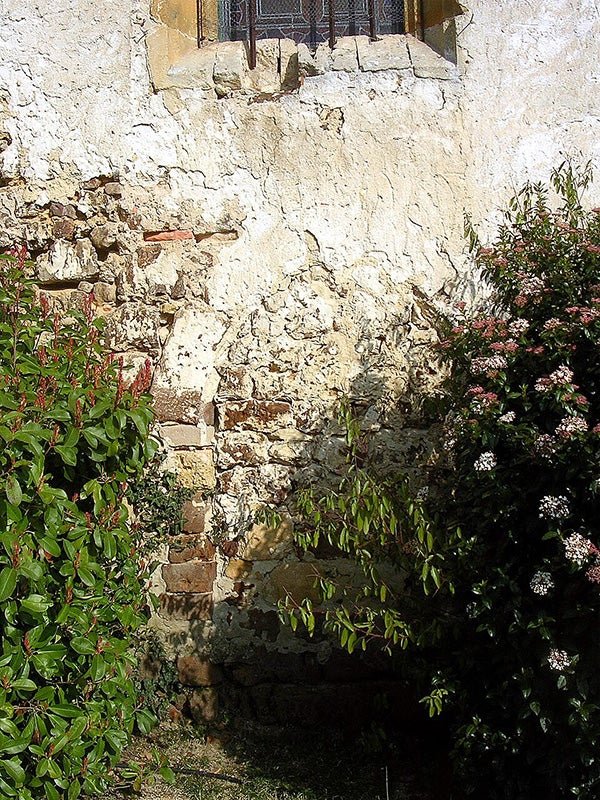
Spurned and reviled, when the Cagots came to Mass at Saint-Martin (for they were Catholics), they were required to enter into the church through this distant entryway and to worship in a segregated section of the sanctuary. They also received holy water through separate fonts lest their mere presence contaminate the purity of the sacramental fonts that can still be seen today.
Weekly Newsletter
"*" indicates required fields
Now the Cagots are largely forgotten, even in France and Spain. Perhaps a surname survives here or there, or the residual architectural evidence of their persecution remains visible beneath paint and brick. Yet they offer an instructive lesson about the irrational nature of bigotry. In some sense, the hatred the Cagots faced represents persecution in its most distilled form.
When it comes to the issue of difference, D. Hack Tuke in an 1880 issue of The Journal of the Anthropological Institute of Great Britain and Ireland noted that “I have been unable to obtain any evidence which marks the Cagots out as a people distinct from the surrounding inhabitants.” No marker of race, ethnicity, or religion differentiated them; aside from their inherited designation of Cagot, they were indistinguishable from the French and Spanish among whom they lived.
Regardless of the lack of justification, the effects of anti-Cagot bigotry were horrific. The nineteenth-century British novelist Elizabeth Gaskell, author of North and South, provided one of the few English-language sketches of the Cagots just as liberal reforms ensured that they functionally ceased to exist as a separate persecuted community. She recounts in her 1855 story “An Accursed Race” how, around 1700, a soldier in Brittany punished a Cagot who drew holy water from a prohibited font. She writes that the soldier “cut off… [the Cagot’s] hand, and hung it up, dripping with blood, as an offering to the patron saint of the church.”
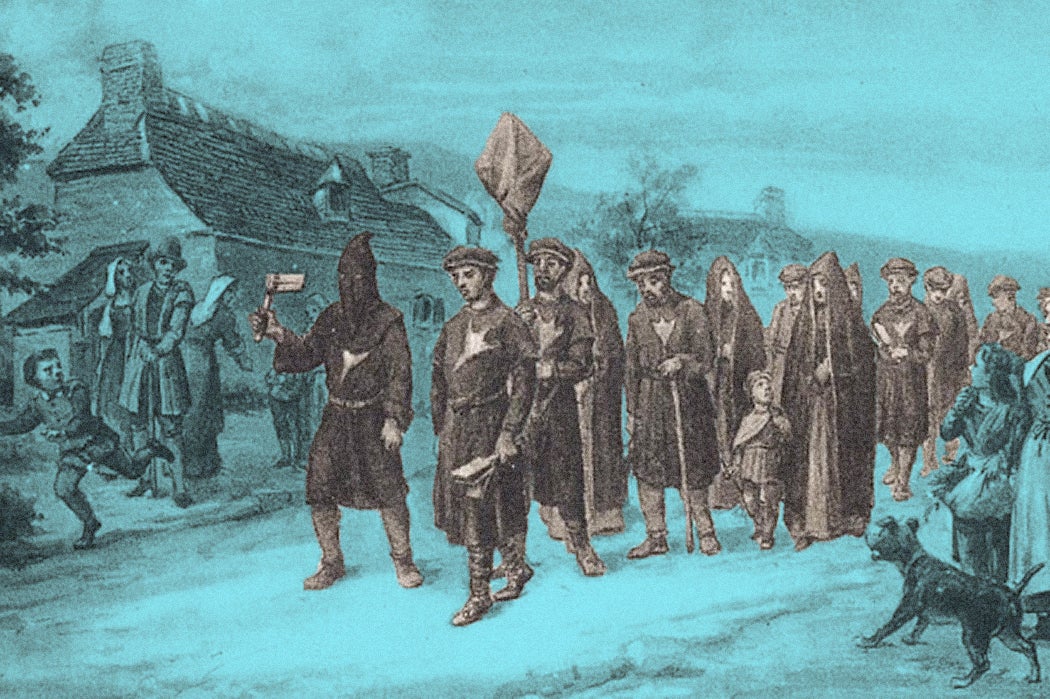
Lurid though that particular anecdote may be, and others Gaskell provides—such as one in which rebelling Cagots murdered oppressive town officials and used their heads as balls in an impromptu game of soccer—their daily persecution was no less unjust for being more prosaic. Cagots were relegated to distinct ghettos in towns and villages, and were mandated to dress in a particular manner to announce their separate identity. All had to wear a badge featuring a red symbol in the shape of a duck’s foot. They were only allowed to marry within their own community, and when that restriction loosened, anyone from outside who married into the group was recategorized as a Cagot. They were also limited to certain professions, including carpentry, rope-making, masonry, and tiling.
As an anonymous writer in an 1870 edition of The Catholic Telegraph notes, the persecution of the Cagots was “not only a popular prejudice; the law consecrated and set its seal about this inconceivable act of barbarity,” whereby they were “legally separated from the human species…[for] they could not devote themselves to any profession, nor live by any peaceful or congenial occupation, nor mingle their blood with that of a society which regarded them as objects of horror.” Much of the treatment of the Cagots echoes that of other scapegoated medieval minorities, such as various Christian heretical groups and, of course, the Jewish community; however, historians have been unable to identify even a spurious justification for their treatment.
More to Explore
A Mother Superior’s Demons
Naturally there has long been an interest in understanding why the Cagots were such a despised minority. Various hypotheses have been proffered as to an assumed original identity. Noting that in 1517 the Consul of Navarre had declared that discourse between Cagots and “other Christians was very dangerous and transmitted contagion,” Emma Wilby observes in Invoking the Akelarre: Voices of the Accused in the Basque Witch-Craze, 1609-1614 that the group was “Often associated with lepers.”
Certainly an epidemiological justification for their exclusion, or at least an association with disease, was explicit in the codes against Cagots. These ranged from their separate fonts for holy water to the long spoon on which a priest would offer them the eucharist so that he could avoid getting too close to them. Yet this imputation of disease appears based more on fantasy than reality. Even physiognomically, sources contradict one another as to whether—or how—the Cagots differed from other residents in the Pyrenees. An 1866 article in The Anthropological Review describes them as being “deeply bronzed, with crisp wooly hair, grey eyes, and high cheekbones,” while The Catholic Telegraph claimed that the “only signs which served to distinguish them from the southern population were their weak and blueish eyes, their pale complexions, and their long light hair.”
The origin of the Cagots is also contradictory. G.W. Dasent and C. Haughton Gill in an 1872 issue of The Journal of the Society of Arts offer an etymology of “Cagot” as being “a corruption of Cams Golhicus, ’dog of a Goth,’ [which] was applied to the descendants of the warriors of the great Alaric, who once had filled all southern Europe.” Six years later, C.F. Keary in The Numismatic Chronicle and Journal of the Numismatic Society proffers an opposing explanation, explaining that the name of the group “may have been applied to the Saracens as expellers of the Goths.” Other sources claim that the Cagots were not descendants of Iberian Muslims, but rather that they had originally been Jewish. Meanwhile, Wilby noted that the Cagots “endured a long-standing association with heretics,” with members of the community themselves claiming to be connected to the Cathar heresy of twelfth-century Provence. However, references to the Cagots predate that period, and the heresy was never present in Navarre. The Anthropological Review suggests a Cagot origin almost diametrically opposed to their supposed beginnings amongst heretics, noting that some claim they are the “descendants of Christians of the primitive Church persecuted and driven into the hills.” Ironically, they were persecuted by the descendants of their pagan tormentors, who had themselves subsequently converted to Christianity.
More idiosyncratically, Graham Robb recently conjectured that the Cagots were related to Medieval guilds associated with woodworking, rope-weaving, and masonry, which had run afoul of civil authorities and had been punished long after anyone remembered what the original indiscretion that merited such treatment may have been. Regardless of the proliferation of potential explanations, none of them have any supporting evidence beyond the flimsiest of associations or coincidences, which is to say that a millennium after they appear in the historical record, we still don’t know why the Cagots were persecuted, much less who they were. Indeed, as Gaskell observed, they “were not easily distinguished by casual passers-by from other men [and because of this] were compelled to wear some distinctive peculiarity which should arrest the eye.” Were it not for the red tunic and the mark of a duck’s foot, nobody would even know that you were a Cagot.
As the history of racism demonstrates, perceived difference need not be real to have an effect on the material realities of a community. By every criterion listed in journalist Isabel Wilkerson’s Caste: The Origins of Our Discontent, the Cagots could be classified as a type of “untouchable.” Their persecution was justified by recourse to divine will; their status was heritable; intermarriage with them was prohibited; the rhetoric of impurity was used to describe the community; they were limited to circumscribed professions; association with them carried stigma; the majority viewed themselves as inherently superior; and they were controlled through the threat of cruelty (think of that hand nailed to the door, skeletal by the time Gaskell saw it). The Cagots were, as Ibrahim K. Sundiata writes in CASTE: A Global Journal on Social Exclusion, “an inferior untouchable caste,” arguably among “‘The Last Untouchables in Europe,’” whose status was not dissimilar to that of the Dalits in India. Gaskell’s writing is the rare source in English to address the Cagots, though they also appear as a plot point in Rachel Kushner’s recent novel Creation Lake. The bulk of what does exist dates to the nineteenth-century, and the suffering of this forgotten group remains as obscured as a stooped doorway in Moustey.
Shirley Foster, in The Gaskell Society Journal, argues that the author’s purpose was to provide a “deconstruction of this superstitious racism, which is historicized as cruel and irrational prejudice.” The Catholic Telegraph similarly observes that the Cagots were “guiltless of angst that should have subjected them to an expiation so long and terrible.” Their persecution, lacking even a pretense of justification, underscores the irrationality of such hatreds: if prejudice against the Cagots was baseless, so too was hostility towards more visibly obvious religious or racial minorities.
Tuke writes that “it was not until the time of the French Revolution that their unhappy lot was greatly ameliorated.” Revolution’s universalizing philosophy of liberation, similarly responsible for the Jewish emancipation during the eighteenth century, was integral to the Cagots’ freedom, suggesting the kind of ideological shift required to exorcize such bigotry. And yet, as Tuke observes, even in the nineteenth century, “a remnant of the old stigma” remained, so that across Brittany, Navarre, and Landes a “certain number of families belonging to the race, hitherto regarded as infamous and accursed… are still living under the stroke of a kind of blight, imposed… by public opinion.”
Reference to the group as a living community dwindled in the twentieth century, a tragic consequence of the fact that persecution had been the only ingredient sustaining the group’s cohesion and identity. What exactly Cagot culture was like—for any community ostracized and separated for so long must have developed its own unique attributes—is now lost to history. Any lessons the Cagots would have had to teach us about survival and endurance remain unlearned. Ironically, the only permanent evidence of their culture lies in the architecture of exclusion, expressed in a segregated font or a bricked-up doorway. The Cagots themselves, as skilled craftsmen, were the builders of many of the churches across the Pyrenees, which had built into their very foundations the inequity of their contractors’ treatment. Churches in which the Cagots would sit and hear a priest intone from Galatians that there is “neither Jew nor Greek… bond nor free… male nor female: for ye are all one,” before serving them communion upon a long spoon lest he be contaminated by his own parishioners’ supposed impurity.