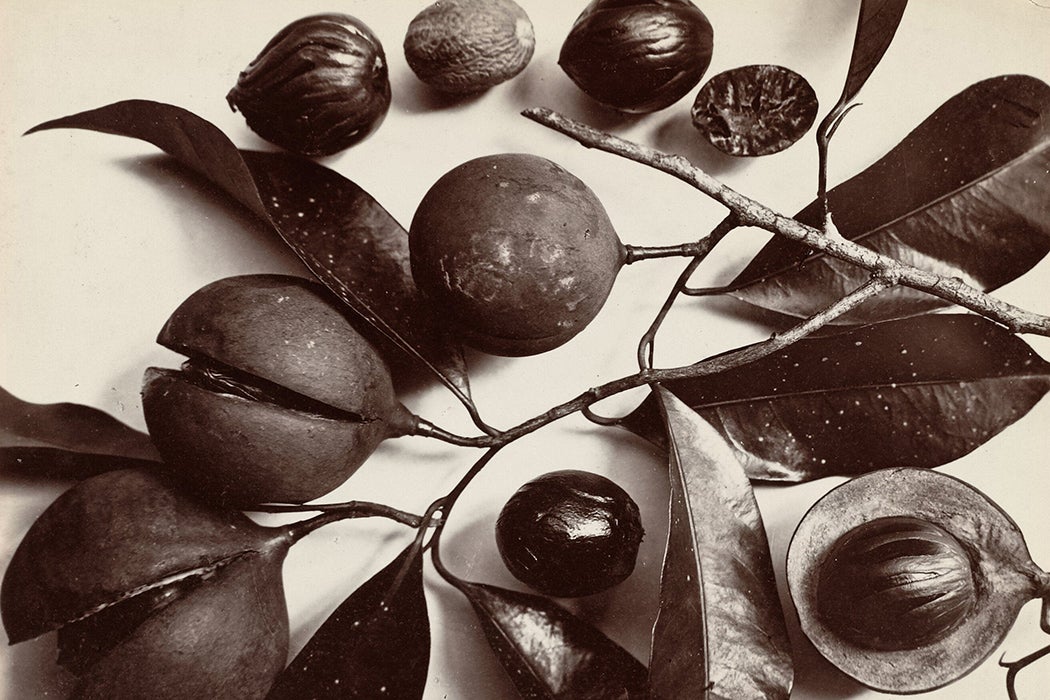
From mulled wine at Christmas to hot cross buns at Easter, nutmeg has become an essential spice in Europe. But its widespread adoption—including in the traditional Dutch breakfast pastry of ontbijtkoek—comes on the back of a sordid history of colonial exploitation.


From the seventeenth to the nineteenth century, Dutch cultivation of nutmeg and the related spice mace involved “one of very few historical situations where Asian slaves worked on European-owned farms or plantations,” according to anthropologist Phillip Winn.
The Banda Islands, once the world’s only source of nutmeg, were home to between 13,000 and 15,000 people until their conquest by the Dutch East India Company (VOC) in 1621.
The roughly 1,000 Bandanese who survived were enslaved alongside other laborers under the perkenier system, where hundreds of workers toiled on each plantation (in Dutch, perk).
“The newly enslaved Bandanese were not simply ‘labour’ in the perkeniersstelsel—they were the original silviculturalists and traders of the islands whose expertise was recognised and utilised by the VOC,” Winn explains. “Enslaved Bandanese were deliberately distributed about the islands to make use of their expertise in cultivation and spice production.”
Yet conquered Bandanese made up just over one-tenth of the enslaved workers. Many other slaves hailed from neighboring parts of the Indonesian archipelago, as the Dutch made arrangements with local rulers to traffic enslaved people captured in regional conflicts.
Some might have come from even farther away. A “little black slave boy” renamed Januari began his journey to the Banda Islands when he was sold to a Dutch vessel, the Amerongen, in the northwestern Indian port of Surat in 1766. From there, the Amerongen sailed east, plying colonial trade routes around Java.
Alicia Schrikker speculates that Januari “may have originated in East Africa and been brought to Surat by Gujarati traders,” though she can find no official trace of him in either the ship’s cargo manifest, where enslaved people were normally listed, or in the payroll registers.
More to Explore
![A Chelsea Pensioner, wearing a sprig of orange blossom [?] in his buttonhole, sipping a dish of tea. Engraving by J. Jenkins after M. W. Sharp, 1840](https://daily.jstor.org/wp-content/uploads/2026/02/consuming_the_empire_alt_1050x700.jpg)
Consuming the Empire
Instead, Januari appears in the historical record because he was still in the custody of the Amerongen in 1769, when he was caught semi-naked in the company of an older youth—a white Dutch teenager who had enlisted as a cabin boy in the VOC.
Though Januari was likely no more than twelve years old, he was put on trial for sodomy and sentenced to hard labor in the Banda Islands. If the boy survived his 10-year sentence, Schrikker grimly notes, “the VOC probably sold him on to a perkenier, a planter, for whom he would have worked as a slave on the nutmeg plantations for the rest of his life.”
The perkenier system is distinct for blurring the interests of the VOC and the planter class. For instance, plantation managers may have held “a more cavalier attitude toward policing their slaves” because they considered nearby Dutch forts to be responsible for the “publicly owned slaves” leased by the VOC to the perken, David Carlson and Amy Jordan suggest.
The perkenslaven, who were allotted by the VOC in quotas to individual plantations, toiled alongside “private” slaves whom planters “purchased” for their personal use. Toward the end of the perkenier system in the 1860s, enslaved people were also joined by indentured laborers.
At the same time, planters might order perkenslaven to grow vegetables and other produce for their own households and businesses, rather than cultivate nutmeg as the VOC intended.
“[I]t ultimately becomes difficult to separate the use of slave labour in support of spice production from that which served household economies,” Winn writes.
In fact, perk compounds could have been designed for planters to display domestic slaves to visitors, since “the mere presence of slaves as a subordinate group to the owner could have served as a display of their material wealth and prestige,” write Carlson and Jordan.
The perkenier setup differs significantly from how plantation slavery was practiced in the Caribbean and the southeastern United States—indicating, Carlson and Jordan write, that “the Bandanese plantation landscape is considerably unlike those found elsewhere in the world.”
Weekly Newsletter
"*" indicates required fields
Scholars point out that the forced mixing of individuals from diverse origins has left an indelible mark on the culture of the Banda Islands. Many perkeniers’ wives were locals, and some were even formerly enslaved women, who might have gone on to own slaves of their own. Cultural hybridity was intensified by the domestic use of creole “Moluccan Malay.”
“Bandanese themselves now use the term campur (‘mix/blend’) in describing their distinctive Malay … but also as an expression of self-description in the phrase orang campur,” writes Winn. “To be Bandanese (Orang Banda) today is also to be an orang campur, a juxtaposition that troubles national narratives of static, regionalised ethnic identities.”

%27),_RP-F-1998-7-11.jpg)