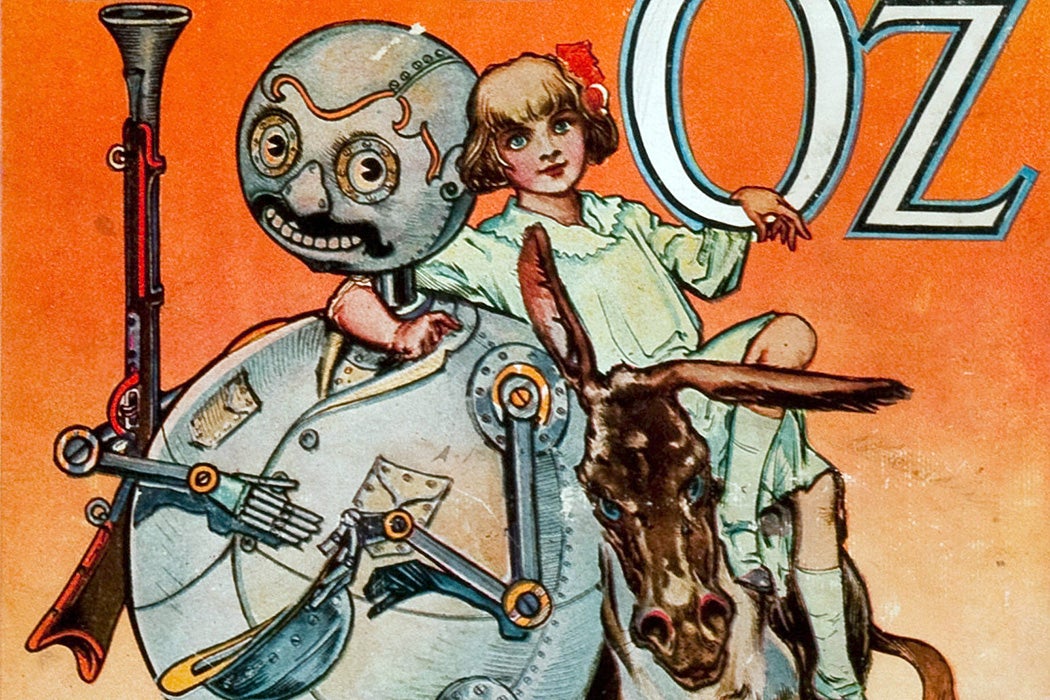
With the rise of large language models, people are increasingly considering what it means to place our trust in “thinking” machines. In answering this question, we have a wealth of media references to draw from. Would a superintelligent AI become a threat to humanity like The Terminator’s Skynet? Can we ensure that chatbots follow Isaac Asimov’s Laws of Robotics? As Paul M. Abrahm and Stuart Kenter discussed back in 1978, people were thinking about these questions even earlier than Asimov. They point to what may have been the very first robot: L. Frank Baum’s Tik-Tok.


Tik-Tok first appeared in 1907 in Baum’s third Oz book, Ozma of Oz, described as a “mechanical man.” This was more than a decade before Czech playwright Karel Čapek introduced the word “robot” in Rossum’s Universal Robots. Abrahm and Kenter note that it’s hard to come up with a solid definition of a robot, but they set out to show that Tik-Tok aligns with the central tropes about them created in the decades that followed.
First off, Tik-Tok is a human-shaped but fully mechanical person, made of copper. He differs in his origin from the Tin Woodsman, who was once a “meat man” but gradually had his body parts replaced with metal ones—making him more a cyborg than a robot. And the two are treated differently, with Dorothy and other characters repeatedly questioning whether Tik-Tok is, in fact, alive.
Another piece of evidence for his robotic nature is that, despite the fact that Oz is a magical land, Tik-Tok was made by human craftsmen—Smith and Tinker—using purely mechanical methods. He also speaks in a monotone, enunciating each syllable, thinks with perfect logic, and describes himself as incapable of emotions like sorrow or motivations like kindness.
More to Explore
Twin Curtains: Oz and the USSR
Abrahm and Kenter also argue that Tik-Tok essentially follows the Three Laws of Robotics that Asimov would lay down decades later—robots must first prioritize human lives, secondarily obey orders from humans, and only consider their own welfare after that. Created by and dependent on humans, who must periodically wind up his gears, he never expresses hostility toward a human, protects them against nonhuman attackers, and acts as a loyal servant to Dorothy. When necessary, he also defends himself from nonhuman magical foes.
Weekly Newsletter
"*" indicates required fields
While Tik-Tok is clearly conscious, being shown to have affective experiences such as boredom, he’s also described as lacking an essential self, with feelings, creativity, and conscience. And at times he mirrors our own nonconscious “artificial intelligences” in his mixture of impressive competence at some tasks and total inability to think in the human sense. For example, he fails completely when asked to suggest which road to take in an unfamiliar area, acknowledging—in a way that ChatGPT probably wouldn’t—that “My ma-chin-er-y is not made to tell that.”
This, of course, makes it nonsensical to ask Tik-Tok to take responsibility for mistakes. As he explains at one point, “My thoughts are us-u-al-ly cor-rect but it is Smith and Tin-ker’s fault if they some-times go wrong or do not work prop-er-ly.” Seen in this light, Tik-Tok offers an early model for thinking about how humans imagine intelligent machines behaving, anticipating modern concerns about control and trust that shape today’s debates about AI.


_cover.jpg)