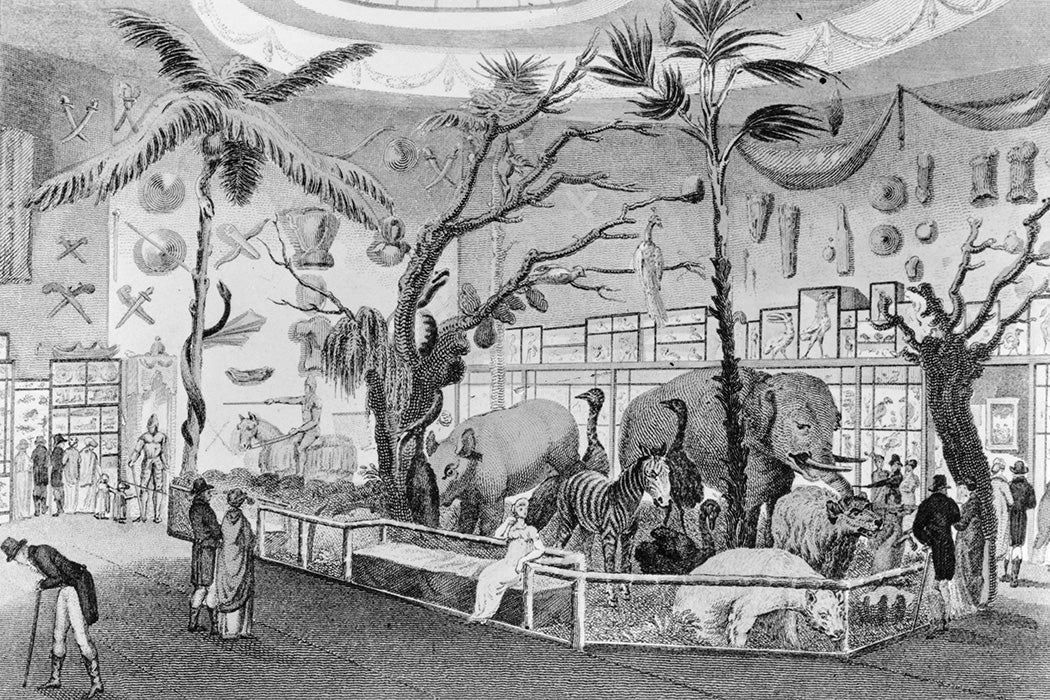
Taxidermy is the art of preserving, stuffing, and mounting animal skins. As historian Alan S. Ross explains, the practice became common across Europe in the early eighteenth century, “upon which it had been adopted with great enthusiasm by collectors and natural historians.”


Taxidermy would become the visual medium par excellence illustrating European expansion—one far more accessible to a broader crowd than anything in books, private collections, or even early zoos. Imperialism was manifest in the taxidermy of “trophy” spoils of colonial exploitation. Ross writes, “To an extent only surpassed by television in the twentieth century, it was the medium of the preserved animal body that brought home the wonders of the planet.”
Alcohol was the earliest embalming fluid, going back to the ancient Egyptians. Charles Darwin used spirits of wine, sometimes strengthened with alum, arsenic, or mercuric chloride, during his voyage on the HMS Beagle (1831–1836). Dead birds, however, became a sodden mess in liquid. The introduction of arsenical soap—based on an earlier recipe developed by ornithologist Jean-Baptiste Becoeur (1718–1777)—revolutionized bird preservation in the early nineteenth century.
Arsenic also negated the need to tan skins of mammals and other animals. Arsenic may be a deadly poison—its presence continues to haunt natural history collections, where it was used into the 1980s—but it opened the floodgates to taxidermy. Arsenic preservation freed the bodies of animals from glass containers and anatomy:
The fact that only the skin of the actual animal remained and that it was mounted on a frame that could take virtually any shape meant that the resulting object could take any posture or expression without being limited by bones, ligaments or muscle texture.
Specimens could now be sculpted. The tradition of the singerie (French for “monkey trick”) in genre painting, in which primates and other animals were portrayed imitating human behavior, was readily adopted in taxidermy. Now, it involved the actual bodies (or at least skins) of the animals themselves. This was not without controversy: Ross quotes novelist Frances Burney’s 1778 shock over a monkey in the “attitude of the Venus de Medicis.” Naturalists and later scientists also protested such allegorical uses of primates.
More to Explore

Natural History: A Reading List
Many of the human props—canes, top hats, desks—used in primate taxidermy became unfashionable in the first half of the nineteenth century, but there were still throwbacks. In 1856, the body of what is thought to have been the first gorilla to reach Europe was purchased by a travel writer, taxidermist, and showman who transformed it into a bizarre caricature of Martin Luther—the facial expressions were supposed to be similar.
African gorillas, the “monster apes,” were read into the racial order of colonialism as word of their presence reached Europe in the 1840s. The “idea of the gorilla as a super-masculine predator” aligned with racist views of African men. Emmanuel Fremiet won a medal from the Paris Salon in 1887 for his large sculpture of a gorilla abducting a white woman. The jump to the fabulously successful King Kong (1933) wasn’t a long one.
“By the mid nineteen century, taxidermy had become immersed in the theatricals of the habitat diorama and formed an integral part of the narratives of self-promotion of entrepreneurial explorers.”
Weekly Newsletter
"*" indicates required fields
“Real animals” appeared to “prove the richness and simultaneous wildness of the colonial hinterlands.” These preserved specimens in supposedly naturalistic settings—which reached their apogee with the grand dioramas of natural history museums—“pervaded urban society and lower social strata to an extent that live exotic animals never did.”
But, concludes Ross, “the ease with which preserved animal bodies could be manipulated [was] detrimental to the progress of natural history.” And it was “exactly this capacity for deception which allowed taxidermy to become a medium of European expansion.”



_(7670344022).jpg)