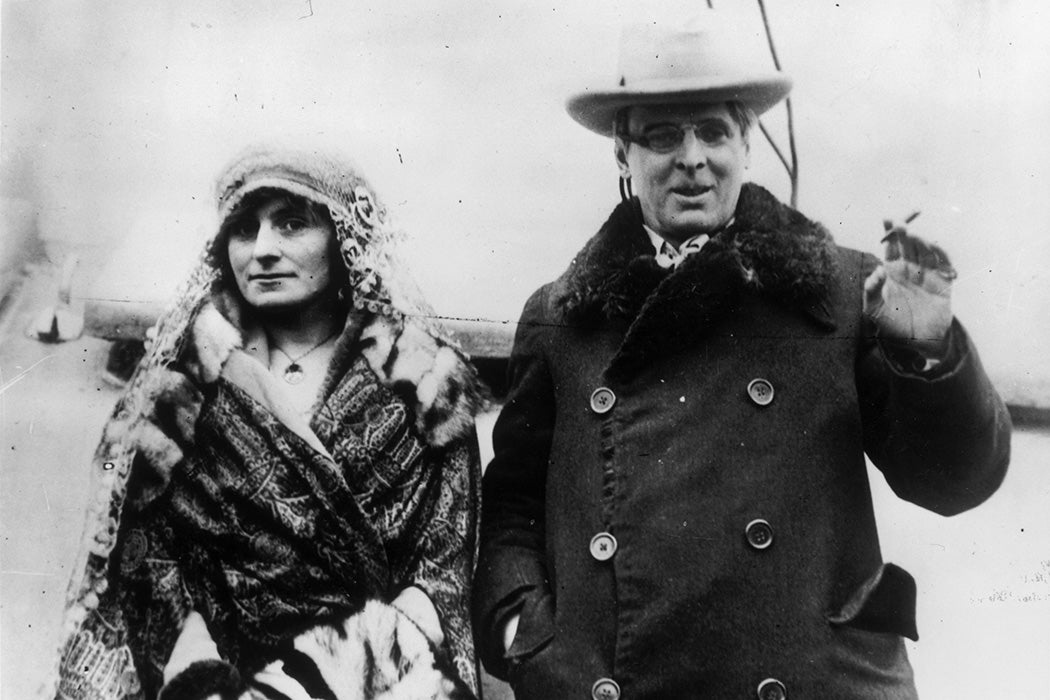
When William Butler Yeats died on January 28, 1939, it may have seemed that his prophecies were coming to pass faster than he had predicted. Yeats spent the last two decades of his life in turmoil, public and private. Throughout most of the 1920s he served in the new Irish Senate. In 1923 he won the Nobel Prize for Literature. He flirted with, then largely rejected, fascism at home and abroad, as Mussolini invaded Abyssinia and Hitler’s militaristic ambitions grew plainer.


Born in 1865, Yeats grew up in the “Pax Brittanica” of the waning nineteenth and early twentieth centuries, when the general feeling was that war in Europe was a thing of the past. But then the First World War, and the Easter Rising, brought Yeats’s mystically and abstractly inclined mind uncomfortably into the present.
Yeats was a strange modernist: an anti-modern man nevertheless too intellectual, honest, and rigorous to deny the necessity of coming to some terms with modernity. From 1917 on until the end of his life, he was increasingly preoccupied by the contradictions of the individual—in particular, the artist, individual par excellence—inside the unalterable world of history, where we find ourselves trapped, “Turning and turning in the widening gyre,” as he wrote in perhaps his grandest and most compelling expression of this theme, the endlessly quoted “The Second Coming.” Now, in 1939, these grand currents of history seemed to be culminating, uncomfortably quickly, in the buildup to the planetary onslaught that was the Second World War.
The first and the shorter of the poem’s two stanzas is far more renowned than the second. Its last six lines in particular resonate:
Things fall apart; the centre cannot hold;
Mere anarchy is loosed upon the world,
The blood-dimmed tide is loosed, and everywhere
The ceremony of innocence is drowned;
The best lack all conviction, while the worst
Are full of passionate intensity.
One doesn’t have to look far—be it the oceanic drowning of innocence in Gaza, Yemen, Somalia, or America—to recognize that the second coming Yeats warned of, and the “mere anarchy” of inhumanity that heralded it, is only picking up speed.
It’s instructive to note how Yeats and W. H. Auden, in his elegy to Yeats, frame the approach of catastrophe. Auden’s vision is of the “intellectual disgrace,” both a symptom and a cause of the irrational “nightmare,” where nations cower in impotence. Its horror remains steadfastly secular, humanist in outlook, tinged with the influence of Marx and Freud, the two great prophets of a twentieth-century understanding of human “evil.” That “evil” was, in fact, something else, to be rationally explained and therefore, perhaps, improved––the repressed unconscious, or the repressed masses.
Yeats’s “widening gyre” and lost “ceremony,” by contrast, are expressions of a highly idiosyncratic and complex personal vision, worked out through defiantly anti-rationalist and anti-modern methods: prophecy, divination, mediums—in a word, magic.
None of Yeats’s continuous blossoming of finer and stranger poetry late in life would have been possible without those methods and without the book that brought them to their peak of articulation, a synthesis of a lifetime spent investigating increasingly unacceptable ways of knowing.
A Vision, published privately in a limited edition of 600 copies in 1925, is often cited, directly or indirectly, but seldom read. It has admirers—great critics, from Yeats’s biographer Richard Ellmann to Harold Bloom—but it seems to remain an embarrassing bafflement in Yeats’s work, with an uncomfortably undeniable importance. Some knowledge of what it contains is necessary to fully appreciate Yeats’s later output, which culminated in his two great volumes, The Tower and The Winding Stair. Along with “The Second Coming,” Yeats wrote many poems of equal renown, including “Leda and the Swan,” “Among School Children,” and “Sailing to Byzantium,” which appear in these two collections.
A Vision is immensely strange, partly purporting to be a prophetic revelation while subtly and persistently undermining itself; it’s a work of magic and mysticism presented in abstract language, often approaching the tenor of a crank work of pseudo-science. A rationalist systemization of myth, symbol, and metaphor, it borrows from many sources and resembles none.
Weekly Newsletter
Yeats worked for nearly a decade toward its first form, published in 1926, and revised it for a further decade until it was republished, hugely altered, in 1937. Perhaps he never regarded it as truly finished—or finishable. The central conflict of the book, as in Yeats’s poetry, engages the necessity of maintaining the small dignity of our humanity in the chaos of uncontrollable events.
One early reviewer, Kerker Quinn, wrote in 1938 that A Vision would be taken as evidence that the poet had “gone unquestionably, though perhaps serviceably, mad.” That acknowledgment, “serviceably,” should give us pause, because for Yeats poetry, and the world that it worked towards, was always the final end.
“You were silly like us,” Auden writes in his tribute; “your gift survived it all.” Yeats’s silliness, for Auden, means his lifelong devotion to the study of the anti-rationalist arts that are modernity’s outcasts; Auden was likely voicing the majority view for those who read and enjoyed Yeats the poet. Yet to imply that the poetic “gift” survived “despite” these deep preoccupations reveals a powerful misunderstanding—willful or not—on Auden’s part. Yeats remained a great poet not despite his magical investigations but because of them. “The mystical life,” he wrote to a friend, “is the centre of all that I do and all that I think and all that I write.”
In his 1901 essay, “Magic,” which serves as a midlife retrospective of his investigations, Yeats offers a statement of his “beliefs” in “the practice and philosophy of what we have agreed to call magic.” For him, magic refers to and relates several things: “the evocation of spirits, though I do not know what they are;” “the power of creating magical illusions;” and “visions of truth in the depths of the mind when the eyes are closed.” He expresses these alternately in “three doctrines which have, as I think, been handed down from early times, and been the foundations of nearly all magical practices.”
(1) That the borders of our minds are ever shifting, and that many minds can flow into one another, as it were, and create or reveal a single mind, a single energy.
(2) That the borders of our memories are as shifting, and that our memories are a part of one great memory, the memory of Nature herself.
(3) That this great mind and great memory can be evoked by symbols.
From his earliest days as an apprentice writer in London and Dublin, Yeats was also, as biographer Roy Foster puts it, an “apprentice mage.” He studied a host of approaches to what he termed “nature’s finer forces.” For over twenty years he ascended the ranks of the Hermetic Order of the Golden Dawn in London and, more briefly, Madame Blavatsky’s Theosophical Society; he studied Kabala and Rosicrucianism, Vedanta and meditation; he went through a spiritualist period and attended seances, going from “medium to medium.” The Neoplatonist philosophy of Plotinus was important to him, as were later mystics like Jacob Boehme and Emanuel Swedenborg; and William Blake and Percy Bysse Shelley were foremost influences, prophets of a new consciousness.
Through his early work on uncovering Irish folklore, Yeats developed his concept of the “Anima Mundi,” that “great mind and great memory” of the world referred to in his third magical tenet. These myths, and later the occult practices he sought to learn and perhaps revive, were part of a secret tradition of the supernatural, a common human inheritance of wisdom, where collective experience and its derivates, ineffable “symbols” of meaning, were stored. This extended to poetics. The word, seen right and true, was magic, too: a great poem illuminated this hidden lamp of common memory in the mind of the reader, whether they were conscious of it or not.
Despite his anti-scientism, Yeats’s omnivorous and contradictory mind was incapable of swallowing anything uncritically. He notes in “Magic” that he quarreled with his close friend, writer-painter and fellow-mystic A.E. (George William Russell), “because I wanted him to examine and question his visions, and write them out as they occurred; and still more because I thought symbolic what he thought real.” Here again the symbol is linked to magic, and therefore to its etymological relative, imagination, which is the poet’s domain.
More to Explore
W. B. Yeats’ Live-in “Spirit Medium”
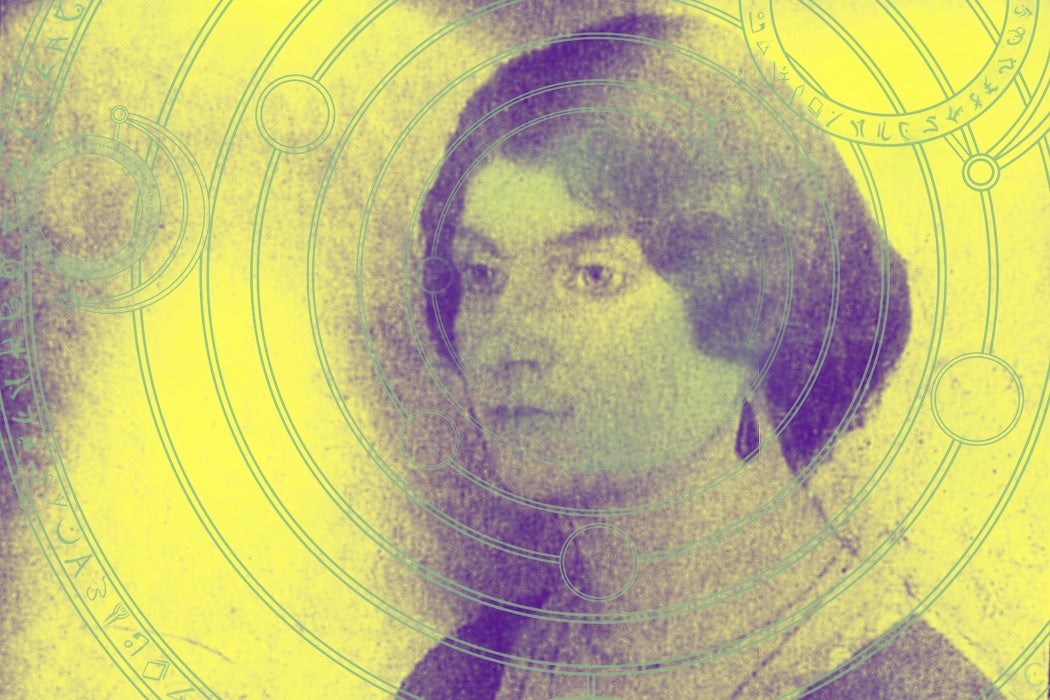
This may help us see A Vision in a clearer light, as does the story of how it came to be written—or, rather, received. In 1917, Yeats, then past fifty, had at last gotten married to Georgie Hyde-Lees, twenty-seven years his junior. On their honeymoon, Yeats began brooding, and, largely to distract her husband from his instantaneous doubts about the marriage, George (as Yeats called her) began automatic writing. Unsurprisingly, her messages contained unsubtle hints that he had chosen the right wife. Yeats was captivated. Then something else happened. As George later told friends and biographers including Richard Ellmann, she felt her hand “seized by a superior power.” In Ellmann’s account, her “pencil began to write sentences which she had never intended or thought, which seemed to come as from another world.”
Encouraged by her husband, George wrote for hours, usually daily, a process which eventually amassed around 3,600 pages. Over several years Yeats then worked to systematize these masses of automatic fragments, with guidance from what he called “my instructors.”
The omni-spiritual Yeats had always had a syncretic bent, and at last, he was presented with the chance to follow the lead of his beloved Blake, who asserted: “I must create a system or be enslaved by another man’s.” To this vast and mad storehouse, he was bringing a lifetime’s study—A Vision is a synthesis, therefore, of the personal and the beyond, the beyond that Yeats had been unconsciously waiting for, and to which George allowed him access. “Truths without father came,” he writes, “truths that no book / Of all the uncounted books that I have read, / Nor thought out of her mind or mine begot.”
This synthesis of the subjective and the objective is the unifying factor of A Vision. The main body of the text is in five books, moving through analyses of the eternal laws of human personality, the development of the soul through life and after death, and the mirroring of these processes in the movements of history. Though often complex, confusing, contradictory, and perhaps ultimately unresolvable, Yeats’s “system” is unified by symbols, which are represented visually both in diagram form and in illustrations by Edmund Dulac.
The principal symbol is the title Yeats gives to one of the five sections: “The Great Wheel.” Organized according to the movement of the lunar month—maybe humankind’s oldest extrapolated symbology of any kind—the Wheel is divided into twenty-eight “phases”: each phase is a different stage of personality, through which each individual soul moves in its many reincarnations in a closed, circular journey.
Phase One, which mirrors the dark of the moon, symbolizes complete unity and potential, or “plasticity,” and Yeats dubs it and the other phases up to Phase Fifteen to be governed by the “primary.” This principle is related to ideas of the collective, the unifying, the given, and passivity, or in Yeats’s words, “that which serves.” It begins at Phase One in the essential ground or primordial dark out of which all springs and into which all must return. The subjective, or “antithetical,” is the primary’s opposing force, or motion, and it’s the realm of action in human life: subjective, individuating, differentiating, pluralist.
Superimposed on the lunar wheel image is the other major symbol: the gyres. It’s easiest to picture them in a kind of mental filmic projection: two interlocked cones, spinning, with the end-point of each meeting at a common center-point at the base. In a cross-section diagram, this looks like two concentric circles, one expanding while the other contracts, until at some point the reverse begins. “I can see them like jelly fish in clear water,” Yeats writes. He had finally found the symbol to express his own self-contradictory, opposite-clashing nature, the spring of all his poetry and thought. “[P]assion is conflict,” he wrote in a diary, “consciousness is conflict.”
To simplify much of Yeats’s long, knotty, sometimes unreadable explanations, these two symbols, with diagrams, examples, and counterexamples, form the basis of “the system.” It’s a different vision of dialectic than we find in Hegel or Marx, yet it is a dialectic: the gyre is the mechanism by which the wheel’s circle—and we, inside it—complete revolutions of the soul. The goal of life, then, is to attain self-understanding, which means to grasp which of the “phases” one is in during the incarnation in which we happen to find ourselves, and to live, in Yeats’s oft-repeated phrase, “according” to it.
Yeats illustrates the different phases with characteristic examples. Most of the great artists (Yeats’s archetypes are all of men and of “man”) fall somewhere between the two poles. Keats, Blake, Dante, and Yeats himself all fall into phases close to Phase Fifteen, the most perfectly human (hence, unattainable) point. Here, subjective “thought,” objective “will,” personalized “effort,” and idealized “attainment” are indistinguishable. Yeats calls this “a phase of complete beauty,” that is, humanized beauty. Though not a Christian, he can’t associate this phase with any person besides the figure of Jesus.
A Vision, for all its anti-modern methods, has a modern creed: life is about completeness of experience and learning what lessons we can, because human life is inherently “subjective”—it’s about differentiating ourselves from our surroundings, about creating oneself, and creating things. For all its throwback qualities, Yeats’s system seems to grow out of a curiously modern condition—the sense that we are irrevocably fallen—yet, in the words of Samuel Beckett, we will “go on.”
A Vision’s final two sections, full of comically complex divisions and subdivisions of time-cycles, discuss the applications of the system to history. To condense this to a nub of significance, we return to “The Second Coming”—its second stanza, of which the final line is the most quoted:
Surely some revelation is at hand;
Surely the Second Coming is at hand.
The Second Coming! Hardly are those words out
When a vast image out of Spiritus Mundi
Troubles my sight: somewhere in sands of the desert
A shape with lion body and the head of a man,
A gaze blank and pitiless as the sun,
Is moving its slow thighs, while all about it
Reel shadows of the indignant desert birds.
The darkness drops again; but now I know
That twenty centuries of stony sleep
Were vexed to nightmare by a rocking cradle,
And what rough beast, its hour come round at last,
Slouches towards Bethlehem to be born?
In accordance with A Vision’s final essay on history, titled “Dove or Swan,” what Yeats describes here is the birth of a new historical movement—in his reckoning, these grand revolutions come round every two thousand years, a reversal in the eternally gyring movement of opposites. Each is marked by the birth of a symbolic god—such as the first coming of Christ, the “victim,” a peaceful, passive, unifying, and self-negating “dove.” As he approached the new millennium, Yeats saw the next cycle approaching, which would be replaced by an antithetical god, some kind of “teacher,” an active and subjectivizing force embodied by the “swan,” which moves towards the full Moon.
This image, this prophecy, is deeply ambiguous: Yeats has seen enough of how history looks on the ground to not be so naïve, and that “gaze blank and pitiless as the sun” haunts us still.
Just how seriously this is all to be taken, how much Yeats really believed everything he put down in A Vision, is a vexing question. When he at first offered “to spend what remained of life” on solving their mysterious messages, he received this response from his tutelary spirits: “we have come to give you metaphors for poetry.” A Vision isn’t for the literal-minded reader, and any attempt at “cracking” its lessons will lead only to infinite regress, since, as Yeats always reminds us, consciousness is contradiction—never at rest.
Yeats wrote that everything in A Vision was “all a myth”. But he did not mean “myth” as our time has come to digest and contain that word, as something believed, but not actual, because not factual. Myth for Yeats “has something sensuous and concrete about it like a house or a person that stirs belief because it stirs affection.” Myth, in this sense, is our means of engagement, of love, with reality in the tallest, widest, most massive, and most luminous sense––or “thinking big” as the late philosopher William Irwin Thompson put it––something which Yeats always sensed modernity moving to extinguish.
Whatever we may see in A Vision, it is certainly the clearest evidence of the depth of Yeats’s immersion in magic imaginings: as for the results, we have only to feel the magic in those poems. We might then consider whether Yeats was on to something useful––our capacity to consciously and conflictedly do the endless work of making reality cohere, all while staying awake enough to remember that it’s all in our heads. In April 1924, Yeats wrote to his book’s illustrator Dulac, “I do not know what my book will be to others—nothing perhaps. To me it means a last act of defence against the chaos of the world.”