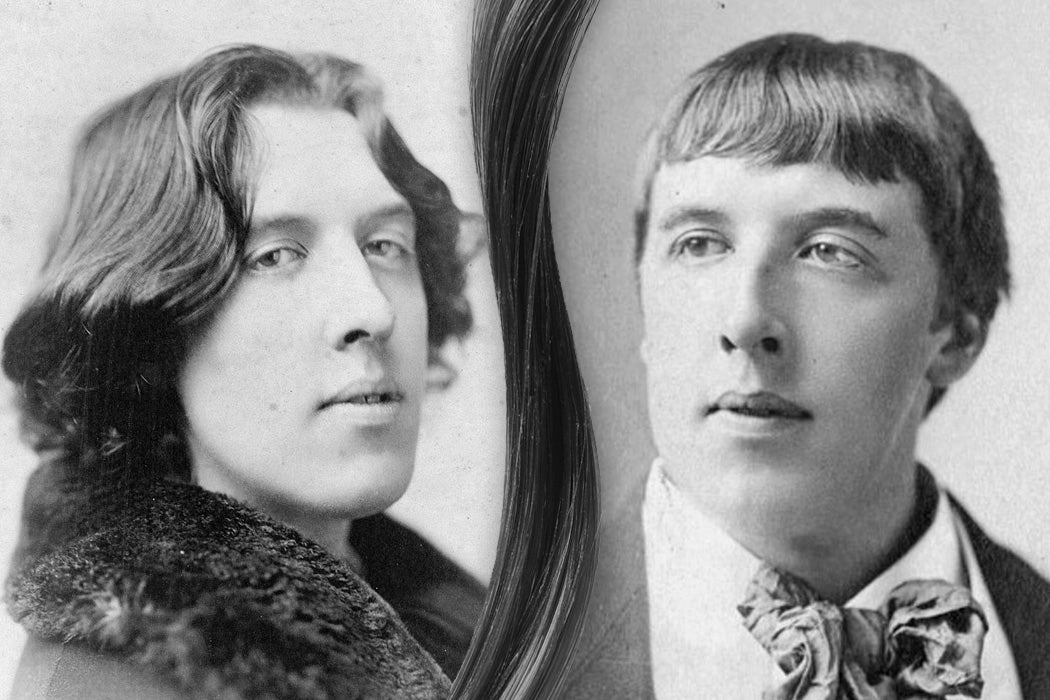
A quote attributed to Oscar Wilde claims that he told a US customs agent upon his 1882 arrival in the United States that he had nothing to declare but his genius. Actually, he probably never said this, but he might just as well have declared his collar-length hair. Combined with a clean-shaven face, this look was virtually unheard of for an adult male European of the middle- or upper-class. And it was this long hair—hippie avant le lettre—that took New York by storm, even more than, writes Wilde scholar Rob Marland, his “poetry, wit, or conversation.”


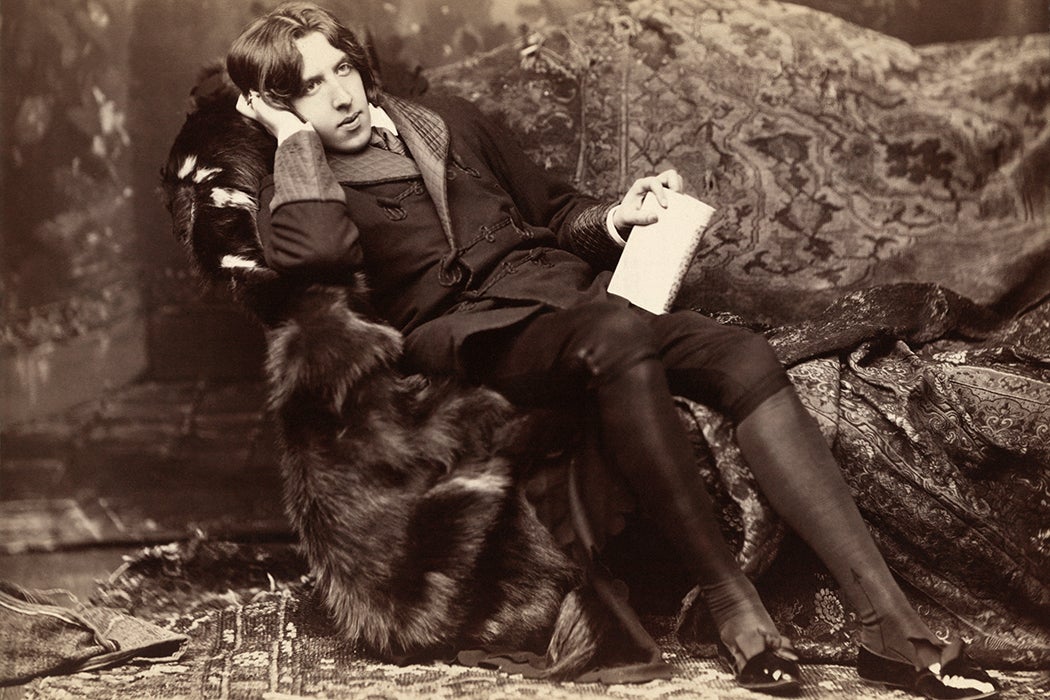
The photographs of Wilde taken by Napoleon Sarony in New York in January 1882 proved so popular that Sarony had to take his fight to extend copyright protection for his photographs all the way to the Supreme Court. Wilde may have lived another nineteen years, but Sarony’s pictures of the 27-year-old have become the defining images of him, reproduced everywhere from books to the internet, even though that particular length of hair was quickly abandoned. Sarony laid some claim to inventing “Oscar Wilde”; he certainly shaped how we picture him today.
The next time Wilde was photographed by Sarony, on his second trip to New York in August 1883, Wilde had a completely different ‘do. This one was much shorter. These photos are harder to find. In an interview—because yes, his hair continued to be a topic of interest on both sides of the Atlantic—Wilde said his square-cut bangs were inspired by a Roman sculpture in the Louvre. Only after getting his hair cut in this style, Wilde claimed to have discovered that the “bust represented Nero, one of the worst behaved young men in the world, and yet a man of strong artistic passion.”
As Marland and others have pointed out, the 1883 Sarony photographs portray a hairstyle that doesn’t match the usual look for Nero. According to Suetonius, the go-to source for physical descriptions of the Twelve Caesars, Nero had “hair shaped into terraces.” Wilde’s 1883 cut is more of a fringy waterfall. That seems to have been an aberration that year, for numerous press mentions describe his hair as curled, with one satiric poem in the London World running,
Our Oscar is with us again; but, O,
He is changed who was once so fair!
Has the iron gone into his soul? O, no;
It has only gone over his hair.
Marland details the contemporary associations made between Wilde and Nero. When Wilde’s enemies, which eventually included the weight of the British establishment, attacked him for his decadence, immorality, sensuality, effeminacy, homosexuality, et al., they often likened him to the shameless Nero.
More to Explore
Oscar Wilde’s Pamphlet: “Children in Prison and Other Cruelties of Prison Life”
“In light of the prevailing Victorians’ attitude to Nero, Wilde’s seemingly innocuous announcement that he adopted the young emperor’s hairstyle could be considered rash or even brave.”
Marland gives several reasons for this. Wilde loved to shock the Philistines; he enjoyed having the public take “his frivolities in earnest”; and he “rejected the popular bent for moralizing about historical figures.” About Nero, Tiberius, and Cesare Borgia, Wilde wrote “they may fill us with terror, or horror, or wonder, but they do not harm us.” But, like Flaubert and Baudelaire across the Channel, Wilde used Nero as a goad. “Society must be amazed,” Wilde wrote in a letter to a friend, “and my Neronian coiffure has amazed it.”
Marland describes four main sculptural types of Nero in the Louvre and other museums. Versions of the teenage Nero, when his mother Agrippina the Younger was angling to position him as the heir to her husband Claudius (Nero’s stepfather), replicated the look of previous fringed-not-curly Caesars. The younger Nero is what Wilde meant, argues Marland, while noting that the particular statue Wilde was likely inspired by is no longer considered to be of Nero.
Weekly Newsletter
"*" indicates required fields
After having his mother murdered in 59 CE, Nero took on the curly look that became iconic. As Marland writes, “Suetonius fixed the image of Nero with his hair shaped into curly terraces, just as Sarony fixed the image of the long-haired Wilde.”
Marland wonders if Wilde made up the Louvre story to deflect the fact that his bangs on returning to America were actually akin to a then-fashionable style among New York City “dudes.” Wilde, who called fashion a “form of ugliness so intolerable that we have to alter it every six months,” never wanted to be associated with anything as mundane as a trendy style.