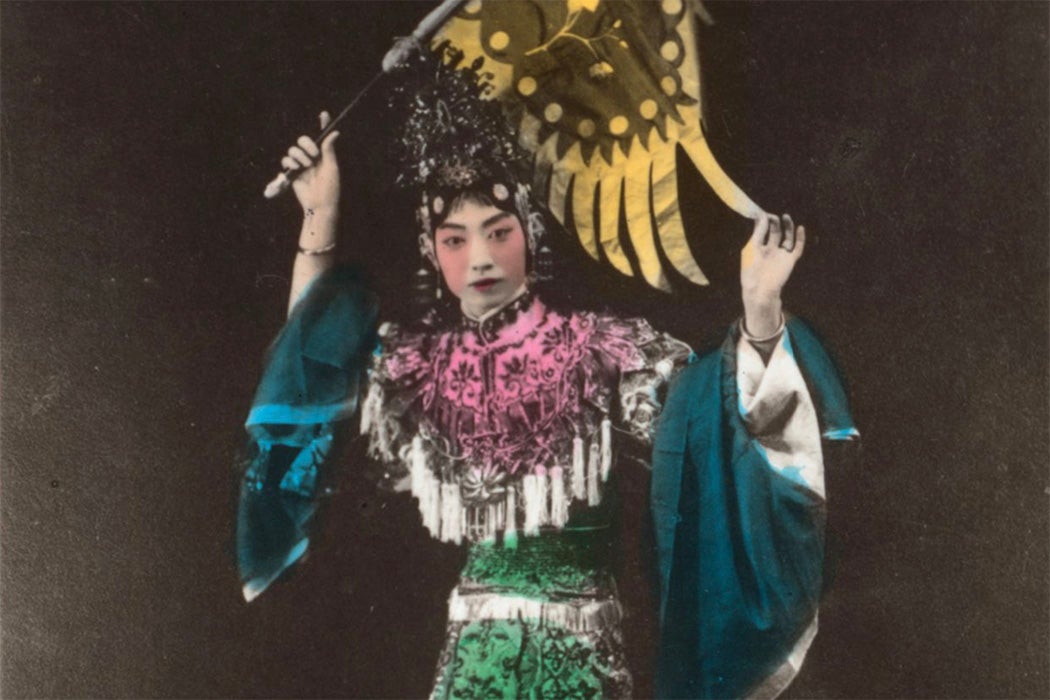
For five weeks in early 1930, well-heeled New York audiences flocked to midtown’s Forty-ninth Street and National Theaters to see Chinese actor Mei Lan-fang headline his celebrated Peking opera act. The production had traveled all the way from Peiping, as Beijing was then known.


“Most of the music was lost with its foreign scale and intention, but I was surprised to find how much of it takes on meaning for an outsider,” ran the verdict in the New Republic. Another critic described the performance as “one of grace and beauty … and of living antiquity.”
Yet while white audiences greeted Mei’s East Coast tour with delight, their reaction to other Chinese opera performances closer to home was far less enthusiastic.
“[T]he highly acclaimed performances of Mei Lan-fang served only to confirm the ‘hideousness’ and ‘unpleasantness’ of the performances by local opera groups in New York’s Chinatown,” explains music scholar Nancy Yunhwa Rao.
Rao also argues that both forms of opera were subject to audiences’ prejudiced and “pre-constructed concept of Chineseness,” as the performers themselves were well aware.
Mei, who specialized in female roles, was a master of Mandarin-language Peking opera. This northern style, which originated in the imperial court, is characterized by what Rao calls “literary and elegant scripts” and an “overall aesthetic refinement.”
Meanwhile, on the Lower East Side, Chinatown-based troupes staged vernacular Cantonese opera, with the “grander visual effects,” folk songs, acrobatic displays, and comic improvisation that appealed to immigrants from southern China’s Pearl River Delta.
Though southern opera troupes had been performing for Chinatown crowds in New York since the 1850s, Rao notes that “the reception of Chinatown opera was mostly uncomprehending and patronizing.” Many critics who praised Mei openly mocked local productions.
More to Explore
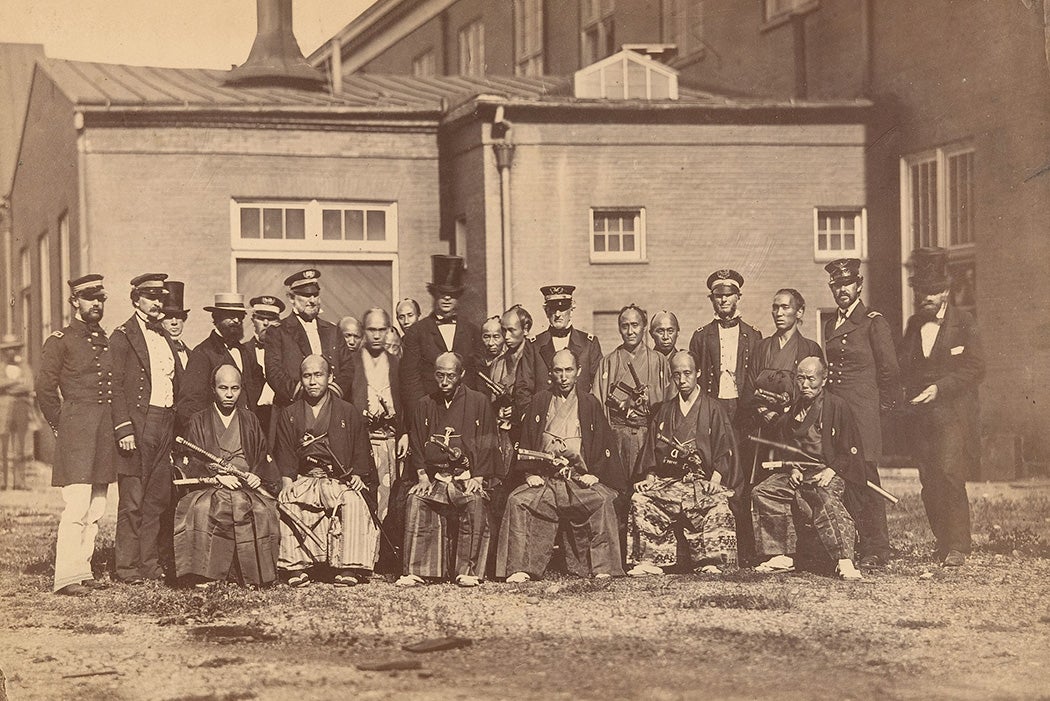
Samurai and Guerrillas: The First Official Japanese Visit
“Mei’s Peking opera, with its artistic refinement, was tied to the image of quintessential chinoiserie, while Chinatown’s Cantonese opera, which appealed to a wide spectrum of the Chinese community, was branded with the image of [the] unwelcome immigrant.”
Mainstream reporters disparaged actors’ costumes as resembling “a sort of goblin bandit” or “a public building on a holiday,” while dismissing the accompanying music as “a deafening din.”
Such newspaper descriptions, which “portrayed a scene of racialized people living at the periphery of society,” are “consonant with a general impression of Chineseness as unpalatable, alien, and heathen,” Rao explains.
Given New York’s disdain for Chinese opera in Chinatown, why did elite audiences clamor to see it uptown? How did Mei “so overwhelmingly attract” audiences that “had little understanding of, and often no interest in his music and language?”
Unsurprisingly, elite New Yorkers enjoyed Mei’s show because it aligned with other cultural stereotypes. When reviewers compared Mei’s poise and performance to pottery or “old paintings on silk,” they evoked the colonialist craze for owning Chinese objects as status symbols.
“It is thus not surprising that Mei Lan-fang’s staging of Chinese opera… became such a popular commodity,” Rao writes. “Framed as the ancient and refined, Mei was objectified.”
In fact, Rao argues that the inability to understand him “did not hinder appreciation, but rather satisfied the notion of ‘Oriental ineffability.’” She also suggests that “the persistent Western ‘desire’ to feminize the Orient as the Other” may have shaped responses to his rendition of female roles.
Far from passively accepting Western stereotypes, Mei astutely capitalized on racial expectations. Rao points out that his team spent a decade preparing for the international stage, making creative decisions with an American audience in mind.
For instance, plots and singing were simplified, aesthetic choreography was emphasized, and operatic arias were even transcribed into Western notation and printed in advance.
Weekly Newsletter
"*" indicates required fields
While Chinatown troupes did not enjoy the same cultural cachet and social status as Mei, they used a similar tactic, playing to stereotypes to remain commercially viable.
Noting that the Chinese theater was “a complex space” that served both local residents and outsiders, Rao describes how troupes presented non-Chinese tourists with “a formulaic performance” of rowdy, circus-like battle scenes—and charged them thrice the going rate.
She acknowledges that white audiences’ divergent responses to Peking opera in midtown Manhattan and Cantonese opera in Chinatown might initially appear contradictory, with the former seen as refined and sophisticated, and the latter dismissed as lower-class and unpleasant.
Still, Rao suggests that these impressions were two sides of the same coin: “Chinese opera has been viewed as not only linked to but actually constituting the foreign and the exotic”—a perspective that ignores the art form’s long and vibrant history on the American stage.