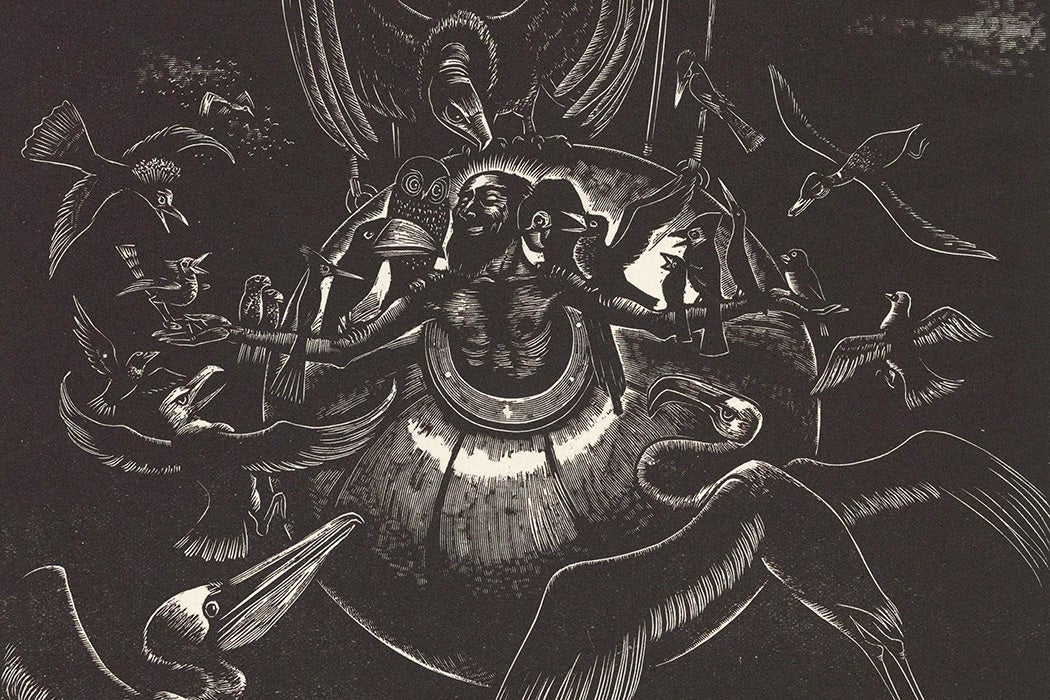
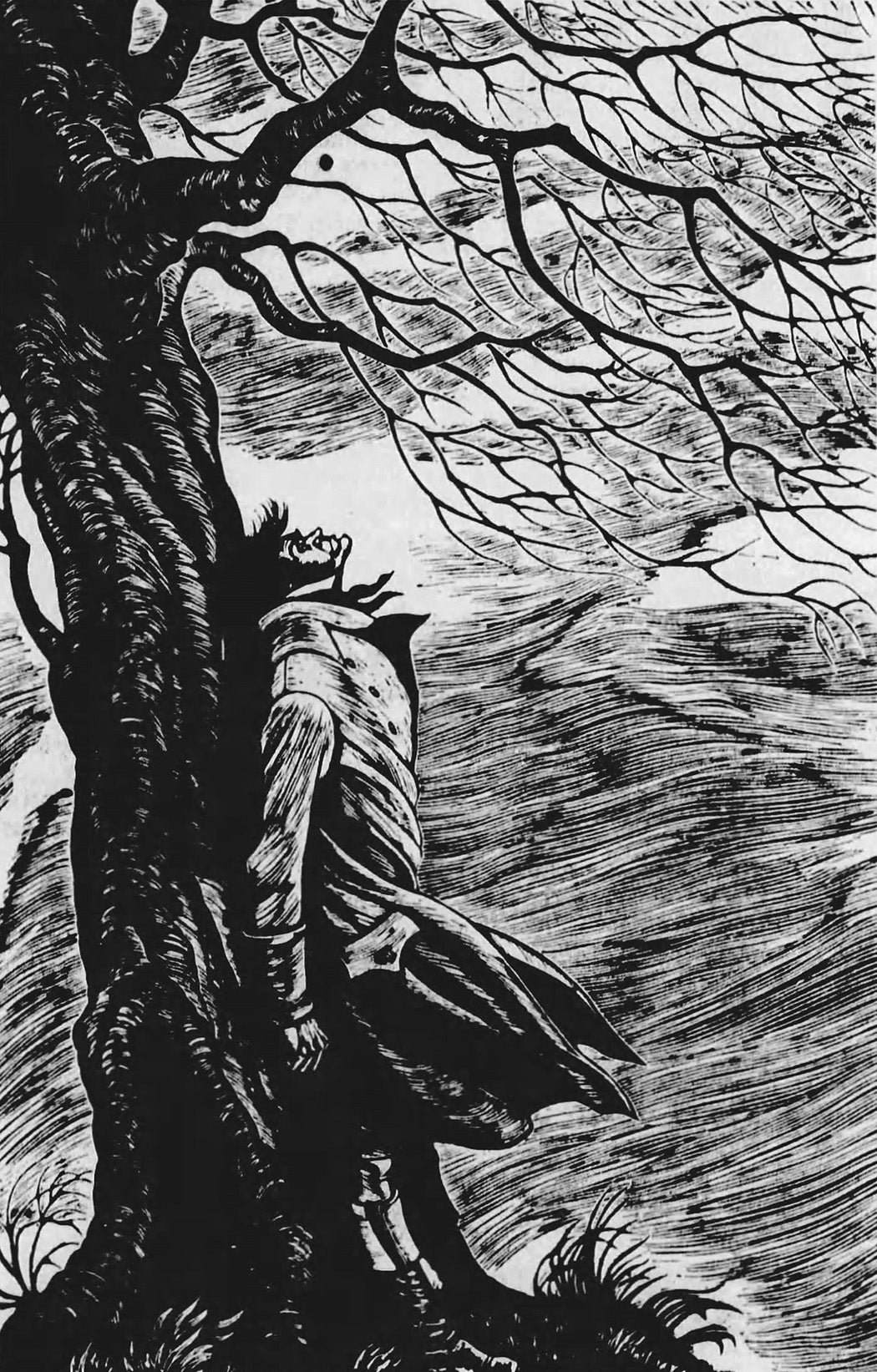
In Fritz Eichenberg’s Heathcliff Under the Tree (1943), Emily Brontë’s antihero leans against a broad tree and faces the sky. His long coat cuts against an opposite volley of wind, animated with an “inner life” by “the touch of the graver.” Described by the artist as a “dialogue” among human and natural elements, the print captures Heathcliff’s turmoil amidst the haunting moors of the English countryside and exemplifies Eichenberg’s ability to convey and elicit human emotion through wood engraving. It is a scene that “captured the imagination of millions of people,” Eichenberg recalled, “[I]t’s always Heathcliff Under the Tree that they say, ‘This is the one that I love most.’”


Eichenberg was a prolific artist, and Heathcliff Under the Tree is one among thousands of works of art created during his lifetime. His oeuvre spans the twentieth century, responding to oppression, war, and exploitation through what he believed was the divine work of creative expression. Today, amid growing anxieties about artificial intelligence and creativity, Eichenberg’s life and work offer new audiences an opportunity for revisiting what’s human about art.
Early Years
Eichenberg recounted his childhood with some melancholy. Born in 1901 in Cologne, he described himself as a “sensitive child” who “suffered through” his first eleven years at school before becoming a lithographer’s apprentice. When he was an adolescent, Eichenberg’s mother took him to a psychologist who told her that, although her son thought “too deeply,” he was otherwise fine. As a young adult, Eichenberg moved to Leipzig to study at the Academy of Graphic Arts and later to Berlin to work as a newspaper illustrator. A Jewish artist publicly critical of Hitler, Eichenberg recalls having “only a vague foreboding” about the coming Holocaust. He visited the Americas for the first time on assignment in 1933 and emigrated to the United States with his wife and child later that year.
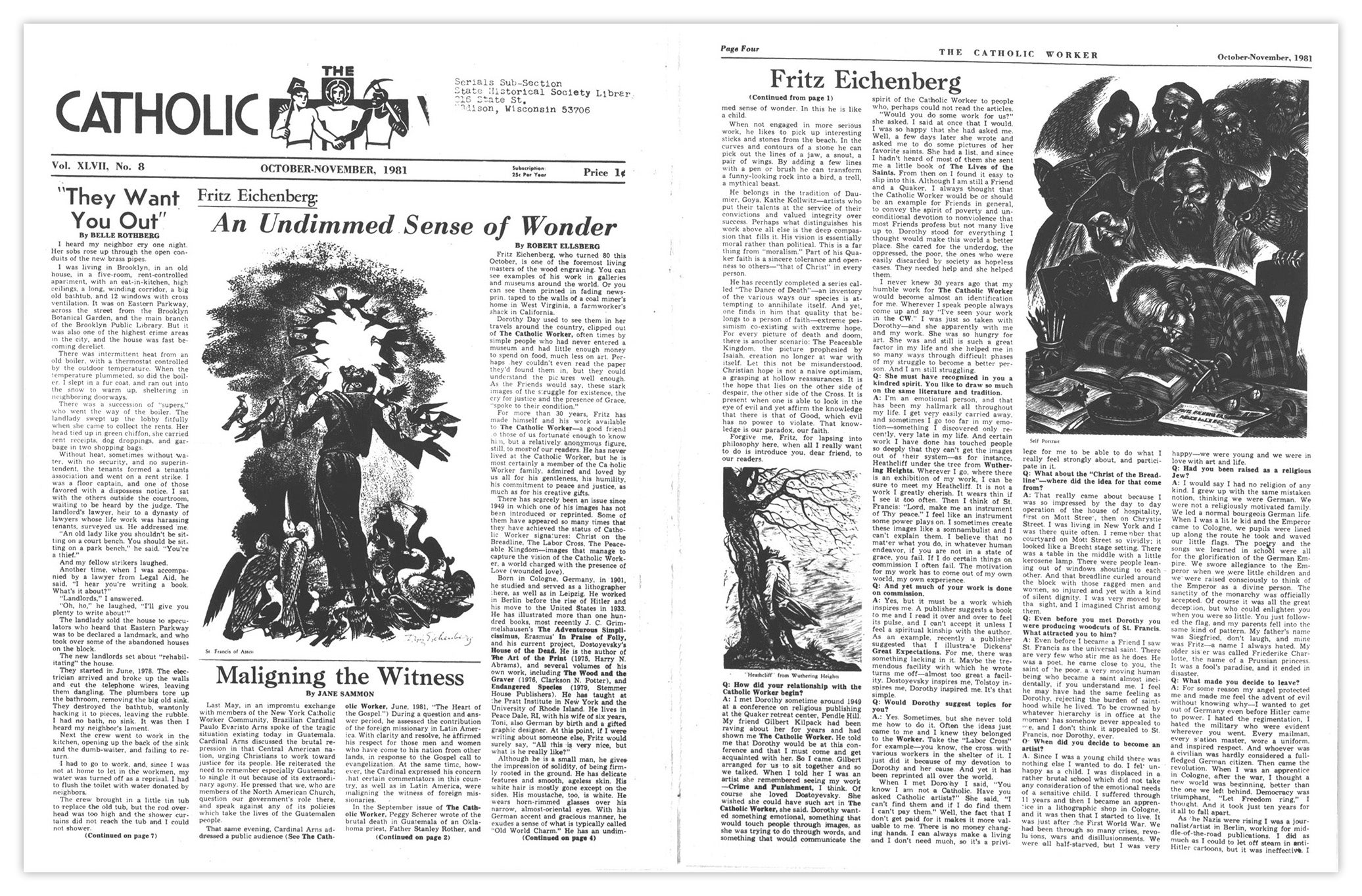
Settling in the Bronx during the Great Depression, Eichenberg eventually began working for the Federal Art Project’s Graphic Arts Division, established in 1935 under the auspices of the New Deal. His timing was fortuitous, as the division’s creation “initiated a printmaking renaissance in the United States by providing unemployed artists with both the opportunity and the incentive to learn printmaking,” according to Jordana Pomeroy. It was a happy time for Eichenberg personally and professionally: “We artists had complete freedom to do whatever we wanted,” he recalled.
The Artist in Spiritual Relief
In 1939, Eichenberg converted to Quakerism by way of Zen Buddhism, two years after his wife’s unexpected death. By the time the United States had entered World War II, Eichenberg was a devoted pacifist: “[I]t was a difficult conflict for me,” he remembered, “but somehow it didn’t cause conflict with my friends. I have always had the blessings of my naivety.” His religious practice reflected his artistic values; Quaker worship was conducted without a priest or other religious leader: “You could listen to yourself and your connection with the deity, whatever, or whoever, it was,” he reflected. Wood engraving—the artist’s favorite medium—allowed him a similar autonomy, “complete control… from beginning to end.”
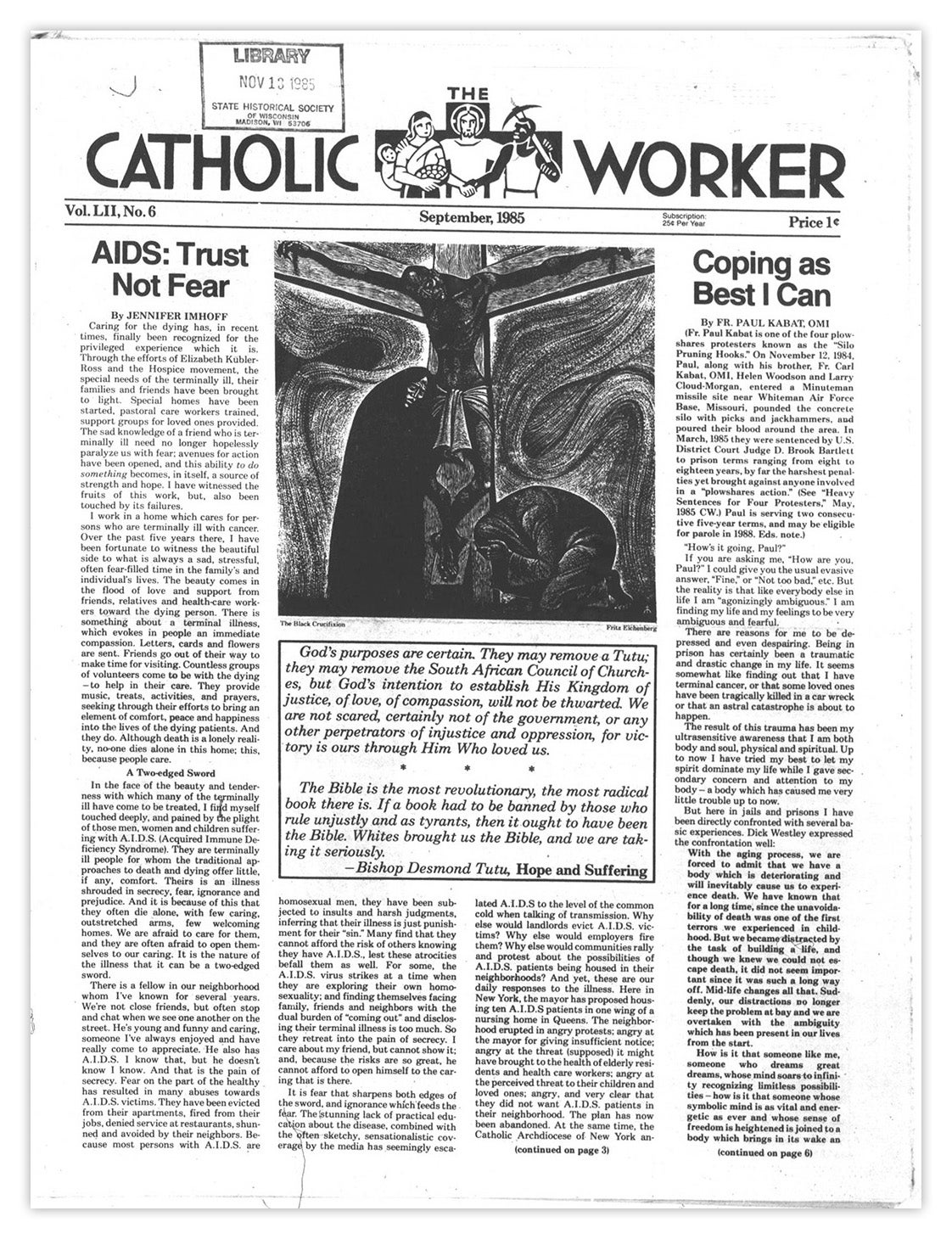
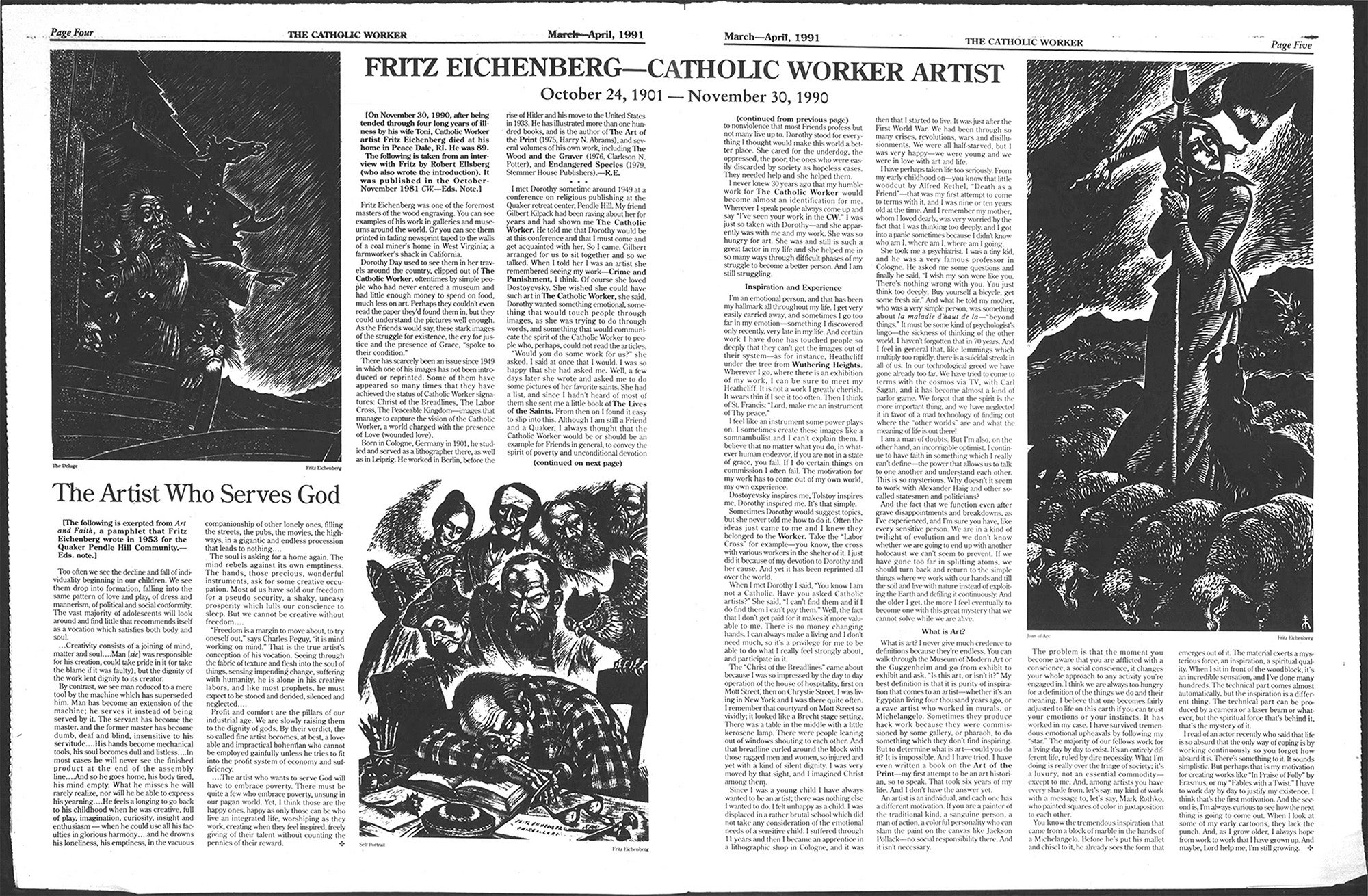
While visiting the Quaker retreat Pendle Hill around 1940, he met Dorothy Day, who persuaded him to begin illustrating for The Catholic Worker, which Day co-founded with Peter Maurin in 1933. Eichenberg describes Day having an enormous impact on him—“perhaps the most important influence in my life”—and her newspaper published Eichenberg’s work for the next forty years, including The Labor Cross (1954), a multiracial depiction of the American worker, and The Black Crucifixion (1963), a representation of crucified Jesus as a Black man, accompanied by Mary, eyes closed in mourning.
Post-conversion, Eichenberg’s art cohered around the Quaker philosophy “that there is that of God in every man.” In the turbulent postwar years through the height of the Cold War, this tenet was a guiding light for the artist, who viewed his work as a way to communicate across linguistic, racial, and religious differences. During this time, Eichenberg became a renowned leader in American printmaking, founding the celebrated Pratt Graphic Art Center in 1956, drawing students from around the world.
Likely influenced by Day’s own “anti-industrial stance,” Eichenberg observed the effects of Fordism on art in an illustrated pamphlet for Pendle Hill, Art and Faith (1952). In it, he suggested that mass production breaks the “creative man” by condemning him to a single function on the assembly line. In the process, “his soul becomes dull and listless—the first step toward the creation of an automaton.”
To reclaim one’s freedom, one must return to one’s art, an ultimately spiritual journey, Eichenberg asserts, on which any person may embark. Eichenberg’s Quakerism converged with Day’s Catholic socialism in a shared interpretation of Christian personalism that emphasized individual freedom and moral responsibility. According to Eichenberg, for the artist to play his part as social witness—perhaps the most important function of art—he must also be free. In a declaration reminiscent of The Catholic Worker’s utopianism, Eichenberg wrote in Art and Faith, “We must become creative again, whole again, and aware of our responsibilities as architects of a new moral order.”
By contrast, Eichenberg described modern art as fragmented and soulless, prisoner to the consumerist spectacle of modern life, alternately childlike—“an attempt to laugh off a nightmare”—or an abdication of man’s “social and political struggles.” Decades later he reiterated this opinion, pronouncing abstract art—including Abstract Expressionism, Earth Art, and Op Art—as largely useless for art’s spiritual function, which necessarily requires an “emotional response.”
Eichenberg’s views on art’s social function reflect its precarious role in Quaker history. In early America, Quakers, respecting “the doctrine of simplicity,” held a generally negative view of the fine arts and art education, writes Erin E. Zavitz. An exception to this tradition was preacher and painter Edward Hicks, most known for his sixty-two Peaceable Kingdoms, inspired by the Book of Isaiah. Eichenberg was similarly drawn to biblical iconography, publishing a portfolio of ten wood engravings of the Old Testament in 1955, including “The Peaceable Kingdom,” which also appears in the 1962 reprint of Art and Faith. In the Preface to the reprint, Eichenberg admires Hicks’ rejection of the faith’s religious iconoclasm and posits that twentieth-century artists should follow in Hicks’ footsteps to become “‘an Instrument of Thy Peace.’”
By this time, Eichenberg viewed his own art as an articulation of social conscience, an expression of common feeling revealed through the woodcut reduction. It was from his Quaker faith, too, that he critiqued the abstract movement, regarding it as neither “civil” nor “useful”—the Quaker standards for appropriate artistic pursuits—and perhaps even “Victorian” in its scarcity of emotional appeal. Yet, while Eichenberg championed representational art at home, he criticized the Soviet doctrine of socialist realism for the limits it placed on “creative freedom.” Recounting his 1963 visit to Moscow with the Graphic Arts: U.S.A. exhibit, he wrote, “There is a lot wrong with art in America—as there is a lot wrong with the world we live in. But art must be an expression of man’s free spirit. It cannot be put into any cage—gold or iron—without killing its very essence.” In the same account, he recalls explaining contemporary art to Soviet audiences who had never before seen “a print or an abstraction.” In those conversations, the modern art he panned in America became “an invitation” to personal contemplation.
Weekly Newsletter
"*" indicates required fields
A self-described “conciliator,” Eichenberg was dedicated to cross-cultural dialogue. He maintained correspondence with artists from the Soviet Union to New Guinea, relationships reflected in Artist’s Proof, a publication he edited for the Pratt Graphic Art Center, which regularly featured work from international artists. In addition to his travels with the U.S. Department of State, Eichenberg advocated for presses and supplies at schools and studios in the Global South to carry out his mission to “promote printmaking” around the world. He eventually published The Art of the Print (1976), which remains a classic account of the global history of printmaking, informed by his international collaborations.
The Lessons of Literature
In addition to his Quaker faith, literature played a huge role in Eichenberg’s artistic outlook. “No doubt, the book and I were made for each other,” he wrote. In the 1940s, he was approached by Harry Abrams, art director of the Book-of-the-Month Club, to illustrate a special edition of Jane Eyre and Wuthering Heights. The partnership was successful, and he went on to illustrate more of the Book-of-the-Month Club editions, including Fathers and Sons and The Brothers Karamazov. He was particularly enamored with Russian novelists, who shared his fixation on human suffering and found in them a point of connection with Soviet audiences during his visits to the USSR.
More to Explore
Preserving the Art of Ed Aulerich-Sugai
For Eichenberg, the process of illustration turned reading into a visual activity. In an essay titled “Portrait of the Artist in Love with the Book” (1965), he describes “mak[ing] thumbnail sketches,” noting the time, space, staging, and environment of the narrative: “After accumulating hundreds of sketches, the conception of the total book slowly emerges—the format, a typeface that fits the mood of the book and the character of the illustrations.” Illustration conveys a careful close reading, an examination of how the elements of a work of fiction fit together to create meaning.
Eichenberg urged his printmaking students to read the world around them in similar fashion, “to cut away all that is non-essential, to define character in action, to discover the significance of silence, and to make it speak to an audience.” In an interview in the early 1980s, as humanity looked for the meaning of life in extraterrestrial species and other planets, Eichenberg lamented our reluctance to find it first in each other. “The best of all possible worlds” is our own, he believed, and the greatest mystery was not the unexplored cosmos but “the power that allows us to talk to one another and understand each other.” At a time of comparable technological upheaval, we might all benefit from finding what Eichenberg called our own “star”: our creative raison d’être, our freedom.


.jpg)