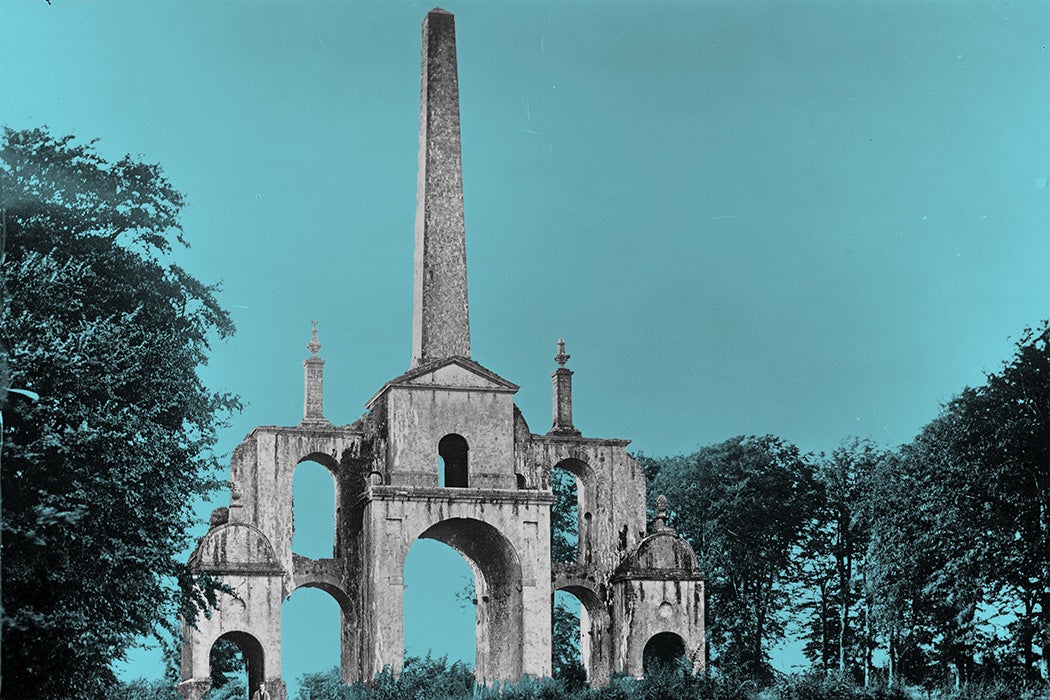
In the middle of a green Irish field stands a bizarre structure: not so much a building as a collection of holes, a series of gaping arches framing the sky. This is Conolly’s Folly, built in 1740 at the height of a terrible famine.


Follies are, by definition, frivolous. They are buildings with no purpose. But there is nothing frivolous about this folly’s history. It was built by the starving as an alternative to simple charity—a way to earn a little money and keep body and soul together.
Conolly’s Folly is an early example of make-work infrastructure. That same model was adopted on a much larger scale when the Great Famine struck just over a century later. The British government was ideologically opposed to providing aid without work. As a result, all across the Irish landscape, there are “famine roads”—running from nowhere to nowhere and now slowly disappearing into the grass.
They are eerie places. In one case, while working on an excavation, archeologists spoke with a local woman who recalled that, in her childhood, anyone who had to go near the road at night would sprint past it for fear of ghosts.
Typically, the roads were planned out by simply drawing a line on a map between one point and another, with little to no surveying of the actual terrain. As a result, in some places, the starving workers were forced to cut through solid rock.
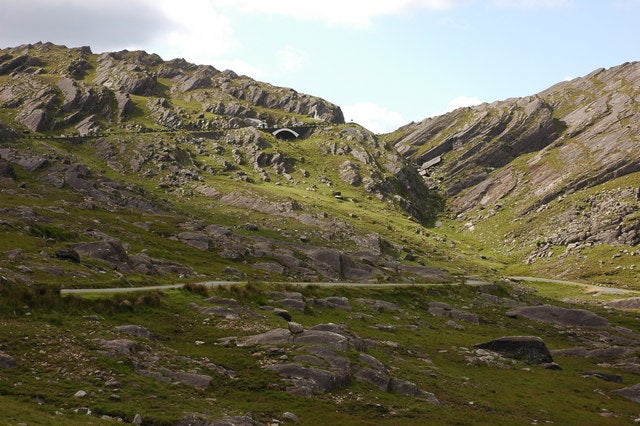
They worked through midwinter, in twelve-hour shifts, starting at 6 a.m.; if they arrived late, their pay was docked, and if they weren’t there for the final roll call, they received nothing. Only heads of household were allowed to work on the roads, so the pittance they received—which was barely enough to buy a few turnips—had to somehow stretch to support a whole family. At the same time, food prices were skyrocketing, and wealthy landowners continued to export grain out of the country.
Still, for the starving, working on a famine road was the best option available. In fact, there was stiff competition for these back-breaking jobs; people stood by and watched as the workers built the roads, hoping that someone would drop and they would be able to take their place.
More to Explore

The Irish Fasting Tradition
In one case, after a man was fired from a famine road, a crew of his buddies broke into the overseer’s house and left a note threatening grave retribution if his job was not restored. As a result, the whole project was suspended, with one official writing that the people working on it were “a most disorderly lot, by all accounts.”
In 2021, the Center for Community Archaeology excavated the remains of one of these roads. They expected to find artifacts buried under the stones—clay pipes, animal bones, the usual signs of human life. There was nothing there. It was, as Professor Eileen Murphy put it, “a stark reminder that these people had nothing.”
Weekly Newsletter
"*" indicates required fields
In 1944, a century after the Great Famine, the Irish Folklore Commission undertook a massive survey to collect memories of the time. In a 1996 analysis of the results, historian Carmel Quinlan observed that the tales collected revealed something strange about the stories people told. Most of the stories of starvation focused on strangers, or claimed that the respondent’s town had been spared the brunt of the famine—even when the statistics painted a different story entirely. She writes:
It is likely that inability to communicate the horror of the famine, together with a legacy of guilt, was experienced by those who witnessed deaths of family members, while they themselves survived.
These absences tell us something about the extremity of the circumstances that produced them: a gap in memory, a void of artifacts, a road leading nowhere and slowly swallowed by the grass.


.jpg)
