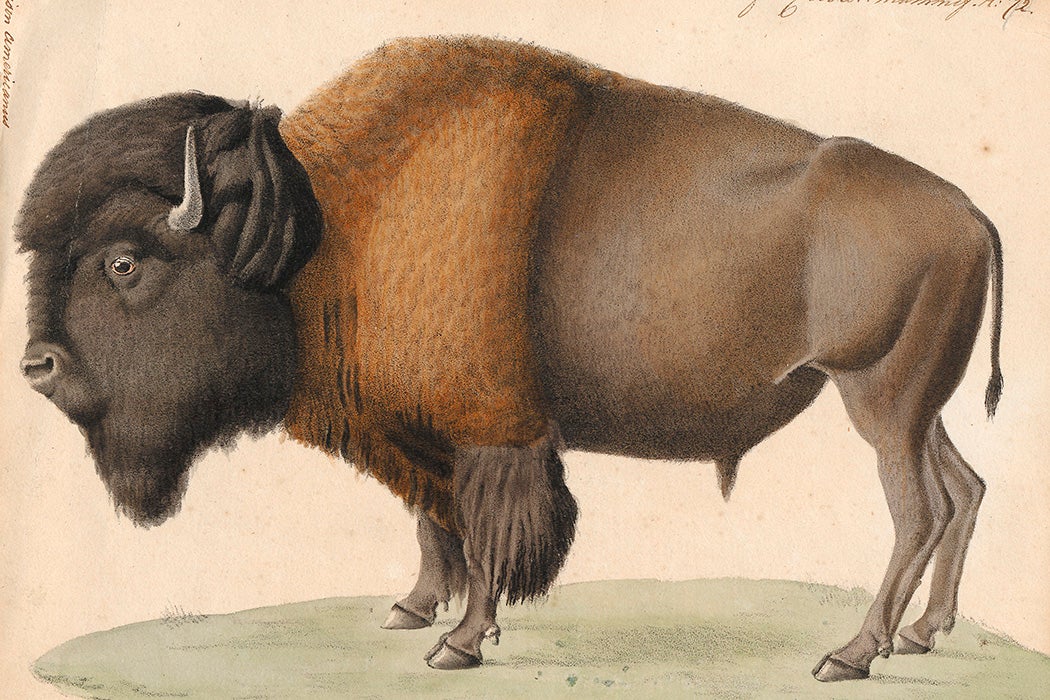
The mass slaughter of the American bison during the 1870s and 1880s was unprecedented. The shaggy bovines of the plains and boreal forests were nearly hunted to extinction in a frenzy of killing that decimated their population. There were tens of millions at the beginning of the century, and barely a few hundred by 1890.


The animals were killed for their hides and their tongues, a culinary delicacy, but also as part of the campaign to ethnically cleanse Native Americans from the land. The John Wayne character in the quintessential movie of settler-colonialism, The Searchers (1956), makes the connection outright: no bison, no food for the Comanche in winter. Bison slaughter was a form of biocide in service of genocide, although neither ultimately achieved its aims.
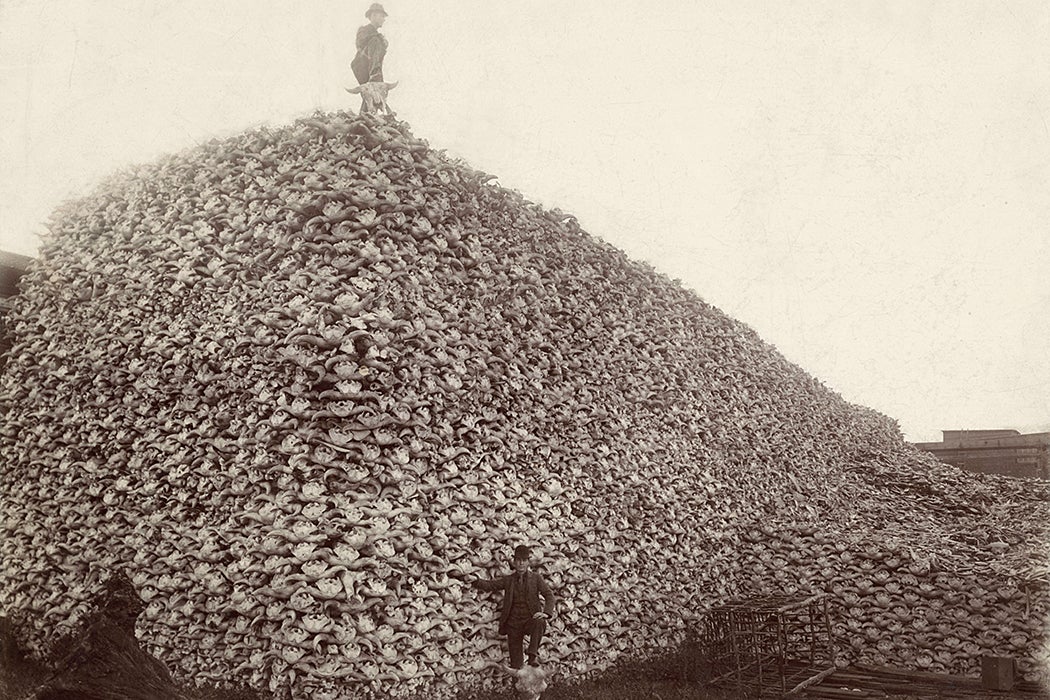
Less well known is that the vast numbers of bones left over didn’t just sit there to decompose over time. They fueled a brief but intensive extractive industry that lasted as long as the raw material. An infamous image of a mountain of bison skulls tells the story in the small print of the caption: they are piled up outside Detroit’s Michigan Carbon Works plant. The bones were the raw material for factories.
The bones were ground up into bone ash, used as fertilizer, and burned to make bone black, used both as a dye and a filter for cane sugar juice. Michigan Carbon’s “Homestead Guano,” for example, was famous on farms to the south and east; belying the name, it wasn’t bird excrement but ground-up bison bones. Meanwhile, remaining hides, skulls, and hoofs could be made into glue. A smaller amount of the bone was turned into buttons, knife handles, fans, and umbrella ribs, bone being a cheap substitute for ivory before the age of plastic.
Historian Casey Pallister argues that the brief but intense era of the bone hunters, those who scoured the land for the bones, should be better known:
The carcasses of the great animals, picked clean by scavengers and left to bleach in the prairie sun, proved immensely important as sources of labor, capital, survival, and imagination in the North American West.
The bison bone trade “was part of a web of well-organized capitalist extraction industries” in which bone hunters were “part of a laboring class as much as they were opportunistic individuals looking to make an extra dollar.”
More to Explore
Where the Bison Roam—Again?
Settler colonialism is characterized in part by the erasure of the history of those removed and replaced, so American myth tells of bootstrapping settlers exploiting the bones. But, as Pallister notes, “when one examines primary literature, it is apparent that Native Americans undoubtedly dominated the workforce, carving out their own place in the prairie industry but often doing so for similar reasons as most white settlers: survival.”
Barred from jobs outside wage labor, Native Americans sometimes “exercised considerable power over the price per ton of bones because of the dependency of middlemen on their labors.” Mixed-ancestry people (called Métis in Canada) who were not bound to reservations, in particular, roamed far and wide collecting bones and came to dominate the trade. As Pallister writes, “The bone trade proved part of a continuous pursuit of bison bodies for sustenance as well as trade goods in the American capitalist system.” It was “hardly a replacement for the rich bison-hunting lifestyle of the past,” but it “at times revealed a certain level of cultural continuity.”
Weekly Newsletter
"*" indicates required fields
Bones from about one hundred complete skeletons made up a ton of weight, which earned bone-hunters $4-$12, depending on the market. (Edwin Ford Piper has “a dollar for a ton” in his poem “Dry Bones,” quoted by Pallister.) The work was hard, and a gamble: “one might hit the ‘motherlode’ and accumulate considerable weight in a matter of hours, but more often it took days and long distances to fill a wagon or cart.”
The bone boom lasted less than two decades, and, being self-devouring, left little trace on the landscape. It was a kind of double erasure: no animals, no remains. Yet there are still hints: before being named for Queen Victoria, Regina, the capital of Saskatchewan, was known as Pile-of-Bones because it was a staging point for bison bone.