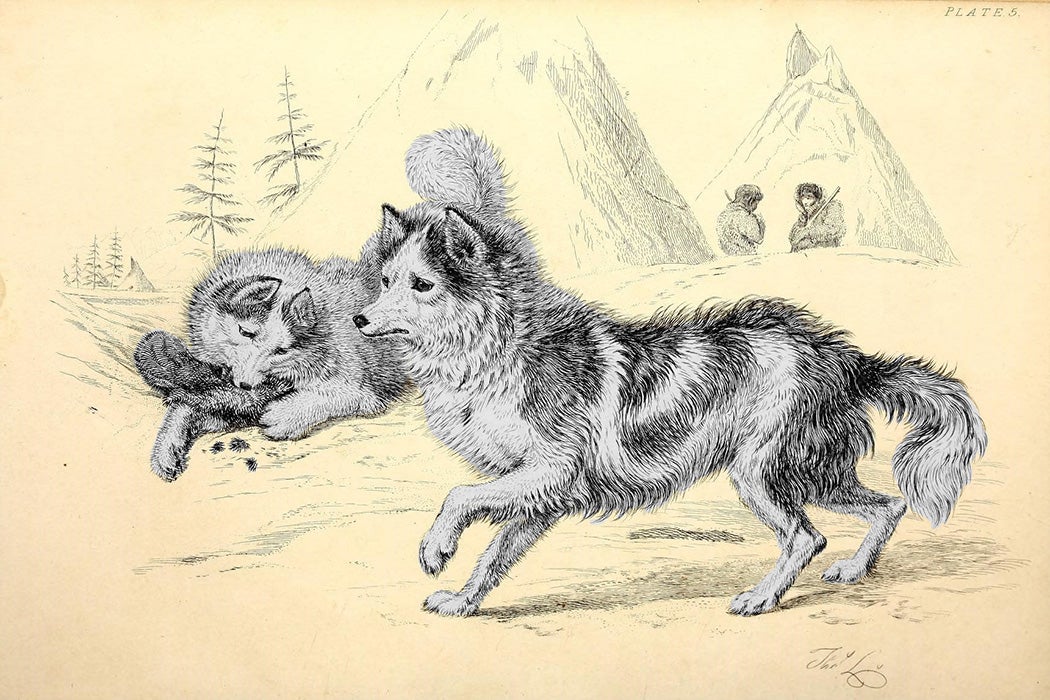
“What is thought to be one of the earliest recorded wolf attacks” in North America, as described on Wikipedia, occurred on January 19, 1621. Mayflower colonist John Goodman was out for a walk around Plymouth Colony with a spaniel, one of the two dogs that had also made the journey aboard that famous ship. The “little Spannell” freaked out when two big bounding canines approached, but Goodman fended them off with a “paile bord” as Mourt’s Relation, the early chronicle of the colony, put it.


Then, curiously, the big canines “sat both on their tayles, grinning at him, a good while, and went their way.” The problem here, as historian Strother E. Roberts points out, is that this does not sound at all like the way wolves act. Roberts argues that the two canines were not wolves but dogs, domesticated Native American dogs whose ancestors had come across from Asia along with the ancestors of the first peoples of the Americas.
“Rather than observing a confrontation between European domestication and American wilderness, Goodman stood witness to the reunion of two branches of the domesticated canine family tree separate from one another for thousands of years.”
Goodman’s error was perhaps the first of the “almost universal tendency among English writers to misidentify Indigenous dogs as either wolves or some separate race of wild dogs.” The tendency has continued; Roberts cites a 2004 history of wolves in North America in which the Goodman incident is related one more time.
It is true that Indigenous dogs didn’t look like European dogs. Domestication in Europe had usually resulted in dogs with floppy ears and shorter snouts, classic signs of domestication as cuteification. American dogs had erect ears and longer snouts, giving them a more wolf-like appearance, the common ancestor of all domestic dogs. Indigenous dogs were also great hunters.
More to Explore
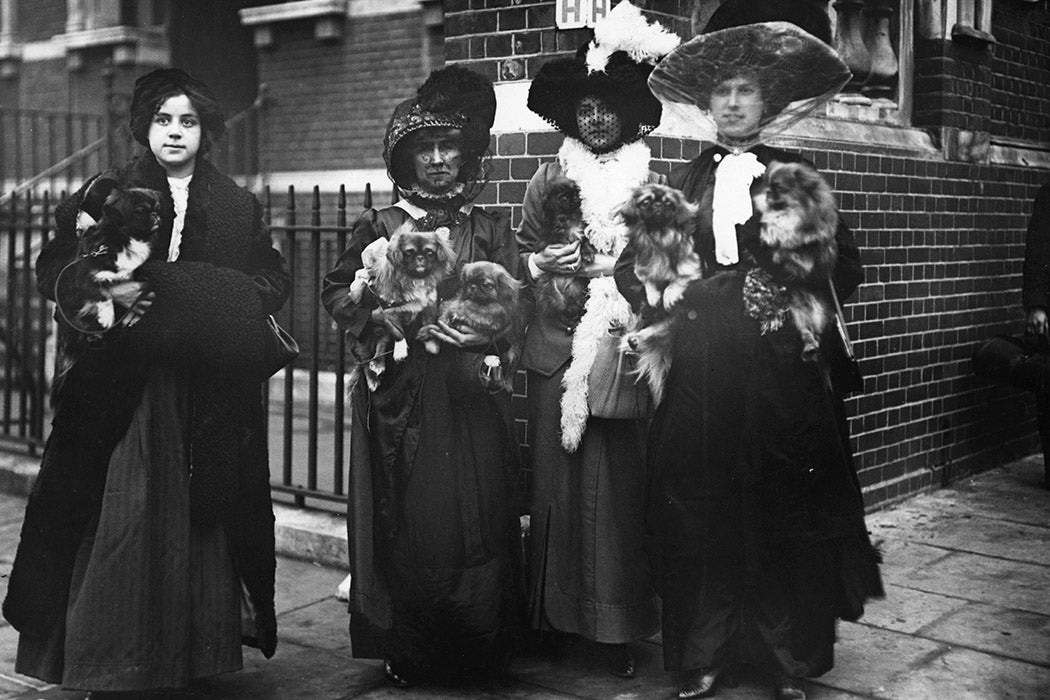
The Surprising Imperial History of the Pekingese Dog
Perhaps more importantly, the settler-colonialists refused to accept that the dogs who lived among indigenous people as companions, guards, and hunters were domesticated. Indians, the English believed, could not domesticate animals since domestication was an art of civilization and Indians were the antithesis of civilization. Claiming the dogs were tamed wolves served the ideological needs of settler-colonialism. Wild animals equaled wild people and vice versa. The English, writes Roberts,
dehumanized the Native Americans in whose communities those dogs lived at the same time that they effectively erased the fact of Native domestication practices from the historical record. Both processes furthered the larger imperial project of impugning Native American nations as uncivilized and, thus, rhetorically legitimized their dispossession.
And the settlers were quite successful at it. The Indigenous peoples of the Northeast were largely erased from the map. And “genetic research on Indigenous canines does clearly show,” continues Roberts, the “replacement of a great majority of the Northeast’s historical Indigenous dogs with those of more recent Eurasian heritage.” But, Roberts reminds us, just as the people were not ultimately extirpated, “despite white scholars’ insistence on their historical disappearance,” the idea of “the complete extirpation of Indigenous dogs should be approached with caution.”
Weekly Newsletter
"*" indicates required fields
“It is impossible to say with certainty that no dogs with indigenous heritage still live in New England. Indeed, the clear parallels to the ‘vanishing Indian’ narrative of the late eighteenth through twentieth centuries warn against writing indigenous dogs off too quickly.”
Indigenous dogs would continue to be “misidentified and persecuted” as wild animals “as explorers, traders, and settlers carried their prejudices west with them across the interior of the continent.”
New England and then continental attempts to eradicate Indigenous dogs were “a means to control Native American communities and tame what the newcomers chauvinistically perceived as a threatening wilderness dominated by savage people and their wolfish companions.”



_(9253153975).jpg)