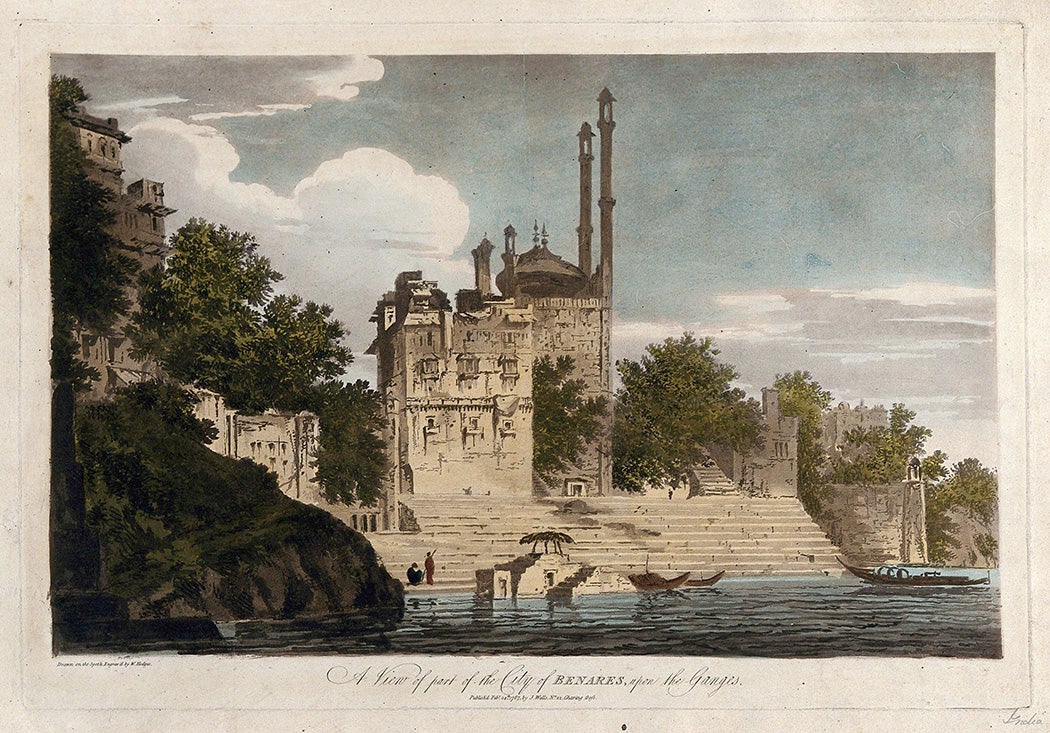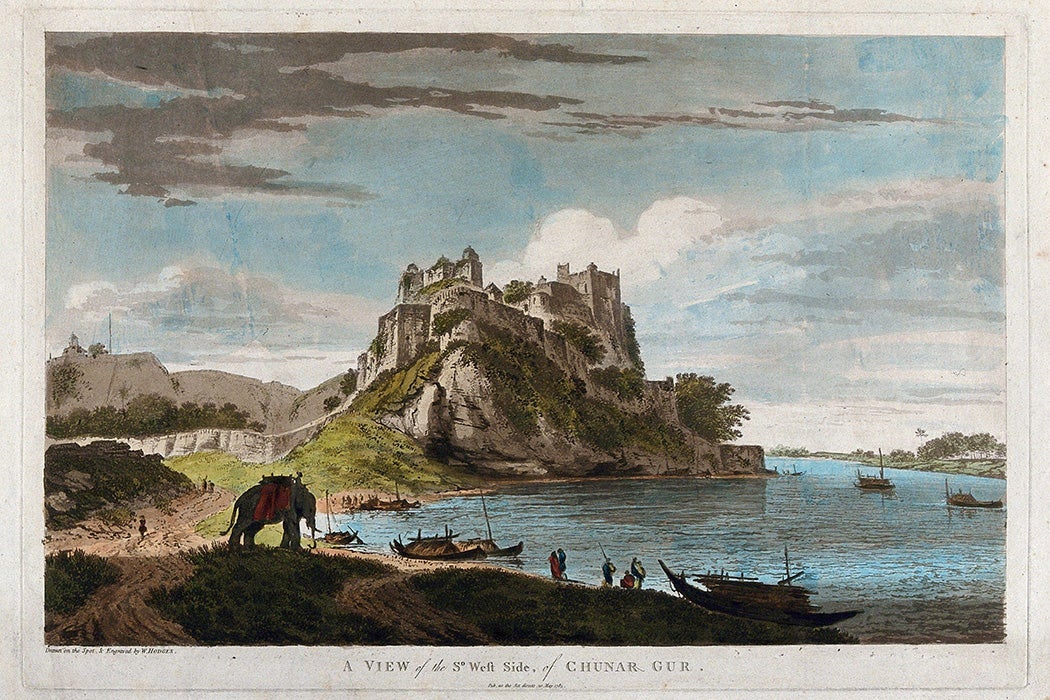
Having apprenticed with landscape artist Richard Wilson for seven years, William Hodges began traveling the world to capture scenery in far-flung lands through his sketches, paintings, and etchings. The artistically uncharted territory of India was a huge draw for him, and upon arriving there in the late eighteenth century, he was taken under the wing of Warren Hastings, the Governor-General of Bengal.


Their relationship proved mutually beneficial. In a 1973 article, historian Isabel Stuebe explains:
On arriving in Calcutta in the spring of 1781, William Hodges first met Warren Hastings, then Governor-General of Bengal, who was to become the artist’s lifelong friend, as well as his most generous patron. During Hodges’s two-and-a-half year stay in Northern India, Hastings granted him an annual salary, and later in England he purchased many paintings of Indian subjects.
Stuebe notes that Hastings’s collection at his house at Daylesford included numerous paintings, drawings, and aquatints by Hodges.
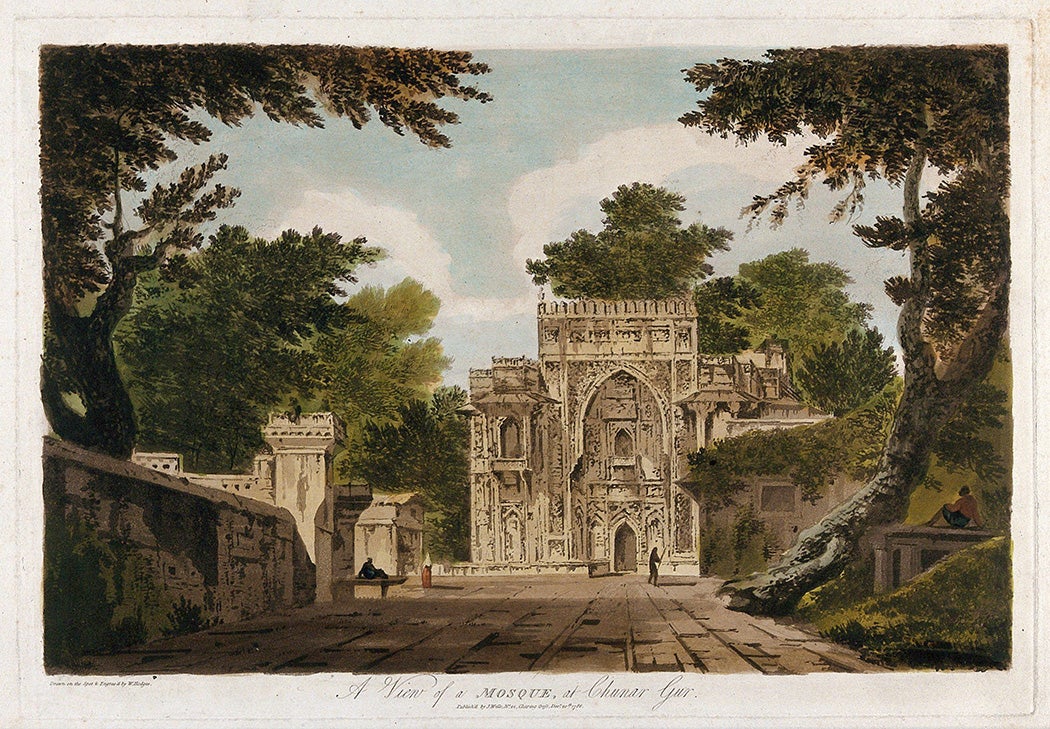
While the artist’s prodigious skill offered cause for appreciation, Hodges’s exalted position can also be credited to peculiar circumstances. In the summer of 1781, Hodges accompanied Hastings to Benaras on a diplomatic visit to Chait Singh, the area’s zamindar, or landowner, who defaulted on an additional tax payment imposed by Hastings to fund the British army’s military campaigns. When fighting broke out, the English party beat a hasty retreat to a nearby fort under their control.
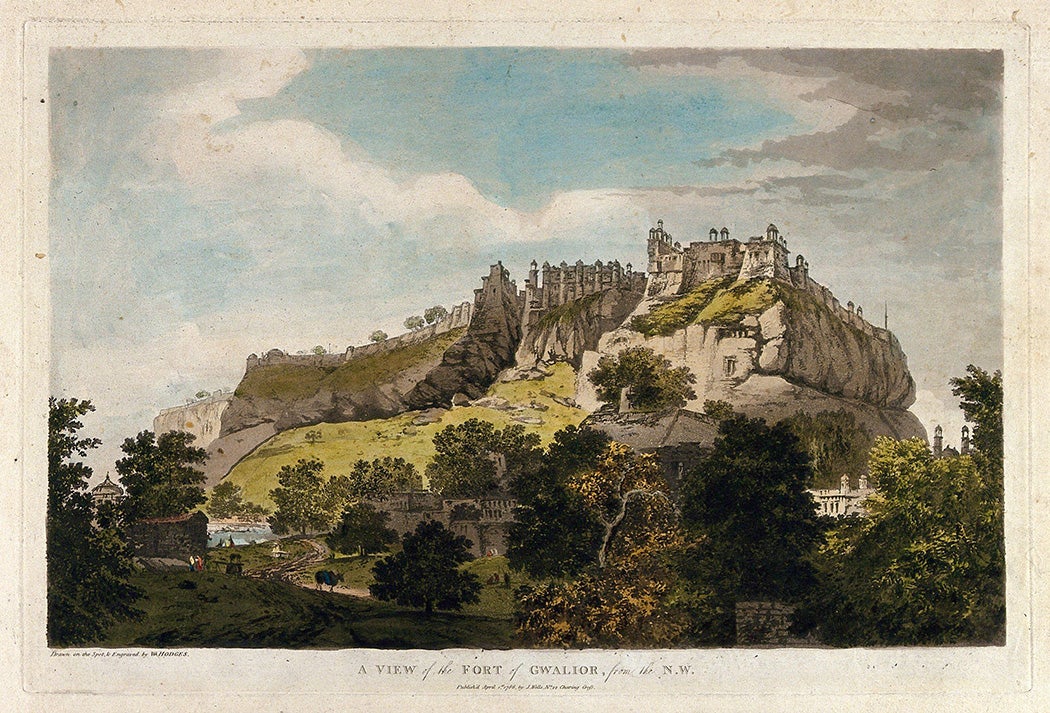
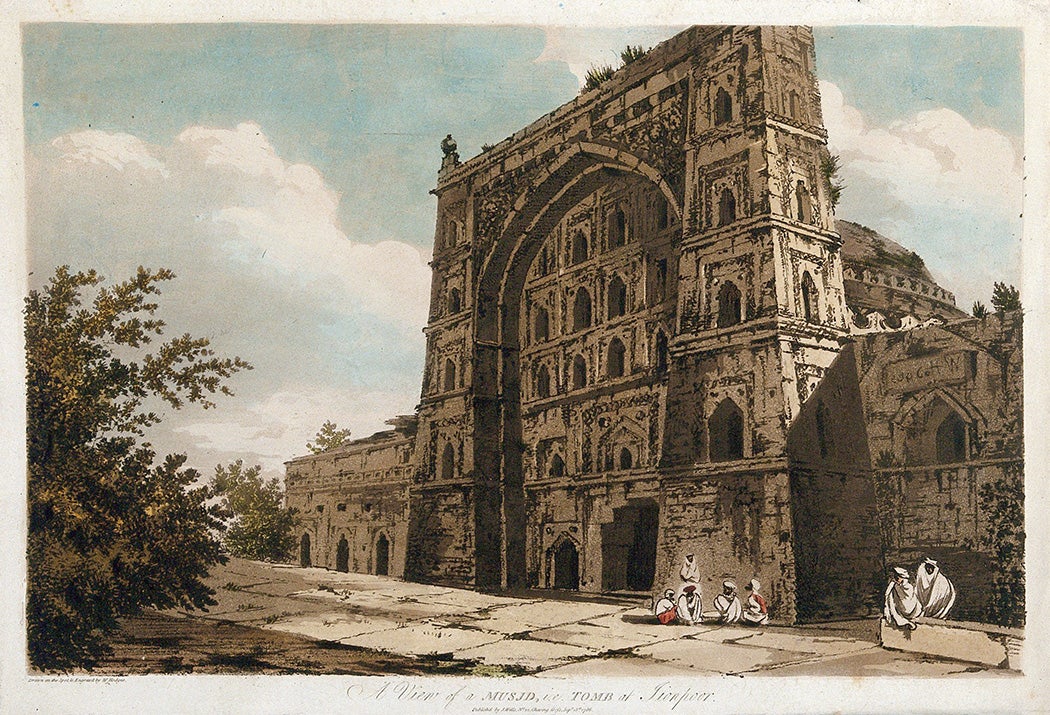
Over the next few months, Hodges documented the scenery of their unusual hideouts in his art. In keeping with his artistic training and the demands of the day, he eschewed gory scenes of battle, painting romanticized and picturesque landscapes instead. These included drawings of the two fortresses that his party occupied during this campaign—Chunar and Bijaigarh. Later, he accompanied Major Browne’s troops to Agra and Gwalior, documenting the former’s important monuments and the latter’s status as the historic site of a major British victory in 1779.
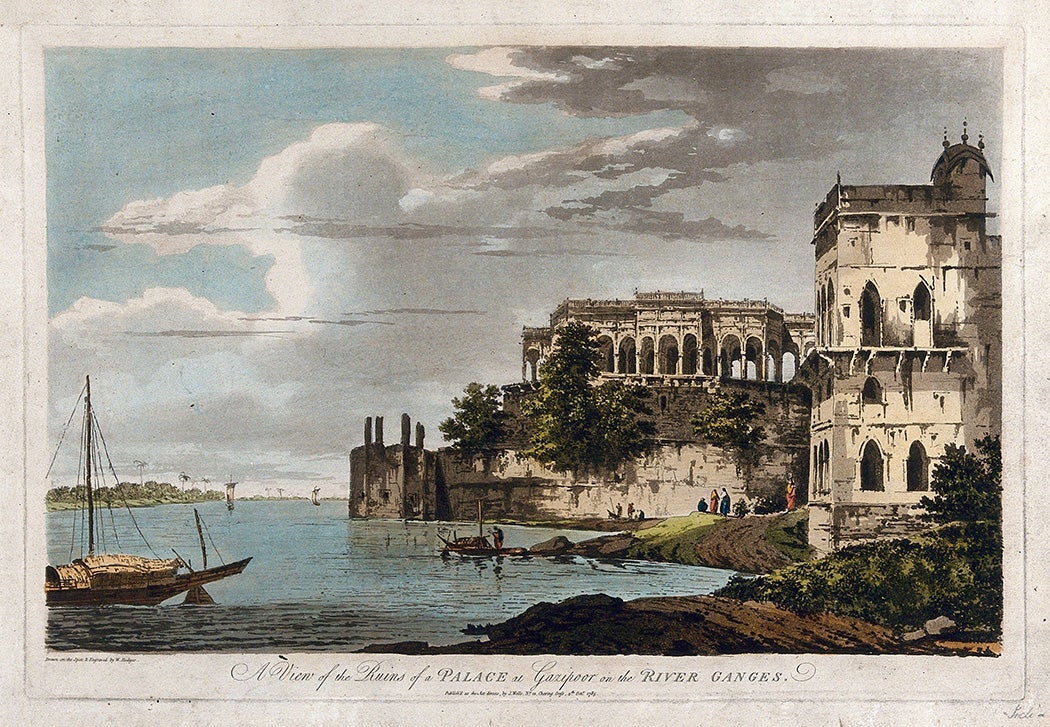
Hodges’s depictions of the region’s vast landscapes cast colonization as an idyll, rendering them as picturesque extensions of Europe. As Jeffrey Auerbach writes in a 2004 article:
How did Britons conceive of and represent their empire, especially during the 19th century, the period of its greatest expansion?…Art too was critical in helping British men and women construct and visualize their empire. This was especially true of the picturesque idiom, which had a powerful impact on almost all subsequent forms of imperial representation, including photography and advertising from the mid- 19th century onwards. Most of the recent studies in this area have emphasized the ‘ideological work’ of paintings, through which the appropriation of land, resources, labour, and culture is transformed into something that is aesthetically pleasing and morally satisfying.
Auerbach argues that this “picturesque” aesthetic presented a homogeneous version of the far-flung regions of the British Empire, flattening differences across regions as diverse as South Africa, India, Australia, and the Pacific Islands.
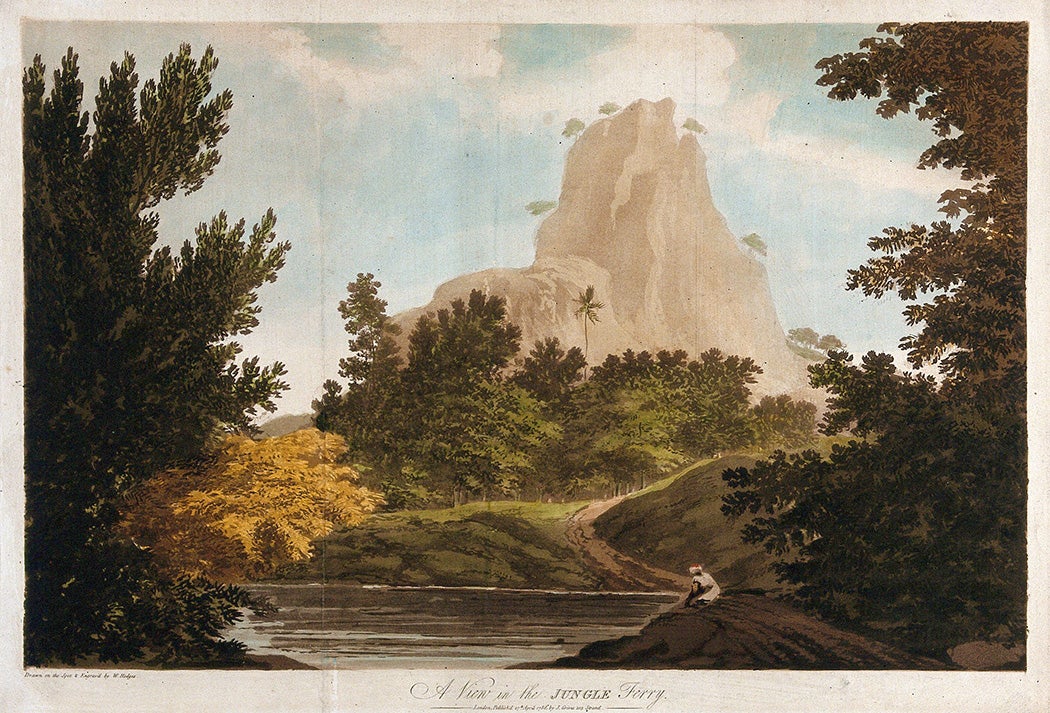
While Auerbach’s theory places Hodges within a larger category of artists romanticizing the notion of empire, Stuebe believes Hodges was singular in his “fascination for architecture and exotic scenery.” This is especially true in the case of India, as he was the first professional landscape artist to venture there.
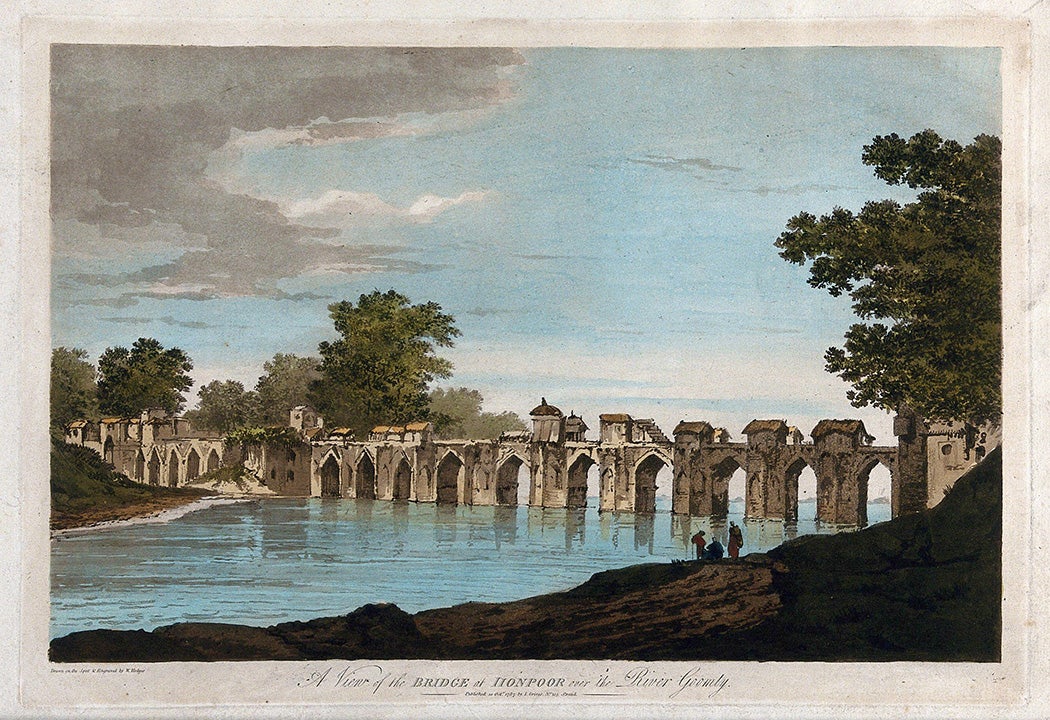
Stuebe further asserts that Hodges pandered to the idea of a homogenous empire promoted by the East India Company because he was grateful for the patronage he received from Hastings. Calling attention to Hodges’ drawings, which are sometimes at odds with the picturesque final paintings and prints made after his return to England, she argues that, left to his own devices, he may have presented Indian landscapes in a different light.
Weekly Newsletter
"*" indicates required fields
However, G. H. R. Tillotson offers a different view in a 1992 article for the Journal of the Royal Asiatic Society, arguing that Hodges’s adherence to the picturesque reflected artistic convention rather than pressure from patronage:
This, by an eighteenth-century view, was not making concessions but making art…He was not concerned with inventing the future of art history; like many artists of the eighteenth century, he was concerned to paint, not in a new manner, but in an established, fine one.
Whatever his motivations, Hodges’s paintings played an important role in shaping ideas of empire. Setting aside the political implications, they remain invaluable for their documentation of Indian heritage sites and people. As Tillotson puts it, “Being the first into the field, William Hodges did not have to contend with precedents, with others’ views, but could work on a clean slate. He therefore could and did fix an image of Indian architecture for his generation and beyond.”