Reveal Digital on JSTOR
When approaching recent historical events, where the scope of destruction and loss can be unfathomable in scale, oral history can bring both connection and immediacy through individual stories of loss, grief, rescue, or triumph that would otherwise disappear in the grand sweep of “Great Men and their Deeds.”


Scholar Indira Chowdhury describes the approach:
[T]he method enables the documentation of certain aspects of historical experience that are often missing from other kinds of historical sources. Oral historians not only interview and engage in conversation with living sources, they also find themselves challenged in a unique way—the historian is transformed into a protagonist in the dialogue. Oral history is perhaps the only field where the sources talk back to the historian, confronting, disputing, disrupting, and sometimes resisting the historian’s understanding of the past (Frisch 1990; Shopes 2012). Oral history works with the interviewee as a partner in dialogue and the verbal form historical truth can take is always co-constructed (Cook and Goodall 2013; Goodall and Cadzow 2009; Portelli 1991).
Some of the most effective (and affecting) projects using this approach concern communities that may be far outside of the audience’s experience, whether due to time, geography, or identity. Works like Shoah by Claude Lanzmann, Hard Times by Studs Terkel, and Boots of Leather, Slippers of Gold by Elizabeth Lapovsky Kennedy document their subjects through the voices of those who lived through specific moments and events that can be overwhelming or remain unknown without a more interpersonal method.
The history of the HIV/AIDS epidemic has recently become the subject of numerous oral history projects, where the stories of survivors, caregivers, activists, and health care professionals have been collected and made available online, traditionally published, and edited into documentaries.
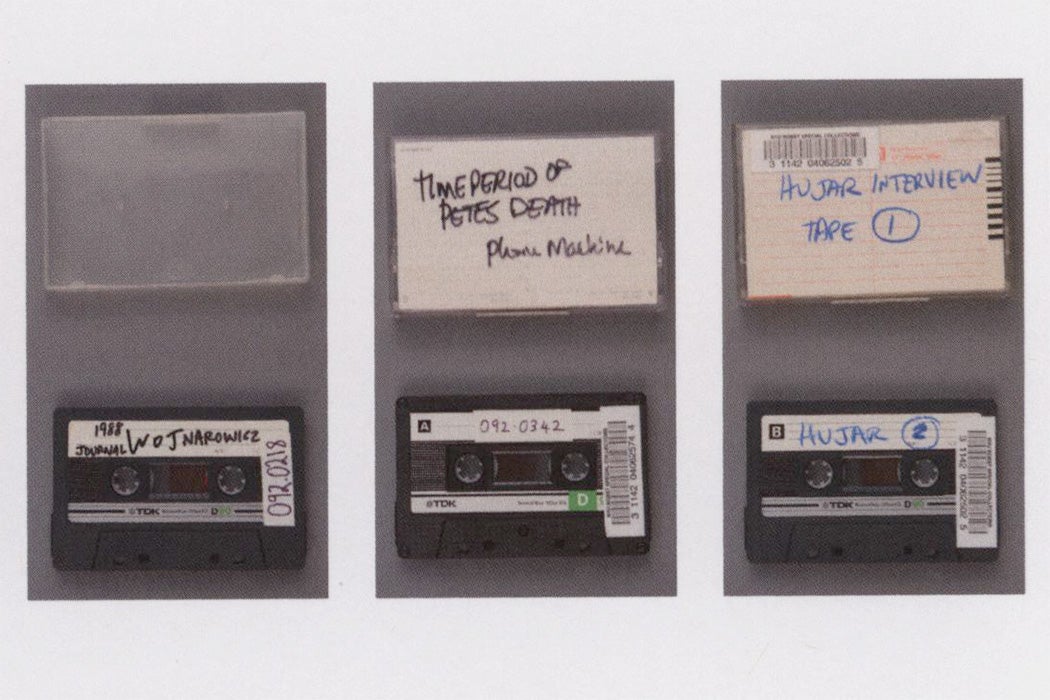
One such collection, Visual Arts and the AIDS Epidemic, was begun in 2015 by the Smithsonian Archives of American Art after receiving a grant from The Keith Haring Foundation. Haring founded the foundation in 1989, a year before his death from HIV-related illness, to maintain his artistic and philanthropic legacy. The project interviewed forty artists about their lives, their work, and how the AIDS crisis intersected and permeated both.
Weekly Newsletter
"*" indicates required fields
The interviews in the Visual Arts and the AIDS Epidemic collection cover wide ranges of personal and creative history, ranging from insider gossip and “name-dropping” to theoretical discussions of method and art history. They benefit from interviewers who bring their own experience as artists, art scholars, and historians to the conversation, with questions and insights that make this collection a rich multifaceted history of AIDS, the arts, and activism.
In his 1990 article, journalist Richard Goldstein wrote about the deep relationship between art about AIDS and its creators. “One senses in much art about AIDS a sense of familiarity with its subject,” Goldstein writes,
as if the artist were immersed in dealing with the epidemic—as so many are. Many of the best works about this disease have been produced by people at various stages of HIV infection. Perhaps they have lost a lover, nursed a dear friend, or attended a dozen funerals at a young age, and feel themselves to be, in every sense, set apart by the experience. They are implicated. Their art signifies a collective trauma—mass death in the midst of life.
Reveal Digital, an initiative “to amplify important, long-overlooked voices of the twentieth century,” has made these histories, and more, available in their developing open access collection HIV, AIDS and the Arts.
Artists in The Early Years of the Epidemic
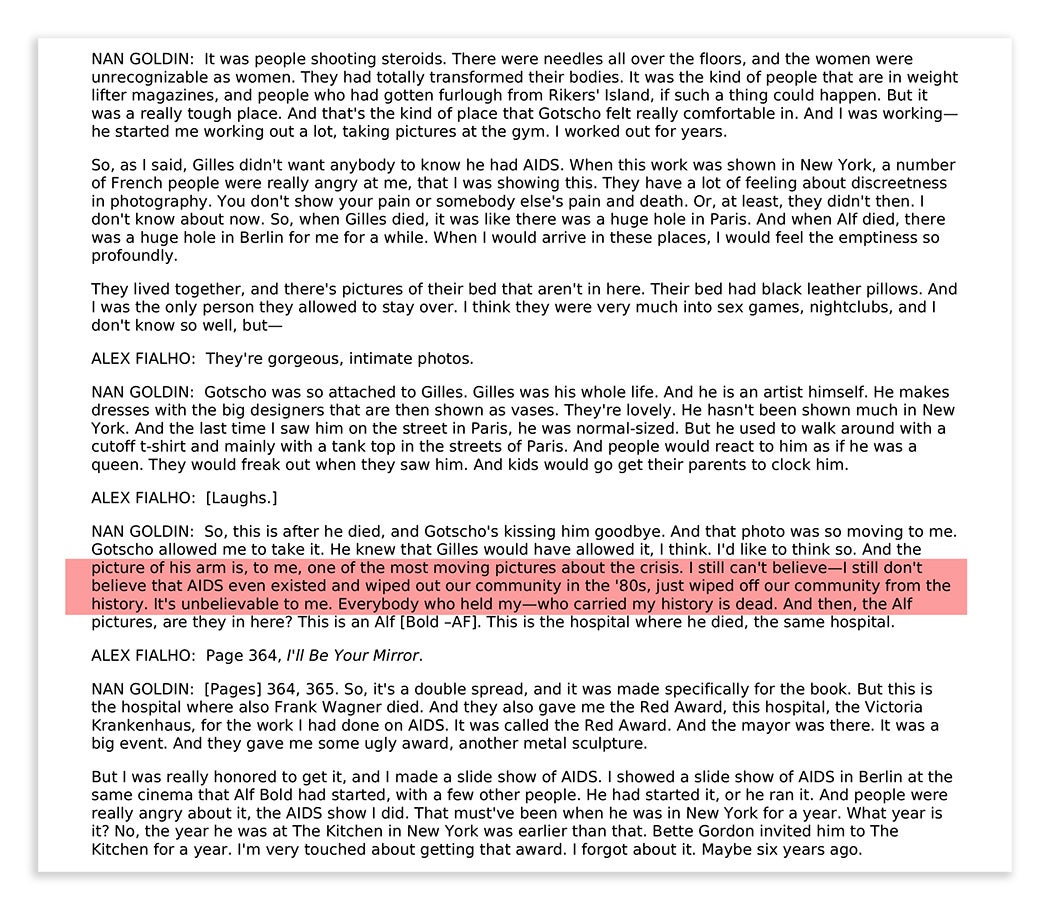
“I still can’t believe—I still don’t believe that AIDS even existed and wiped out our community in the ’80s, just wiped off our community from the history. It’s unbelievable to me. Everybody who held my—who carried my history is dead.” —Nan Goldin
The initial public responses by the US government to the first years of the epidemic were jokes at the expense of the ill at press conferences. President Reagan didn’t publicly say the word “AIDS” until 1985, four years after the first reported cases and two months after family friend Rock Hudson died of AIDS-related complications. That same year, Ryan White, a hemophiliac teenager with AIDS in Indiana, was prevented from returning to school after his diagnosis, and his family had to move after someone shot into their home.
One year later, William F. Buckley published a New York Times op-ed calling for HIV-positive people to be tattooed on the upper arm and buttocks to protect others (assuming that would protect both future sexual partners and intravenous drug users who might share needles). News reports about the disease largely focused on fear of contagion, the promiscuity and danger of gay men, and the threat of HIV to “normal” Americans.
Information about treatments for the many opportunistic infections that HIV made people vulnerable to was gathered in the early years by those under threat. Newsletters like “AIDS Treatment News” were photocopied and sold at LGBTQ bookstores, and buyers clubs imported potential treatments not yet approved by the Food and Drug Administration or available in the US. These groups and others, working with health care providers, had to become experts and educators at a time when US Congress was successfully prohibiting the use of funding from the Centers for Disease Control for education and prevention materials that would “promote or encourage, directly or indirectly, homosexual activities.”
In the interviews gathered in the Visual Arts and the AIDS Epidemic collection, artists describe how they first became aware of AIDS: from a loved one diagnosed after an illness; from hearing of a friend’s passing after not seeing them for a while; from a doctor telling them to stay with a partner because “there’s something going around”; or by learning of their own diagnosis. Friends were lost to the disease, and surviving family members denied the illness or sometimes actively excluded partners from funerals.
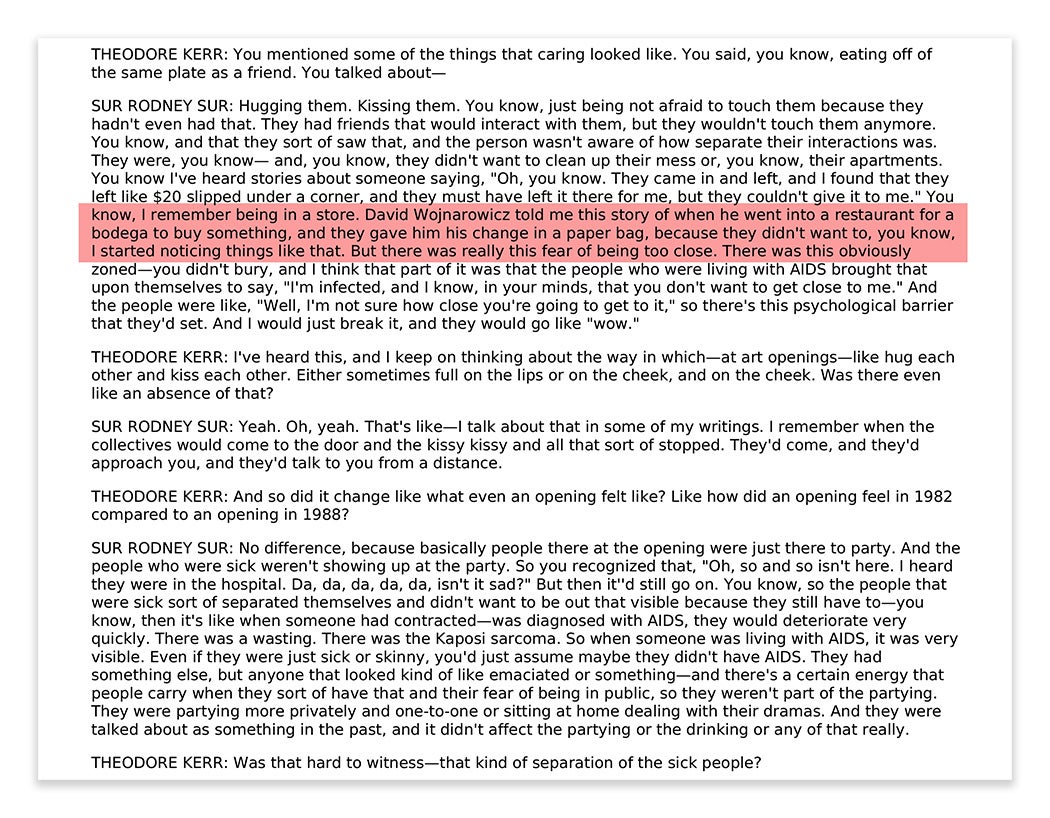
Sur Rodney (Sur), a New York City-based writer, gallery co-director, and archivist, relates that the late artist David Wojnarowicz would go to his local bodega in New York City where the clerks returned his change in a paper bag, out of fear. He describes his own anxieties when stepping in after a friend’s death to help save and archive their artworks and collections so they wouldn’t be destroyed (before there were nonprofit organizations to do so).
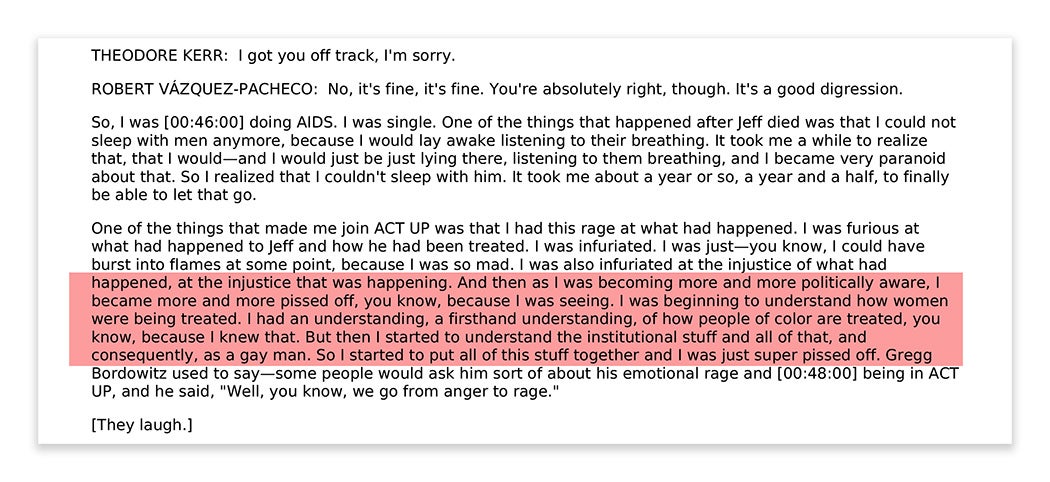
These personal experiences unfolded within the larger context of governmental indifference, active discrimination against people with the disease (or belonging to groups that were deemed “at risk”), and a growing consciousness of the political landscape of the epidemic. Robert Vasquez-Pacheco, a member of ACT UP and Gran Fury, recounts,
as I was becoming more and more politically aware, I became more and more pissed off, you know, because I was seeing. I was beginning to understand how women were being treated. I had an understanding, a firsthand understanding, of how people of color are treated, you know, because I knew that. But then I started to understand the institutional stuff and all of that, and consequently, as a gay man. So I started to put all of this stuff together and I was just super pissed off.
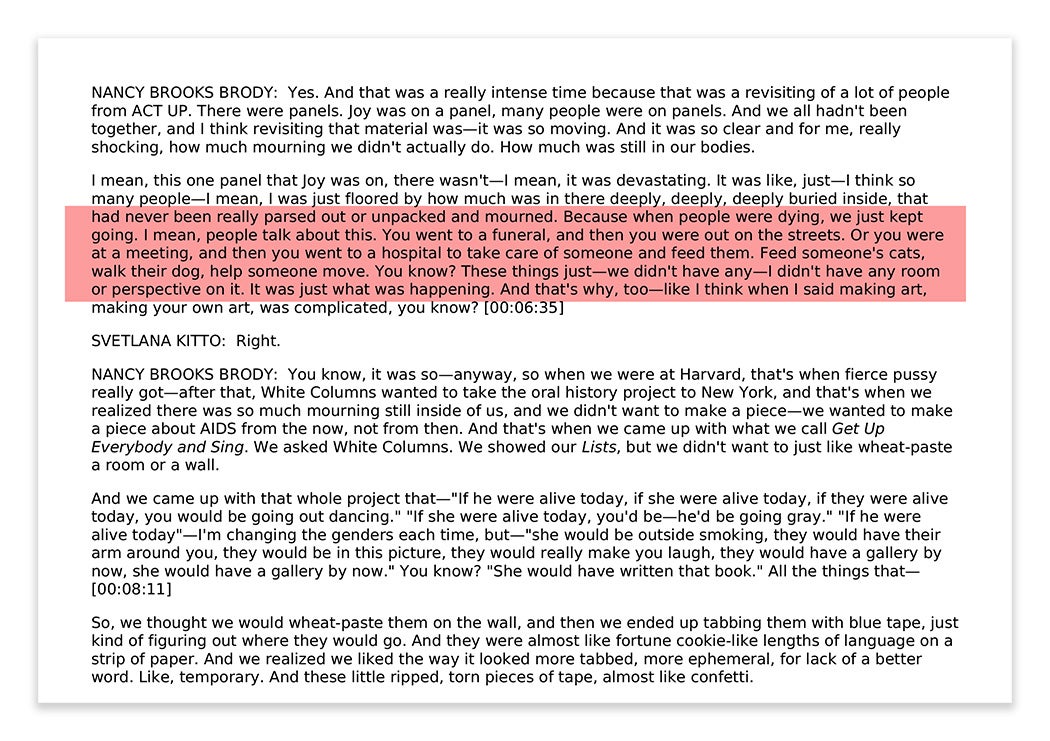
Some version of this process, repeated for many of the subjects, led people to activism, whether through art, volunteer work, protest, or sometimes all three. Nancy Brooks Brody (1962-2023), a visual artist and member of the fierce pussy collective, describes the progression in her interview.“Because when people were dying,” she explains,
we just kept going. […] You went to a funeral, and then you were out on the streets. Or you were at a meeting, and then you went to a hospital to take care of someone and feed them. Feed someone’s cats, walk their dog, help someone move. You know? These things just—we didn’t have any—I didn’t have any room or perspective on it. It was just what was happening.
The meetings she, and others, refer to were those of ACT UP New York (The AIDS Coalition to Unleash Power), which began in 1987 at a community meeting where Larry Kramer asked, “How long does it take before you get angry and fight back?” Kramer, a playwright and essayist who had been covering AIDS since the beginning through journalism, had co-founded the non-profit Gay Men’s Health Crisis in 1982. His play The Normal Heart, an impassioned call to action, spurred members of the audience to meet and subsequently take part in one of the most significant and effective activist movements of the twentieth century.
Creating Art in an Epidemic
The artistic works of those interviewed are diverse, both in media and approach: photographing people living with AIDS, using détournement to turn existing works into calls to action via graphic design, or using their body to confront audiences with the existence of the disease through performance. In some cases, their illness became an essential component of their art: John Dugdale, a former commercial photographer, began using nineteenth-century methods to capture and produce his work after HIV-related retinitis and a stroke left his sight significantly impaired. Ron Athey, one of the NEA Four, used his own HIV-positive body to create work exploring sex, trauma, and desire. The place of the artist within (or outside) a community could become a contentious issue, especially at a time when representation of people with AIDS was so fraught.
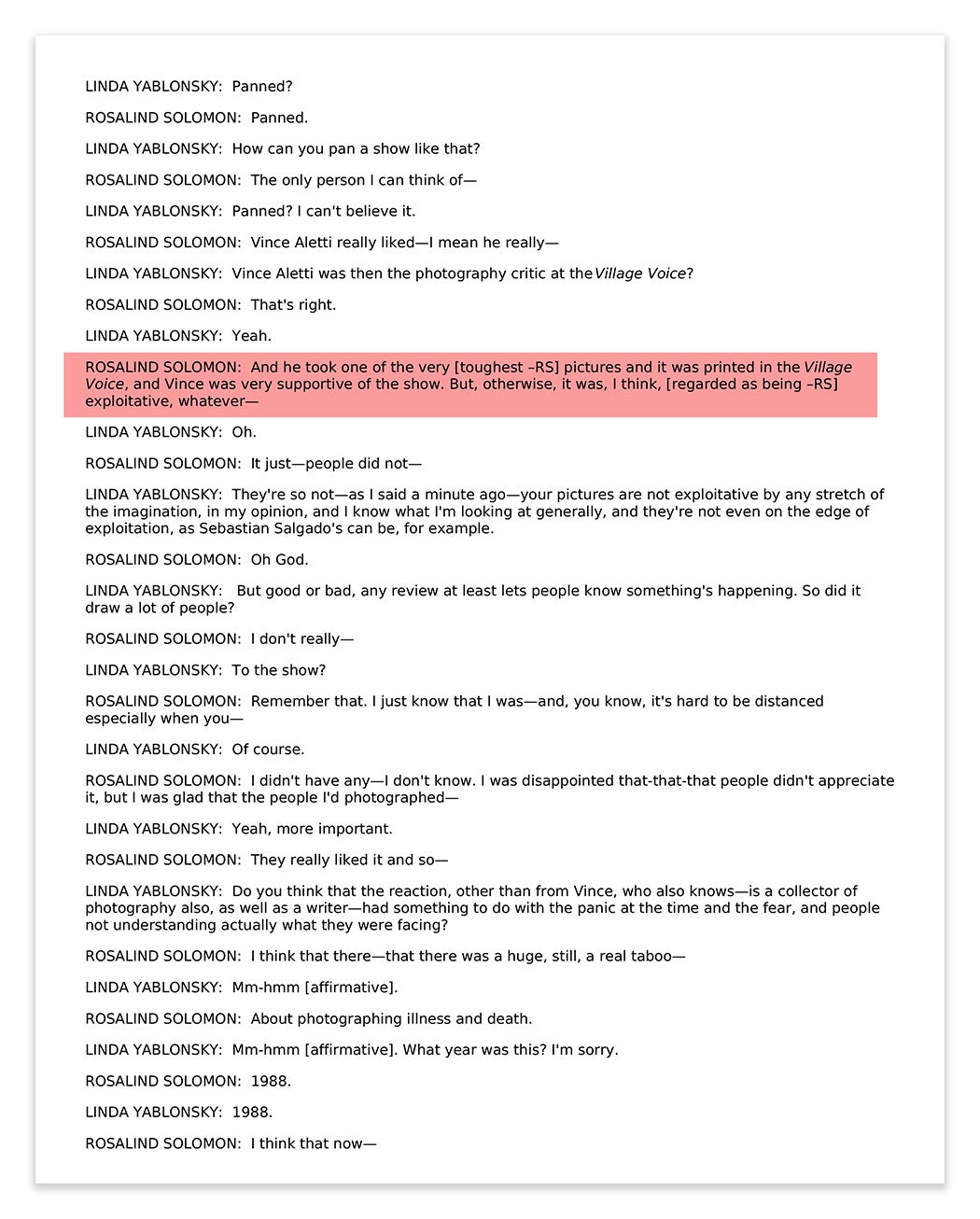
Rosalind Fox Solomon, whose 1988 show Portraits in the Time of AIDS featured photographs of the subject alone or with loved ones, some with visible lesions or in the hospital, relates that her project was critically panned and called “exploitative” at the time.
As another “outsider” to the communities she photographed, Nan Goldin reports that she encountered similar criticism for her exhibition The Ballad of Sexual Dependency, despite her immersion in the cultures she documented. In the book of the collected photographs, she writes, “I’m not crashing; this is my party. This is my family, my history.”
Some of the most vibrant, and now iconic, images of AIDS were created as (and for) protest: Silence = Death, the work of the Silence = Death Collective (and not ACT UP, as Avram Finkelstein relates in his interview) became the primary pictorial representation of ACT UP and a rallying slogan for the fight against the disease. Keith Haring did his own take on it for a poster, adding “Ignorance = Fear” to a “See No Evil, Hear No Evil, Speak No Evil” scene.
Collectives like Gran Fury and fierce pussy, which organized inside the ACT UP activist group, created posters for wheat-pasting that served as art, education, and calls to action around AIDS, homophobia, health care, and visibility. Whether newsprint works of text, guerrilla-installed bus station “ads,” or rolls of stickers of bloody hands announcing “One AIDS Death Every 10 Minutes,” the art of AIDS activism used any means available to communicate the urgency of the crisis.
The Visual Arts and the AIDS Epidemic collection demonstrates the power of oral history to preserve not just historical events, but what it felt like to live in the moment and survive it when so many people did not. Together with Reveal Digital’s HIV, AIDS, and the Arts archive, the collection ensures that these voices, experiences, and creative histories continue to be available to inform and educate future generations.