Great Britain’s island status has always suggested vulnerability to invasion, the open waters surrounding it defining a disquietingly unbounded border. Mostly forgotten today is a literary subgenre that sprang up in the nineteenth century in order to give fictional shape to anxieties about the possibility of Britain’s invasion and defeat by its European neighbors. These invasion fictions took a range of forms, from short stories and pamphlets to novellas and full-length novels, and proliferated especially in the late-Victorian and Edwardian period leading up to World War I, which brought the subgenre’s brief flourishing to an end.


Of highly repetitive and inconsistent literary quality (to put it politely), these texts tend to seem designed to scare and to provoke—often with a barely disguised subtext of making a case for greater military expenditure. Yet even if they were often written as conservative propaganda, such tales of surprise invasions—long-feared national nightmares finally coming true—can possess a particular force, of a kind that would go on to influence the subsequent history of twentieth-century spy fiction.
One very patient scholar of these odd texts, A. Michael Matin, analyzed “more than one hundred invasion-scare narratives published in Britain between 1871 and 1914,” and distilled no fewer than ten motifs, which he characterizes as “so recurrent that they comprise virtually constitutive elements of the form.” These are:
(1) near-future settings, usually the present to five years, for hostilities or narrowly averted hostilities (although the time of narration may be many years later) and corresponding displays of the wisdom of hindsight; (2) demonstrations of the vulnerability of the territories of the British Empire in addition to that of England or Great Britain; (3) depictions of invading or occupying troops and/or subversive foreigners (spies, saboteurs, terrorists, or disguised soldiers) on British soil; (4) blendings of documented fact with fiction (enhancing the verisimilitude and plausibility of the fiction); (5) denunciations of incompetent (usually Liberal) British politicians, including exposures of their mismanagement of the armed forces and of foreign policy; (6) governmental and public underestimations of the capabilities and nefariousness of Britain’s enemies; (7) appeals to the reader’s senses of patriotism and shame; (8) failures to support strategic and tactical innovations, including those associated with technological advancements; (9) geographical specificity and depictions of familiar local detail, such as English national landmarks (monuments of power and national pride that are usually damaged or destroyed); (10) decisive conclusions to events with Britain either defeated and the British Empire dismembered or the nation and empire strengthened by the experience of actual or threatened invasion.
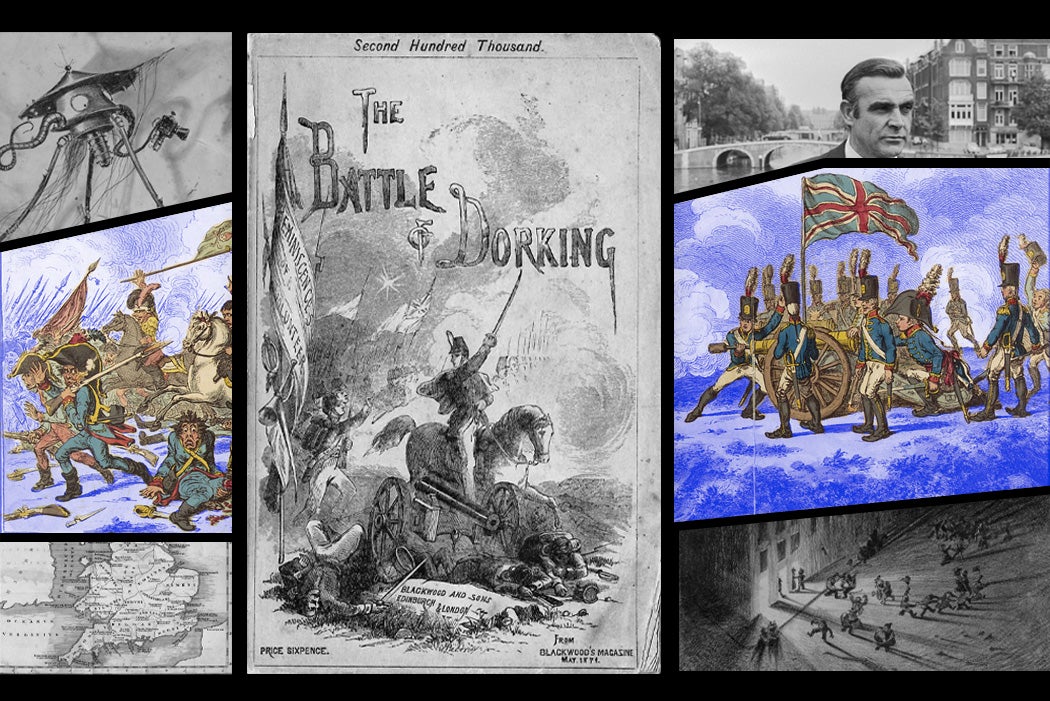
Widely recognized as a foundational text of the subgenre is Lieutenant-Colonel George Chesney’s The Battle of Dorking, a long story or novella published in Blackwood’s Magazine in 1871, shortly after Prussia’s defeat of France (which was shocking and alarming to the British), and then reissued as a standalone pamphlet. I.F. Clarke, a former British military intelligence officer turned scholar, points out that Chesney’s story “touched off a chain reaction of stupefaction, alarm, and such indignation in the United Kingdom that the prime minister, William Gladstone, felt he had to speak out against the ‘alarmism’ of ‘a famous article called The Battle of Dorking.’… Suddenly, for the first time in fiction, a short story became a matter of intense debate for a nation.” Clarke goes so far as to declare that Dorking “must be the most talked-about and imitated short story in the history of printing,” which is perhaps overstatement—but even so, Chesney’s tale was a sensation.
Weekly Newsletter
"*" indicates required fields
The Battle of Dorking is narrated by a war veteran in the present day (that is, 1871) who is recounting to his grandchildren, as they prepare to emigrate from England, the events of a successful invasion and occupation of Britain by Germany fifty years previously. Chesney thus employs something like the classic Walter Scottian “sixty years since” model for historical fiction, but in an alternative-history mode. His narrator is writing in response to a request from his grandchildren, and his narrative is wracked by a sense of dishonor and guilt. The memorable opening sentences declare:
The danger did not come on us unawares. It burst on us suddenly, ’tis true; but its coming was foreshadowed plainly enough to open our eyes, if we had not been wilfully blind. We English have only ourselves to blame for the humiliation which has been brought on the land. Venerable old age! Dishonourable old age, I say, when it follows a manhood dishonoured as ours has been.
Half a century after the invasion, Chesney’s narrator still feels a choking sense of shame:
Even now, though fifty years have passed, I can hardly look a young man in the face when I think I am one of those in whose youth happened this degradation of Old England—one of those who betrayed the trust handed down to us unstained by our forefathers.
Clarke suggests that Chesney’s Dorking helped “to establish a form of propaganda that was perfectly adapted to the military and political requirements of the period” (“Forecasts”). The vivid depiction of the shame and horror attendant on an imagined German invasion promoted conservative military goals. And Chesney’s model proved durable and adaptable. Invasion fictions tended to spring up in response to each new form of invasion panic. When the House of Commons considered a bill in 1882 calling for the construction of a tunnel between Calais and Dover, for example, a wave of Chunnel Invasion stories hit Britain. Among them were The Seizure of the Channel Tunnel, The Story of the Channel Tunnel, Battle of the Channel Tunnel, How John Bull Lost London, Surprise of the Channel Tunnel, and others.
Several scholars have argued that late-Victorian and Edwardian invasion fiction helped to ideologically prime the British public for World War I. Christopher Keep suggests that these texts “contributed to the peace-time maintenance of the belief in war as natural and inevitable, even desirable, as it transmitted to the readers of the mass-market newspapers and magazines an ideological message which helped insure the mass consent witnessed at the battles of the Somme and Verdun.”
The fictional invasion narrative of this period with the most lasting literary and cultural influence was something of an outlier: H.G. Wells’ 1898 The War of the Worlds, which can be read as an ironic reversal of many of the motifs of classic invasion fiction. In Wells’ tale, which has always proved irresistible to filmmakers, the invaders are neither German nor French but Martians, for whom, Wells’ narrator observes, “we men, the creatures who inhabit this earth, must be … at least as alien and lowly as are the monkeys and lemurs to us.” Keep argues that Wells “stands alone among the writers who produced future-war texts” in his awareness of the consequences of the kind of “chauvinist imperialism” and jingoism that writers from Chesney onward had promulgated. And Denis Gailor similarly suggests that “Wells is explicitly concerned with the English, as the biggest imperialists of the day. He says, more or less openly, that they deserve to be punished for their arrogance.”
More to Explore
The Spy Who Shared My Foyer
It is generally agreed that the wave of invasion fiction that followed Dorking in 1871 more or less petered out in 1914. It’s as if these propagandistic stories of a Britain overthrown because of insufficient defensive preparation had finally achieved their goal of militarizing the nation—and thus could at last retire in glory.
But a case can be made that even if “invasion fiction” in its classic form faded away, many of its elements found new life in a newly ascendant genre: the spy novel. In “Spies and Gentlemen: The Birth of the British Spy Novel, 1893-1914,” David Stafford suggests that William Le Queux’s highly propagandistic (and antisemitic) 1894 invasion novel The Great War in England in 1897 can be read as a pivot point in the evolution of the genre: “The book remained within the tradition of the invasion novel, but attributed a major role to espionage and to the character of a foreign spy,” and in so doing, marked a transition to what became the spy novel proper.
Popular and influential Edwardian texts like Erskine Childers’s 1903 The Riddle of the Sands and John Buchan’s 1915 The Thirty-Nine Steps are classics of early spy fiction, but they’re also, in important respects, German invasion narratives, in which a plucky British amateur stumbles upon and improbably defeats a nefarious foreign invasion plot.
In this way, the minor subgenre of the invasion-of-Britain story left a substantial mark on one of the most enduring templates for popular fiction and film today. When Mick Herron’s shambolic MI5 agents struggle to prevent terrorist attacks on Britain by operatives from Russia or North Korea, the antagonists may have changed, but the fictional DNA of these plots can arguably be traced back to their forgotten late-Victorian predecessors.