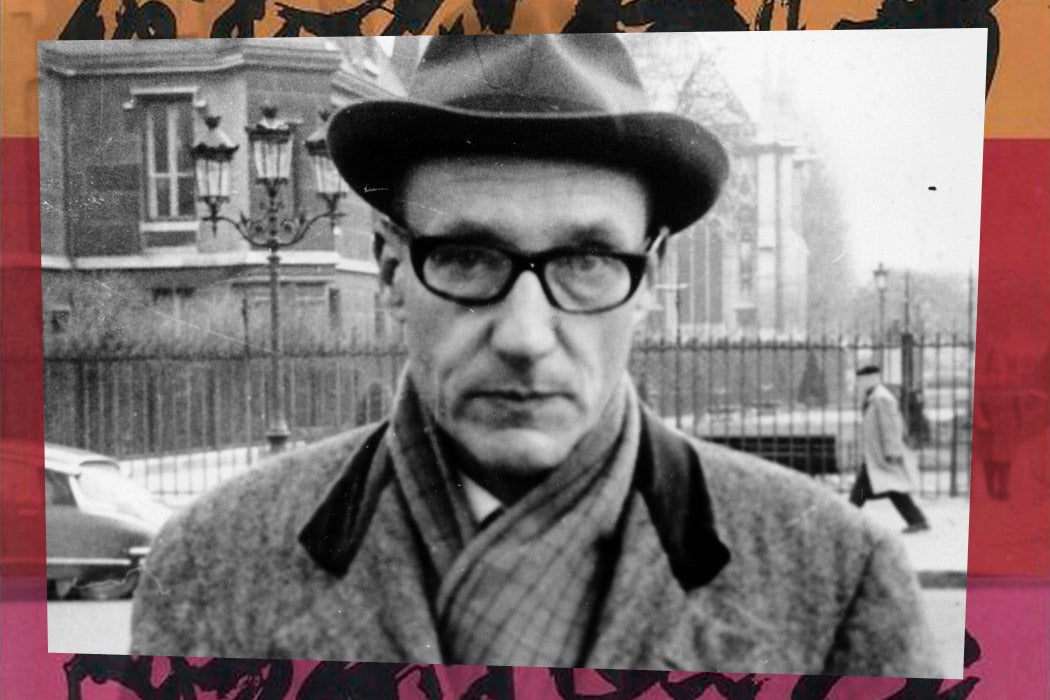
The writers of the Beat generation adopted ideas and images from cultural traditions ranging from Buddhism to jazz. William S. Burroughs repeatedly turned to another source: the ancient Maya. As independent scholar Paul H. Wild writes, Burroughs drastically reshaped Maya culture for his own purposes, but his stories were grounded in ideas about the civilization that were common in academic circles at the time.


Wild writes that Burroughs had a longstanding interest in archaeology and anthropology, and particularly in hieroglyphics. In 1950, he enrolled in Mexico City College, where he studied anthropology of Classic Maya and Aztec civilizations—two cultures he either conflated or intentionally remixed in some of his later work.
Wild notes that it’s unclear how much studying Burroughs did in the 18 months he was enrolled at the Mexican college. During that time, he also indulged in heroin, wrote a version of his first novel, Junky, began a quest to find yagé, also known as ayahuasca, and shot and killed his wife, Joan Vollmer, in what he claimed was either an accident or a party trick gone wrong.
In 1950, the academic study of Maya culture was almost totally dependent on writings by the sixteenth-century friar Diego de Landa, who destroyed the vast majority of Maya codices known to Europeans and wrote up his own observations of the literature. Based on Landa’s work, Mayanists of the 1930s and ‘40s developed an image of the classic Maya as a civilization without war, but living under the control of astronomer-priests who used their complex calendars to rule the common people.
In Burroughs’ 1961 novel The Soft Machine, Maya priests use a “control machine” to telepathically enslave the common people until a time-traveler destroys the machine, leading to a revolt.
More to Explore

How the Beat Generation Became “Beatniks”
Wild writes that, somewhat paradoxically, given his profession, Burroughs railed against the “Word Virus” as a tool of control. And so he was fascinated by the hieroglyphic nature of Maya writing, which he claimed could convey ideas more directly, avoiding the need for words. This followed a common scholarly notion that Maya hieroglyphics were not tied to spoken language.
Many of the ideas about Maya life that Burroughs had access to in the 1950s were turned on their head in the next decade, when epigraphers realized that Maya writing was, in fact, partly phonological, and could be directly translated into speech.
Weekly Newsletter
"*" indicates required fields
This led to a breakthrough in translation, which, along with new archaeological discoveries, produced new understandings. For instance, classic-period images that had been understood to represent the priestly class actually showed rulers and warriors—and it turned out that the Maya had engaged in plenty of warfare. By 1999, the general view was that there were no priests in classic Maya communities, and that they only appeared in the Postclassic Maya revival in the northern Yucatan starting around 1000 CE—the period of the materials Landa had access to.
Of course, given the loose relationship between scholarship and Burroughs’ uses of it, all that may be beside the point for anyone reading his novels.