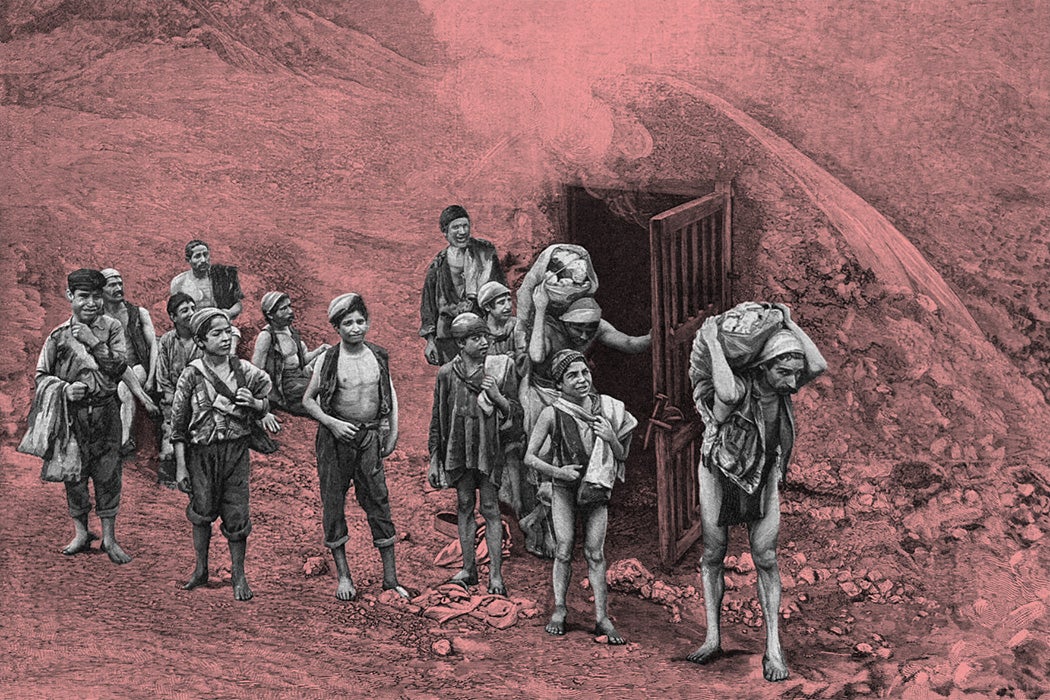
The Industrial Revolution that began in Great Britain had distant frontiers. Across the Atlantic, enslaved Africans and their descendants provided the raw materials. This “mass mobilization of slave labor” fed Britain’s sweatshop textile mills, but as historian Daniel Cunha details, that was hardly the end of the chain. After the spinning and weaving, textiles had to be cleaned and bleached. For decades, this “finishing” was done with chemicals derived from sulfur sourced in Sicily, whose mines were a hell on earth.


“Finishing encompassed a set of operations: washing, ‘soaping,’ bowking (i.e., immersing the cloth in alkali solution), ‘souring’ (immersing the cloth in acid solution), and bleaching (removing the color),” writes Cunha. Each of these steps was necessary—in sequence, sometimes repeated—with washings to remove impurities (greases, salts) left by previous steps.
Until the middle of the eighteenth century, all this was “done with natural alkali (potash, extracted from the ashes of timber), sour milk, and ‘crofting,’ the exposure of the cloth to the sun and air in bleachfields.” British manufacturers “sent a large fraction” of their cloth to be finished in the Netherlands, “with its abundance of dairy (sour milk was basically a by-product of abundance) and famous purity of water.”
But these traditional methods could not keep up with the amount of cloth produced by mechanical production. Chemical innovations were needed alongside mechanical ones. Cunha argues that the textile industry “generated a new branch of industry, the chemical industry.” Instead of sour milk, this spin-off industry used sulfuric acid (made from sulfur); instead of potash, it used synthetic soda ash (sulfuric acid, salt, coal, and limestone); and instead of crofting’s solar bleaching, it used chlorine (sulfuric acid and salt) to oxidize cloth white.
In 1792, Sicily’s main export commodity was wheat. Sulfur was eleventh in importance. Britain gained a virtual monopoly on Sicilian sulfur with an 1816 treaty. By 1834, sulfur had become Sicily’s number one export.
More to Explore
The Lemon Gang: Citrus and the Rise of the Mafia
In hundreds of grim mines, Sicilian children were exploited in slave-like conditions. As in many extraction economies in underdeveloped places, corruption and violence were rife—one of the roots of the Sicilian mafia was the private protection rackets that formed in the mining regions. Local communities, meanwhile, were poisoned by the sulfurous gas created by smelting: land around the mines lost its fertility and vegetation. Contemporary Italian commentators likened the British control of Sicilian sulfur to colonialism.
In 1840, Ferdinand II of the Kingdom of the Two Sicilies (the other “Sicily” was Naples), cut a deal with a French company to limit sulfur production and thus control the price. Britain responded with a war-footing, blockading the Bay of Naples. The “Sulfur Crisis” or “Sulfur War” of 1840 wasn’t much of a war; but peace came at a high price, with the Kingdom forced to pay reparations to both French and British interests.
Weekly Newsletter
"*" indicates required fields
Sicilian sulfur’s centrality to Britain’s textile industry was soon displaced by pyrites from Ireland, sulfur from Spain and Louisiana, and an early form of recycling, though sulfur would continue to be mined in Sicily. It was used “for vineyard pest control, gunpowder, and other uses, which was enough for exports to increase about sixfold between 1840 and 1900.” In the early part of the last century, a visiting Booker T. Washington, born in slavery in the US, went down into a Sicilian sulfur mine and wrote that the experience was “about the nearest thing to a hell that is conceivable.”
Pure white cloth, born in the murderous toil of slavery, formed in debilitating factory conditions, and finished through the agony of Sicilian children, was bleached in more ways than one. The full story of its production from seed to market and the full accounting of its human and environmental costs is still being told. Cunha argues that we must also “acknowledge the slave-like child labor in Sicilian mines as a requisite of the rise of the chemical industry.”

.jpg)