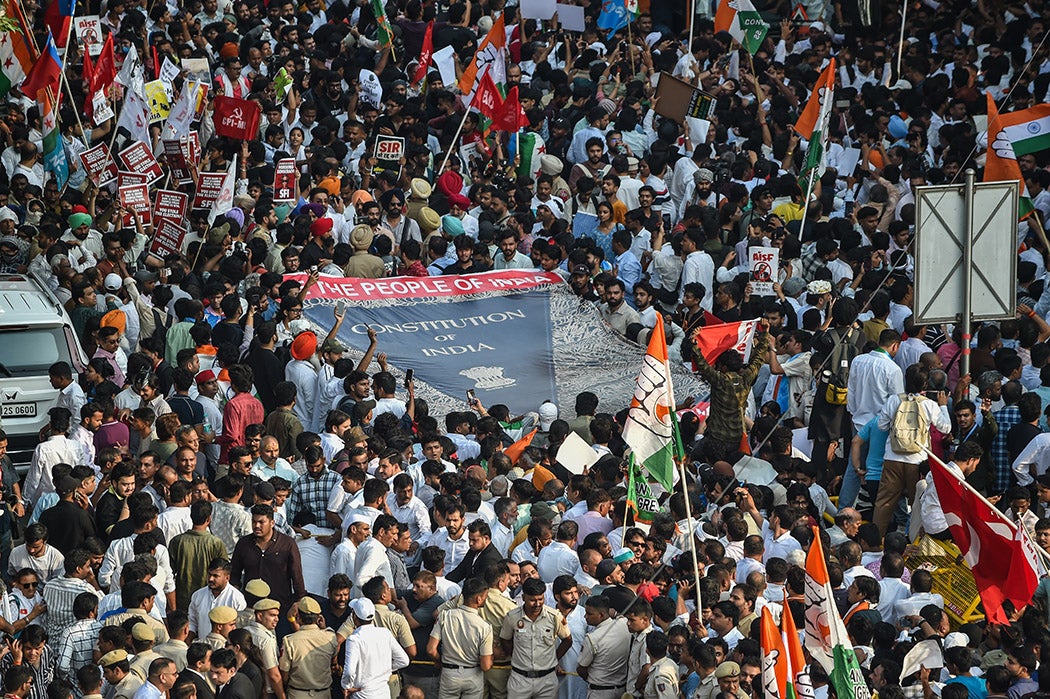
Gen Z protests in India in July demanded the resignation of the Minister for Education following a string of student suicides. The deaths followed the cancellation of a medical training examination after its exam paper was leaked. After millions engaged in peaceful protests throughout the country, the minister eventually resigned.


After a brief hiatus, the protests regained momentum following news that the election commissioner, who oversees the independent body responsible for conducting elections at both central and state levels, was accused of deleting thousands of names of eligible voters from electoral lists on the basis of their religion. Some parties claim that this has affected the outcome of elections across the country in favor of the Hindutva groups currently in power.
While the increased level of participation in these protests may seem surprising after years of citizens tolerating an increasingly fascist state apparatus, India has a long history of peaceful protests to bring about change.
Mahatma Gandhi’s non-violent movements, which began 100 years ago, brought the mighty British Empire to heel. “Under the inspiring leadership of Gandhi, several movements were launched to pinpoint the urgency and need for granting independence to India,” writes Dalip Singh in his paper “Protest Movements in India,” published in The Indian Journal of Political Science in 1991. These movements took place in phases, including the Non-Cooperation Movement of 1920–21, the Civil Disobedience Movement of 1930–31, the Individual Disobedience Movement of 1940, and the Quit India Movement of 1942–45. The underlying principle common to all these movements, however, was non-violence. Singh writes, “Even those followers of Gandhi who did not believe in non-violence as a creed, accepted it as a political expediency. From the above account one has to accept that hunger strike, bandh, gherao, dharna, etc. had gained the legitimacy of the people during the nationalist movement.”
More to Explore
Caught in Partition’s Violent Fray
This system, termed the “Gandhian system of protest” by retired professor Chaman Lal, was lauded in an article published in the Economic and Political Weekly in 2016. He wrote of a gathering of writers and activists on the eighty-sixth anniversary of the historic Dandi March to “raise their voice against growing communal aggression against innocent people, not only in India, but throughout the world.”
David H. Bayley, meanwhile, divides the systems of protest in India into two distinct categories in a 1969 paper published in Pacific Affairs titled “Public Protest and the Political Process in India,” calling them legal and illegal forms of protest. The illegal forms come in two varieties—violent and nonviolent. Satyagraha, or nonviolent civil disobedience, is a nonviolent but often illegal form of protest. Violent illegal protest refers primarily to riots, although it may include assassinations and coups d’état as well. Bayley explains the political motivation for such violence:: “The point to underscore is that one common variety of social violence in Modern India has an explicitly political motivation, and it stems from a desire to shape government policy.” This, however, also seems to be the case with recent nonviolent protests.
A major cause of protests in the 1990s and early 2000s was the privatization of India’s economy. Katrin Uba collected data for her 2008 paper “Labor Union Resistance to Economic Liberalization in India: What Can National and State Level Patterns of Protests against Privatization Tell Us?” published in Asian Survey. Her findings reveal
increased anti-privatization protests and an enlarged repertoire of labor movement mobilization approaches from 1991 to 2003… While unions organized few protests during the early 1990s, their mobilization intensified as successive central governments and their state-level counterparts accelerated the pace and scope of privatization… This study also shows that all major labor unions in India, regardless of their ideological leanings, took part in protests against privatization.
More recent mass protests include those following the 2012 gang rape in Delhi, which, for a variety of reasons outlined by Poulami Roychowdhury in her article “The Delhi Gang Rape: The Making of International Causes,” published in a 2013 issue of Feminist Studies, “provoked a mass media furore across the globe.”
Weekly Newsletter
"*" indicates required fields
In 2019–20, there was mass mobilization against the passing of the Citizenship Amendment Act, which sought to define citizenship on the basis of religion, and 2021–22 saw farmer protests against economic policies seen as favoring private enterprises over agricultural ones. Both drew large crowds, with social media and WhatsApp groups becoming an important source of information, assistance, and support. Madhavi Shivaprasad describes the experience in her paper “Protest and Performance: My Engagement with the Anti-CAA-NRC Protests in India,” published in the Journal of Feminist Studies in Religion in 2021. She wrote,
Students’ Instagram, Twitter, and Facebook accounts became temporary “responsible” digital fact-checking sites for news around the anti-CAA-NRC protests as local and national news channels became unreliable. These accounts began to be counted as dependable because they were being shared by and among other fellow protesters. I became actively involved on a daily basis in online mobilization and amplification of the voices of people at the various sit-ins and protest events being organized around the CAA-NRC through social media such as Facebook and Twitter.
This reliance on social media was taken a step further in the recent Gen Z protests organized by the satirically named political body known as the Cockroach Janata Party, during which independent news outlets on social media platforms were the only sources of news considered reliable.
India’s robust history of protest movements, especially over the last 100 years, is affirmed by this observation from Dalip Singh: “So long as feeling of discrimination, injustice and denial of fair treatment to the genuine demands of such groups continue to exist, the phenomenon of protest in one form or the other will continue to operate.” Protests are, after all, a sign of a healthy democracy, and India considers itself to be the largest democracy the world.