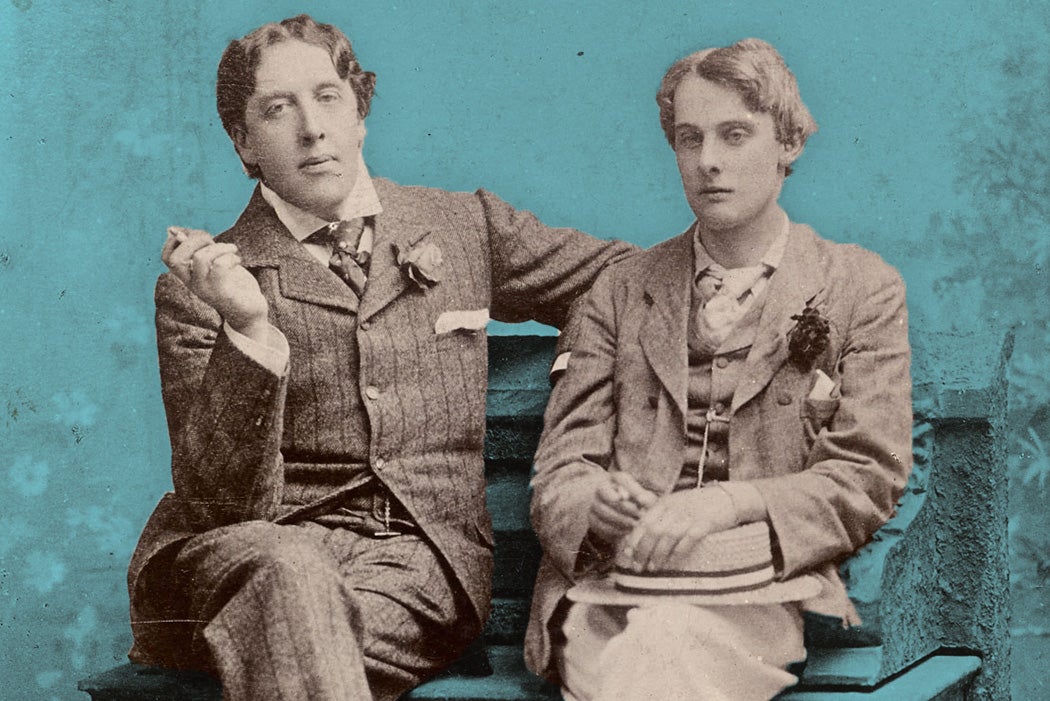
In 1896, Lord Alfred Douglas was experiencing a spiritual crisis. His companion Oscar Wilde had been in prison for more than a year after Douglas’s own father, the Marquess of Queensberry, accused Wilde of being a sodomite [sic], prompting Wilde to file—and subsequently lose—a libel suit against him. “My whole life,” Douglas would later write of that period, “can be described as a continual longing to see him again.”


A central conflict defined Lord Alfred Douglas’s spiritual life: he began as a hedonist devoted to Hellenism and later became a Christian moralizer. In his youth, Douglas identified as “an enthusiastic pagan” and studied “The Greats” at the University of Oxford. Core to that curriculum was Plato’s Symposium, a central text in Western philosophy that presents beauty, especially male beauty, as a catalyst for love. “This text was a great eye-opener to young men who were attracted to other males,” writes Laura Lee in The Wildean. “Men who loved men discovered their own script in the pages of the Symposium along with a vocabulary of celebration rather than repression.”
The physical component of Wilde and Douglas’s relationship appears to have been marginal, a dynamic that aligned with the Grecian ideal of love. “Lack of sexual expression confirmed rather than negated their love,” writes Lee. “If a relationship truly blossomed, it transcended its erotic beginnings and evolved into a perfect intellectual friendship that leads to a ‘pregnancy of the soul’ producing great works of art and creative achievement.”
Hellenic paganism could not assuage Douglas’s pain. It lacked a vocabulary for consolation and lovelorn bereavement, while Christianity spoke directly to grief and suffering. Although Douglas still found the faith overly dogmatic, he gradually reconciled himself to it around the time he resolved to marry Olive Custance, an American-born poet whose androgynous self-presentation intrigued him. In a world where the only acceptable family structure was based on sexual attraction between a man and a woman, the church presented an alternative.
“Christianity suited Alfred Douglas’s personality. Where Wilde liked to ‘play gracefully with ideas’ and write dialogues so he could take up both sides of an argument, Douglas had always preferred absolutes,” writes Lee. Temperamentally conservative, Douglas was comfortable with the status quo and the privileges it afforded him, and had no interest in broader social change. The only thing that put him at odds with his world was his sexual orientation, and as a married man he believed that conflict had been resolved. Around this time, he also began to drift away from many of the bohemians and artists in Wilde’s circle.
More to Explore
Four Flowering Plants That Have Been Decidedly Queered
Douglas formalized his embrace of Christianity in 1911, when he converted from Anglicanism to Catholicism. The decision did not reflect a family tradition. “Rather, it seems becoming Catholic was what all the ‘artistic men’ he knew did when they got to a certain age,” writes Lee. In this, Douglas was following a path already taken by many queer men and adherents of the Decadent movement. Lee writes,
The ritual, the theatricality, and the music are often referenced. The doctrine of original sin was also a paradoxical pull. Homosexuals in Victorian England were isolated by their shame. The doctrine of original sin, however, pronounced all human beings sexually stained by their birth. Within the walls of the church, being in a state of shame was unifying, not dividing. It did not matter which temptations one wrestled with, or what type of lust he needed to suppress, all that mattered was that he did not give in to it, or that he went to confession when he failed.
The kinship offered by the church mirrored the one Aesthetes had shared in their youth. “Family, in Christian terms, was not defined by biology or sexual compatibility. All who accepted the doctrine became ‘brothers and sisters in Christ,’” writes Lee.
Throughout his life, the Catholicism that sustained Douglas bordered on the mystical, something Lee hypothesizes may have been connected to symptoms of bipolar disorder. Douglas believed himself a martyr and imagined angels were intervening and supporting him in his quest for justice. Yet even if mental illness was the cause of these visions, it does not diminish their religious significance as Douglas experienced them. “He was persuaded to the core of his being by his mystical experiences that he had found the truth. Douglas was on a mission to become a saint. Christ would finally vanquish Apollo,” writes Lee.
Weekly Newsletter
"*" indicates required fields
His sonnet “In Excelsis” explores the difficulty of finding love in the world rather than through spirituality. “‘In Excelsis’ makes it clear that Douglas has built his entire self-image on the courage he showed during the Wilde scandal, and his refusal to distance himself from his friend. From that formative experience, he has learned to distrust the wisdom of the world,” writes Lee. He eventually embraced celibacy too. The sonnet reads:
For love essentially must needs be chaste,
And being contracted to unchastity
(Even in marriage) knows essential loss.
After Douglas was jailed for libeling Winston Churchill over claims related to World War I, he spent part of his sentence reading Revelation of Divine Love by Julian of Norwich, a gift from his wife inscribed, “Heaven protect our love.” Julian of Norwich presents Christ in maternal terms and frames suffering and sin as necessary for self-awareness and humility. “With the help of this book, Douglas stopped questioning God for making him as he was,” Lee writes. “He also stopped angling for sainthood. His mystical visions disappeared.”
Upon release, Douglas once again allowed himself to enjoy his unconsummated physical attractions to and warm relationships with other men. “In almost all of his later writings,” Lee writes, “Douglas argued for the decriminalization of homosexual acts and for the beauty and purity of love between men, even as he maintained his belief that homosexual acts were a sin.”