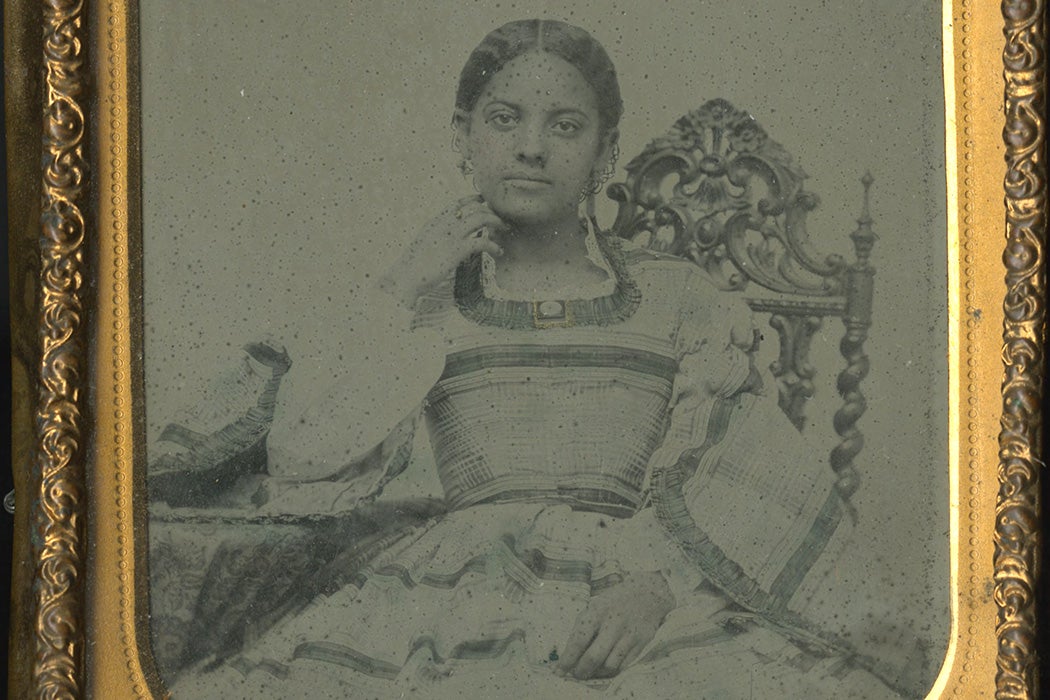
In the 1840s, “the first generation of professional scientists in the new American republic” were obsessed with the fertility of mixed-race women, explains scholar Myrna Perez Sheldon. Called mulattos, mestizos, métis, quadroon, octaroon, or quintroon, these women were considered by members of the American School of Anthropology to be “hybrids” of two distinct races, the “Caucasian” and the “Ethiopian.”


These were two of the five world races defined by the influential German naturalist Johann Blumenbach. According to polygenism, one of the most important constructions of race in the mid-nineteenth century, each of these distinct races had separate origins, either by divine creation or, in later interpretations shaped by Darwinian thought, by distinct evolutionary paths. Either way, white theorists placed white people at the apex of human development.
American School of Anthropology members Samuel George Morton and Josiah Nott, for instance, postulated that mixed-race women were less fertile than either Black or white women, “a claim they asserted was proof of the species distinction between the two races.” Morton was infamous for his skull collection: he measured brain capacity to argue that whites had larger brains. Nott took up Morton’s mantle after the latter’s death in 1851 and was a “full-throated” cheerleader for slavery. Nott also wrote that “probable Extermination” of the white and Black race would result from intermarriage.
Morton, Nott, and company based their beliefs about human hybrids on animal analogies: horses and donkeys could breed, but the resulting offspring, mules, were sterile, which meant that horses and donkeys were separate species in the genus Equus. Even earlier, Edward Long’s The History of Jamaica (1774) had claimed that mulattos were actually sterile—the ultimate proof that whites and Blacks were separate species. (Long’s view was, of course, nonsense.)
More to Explore
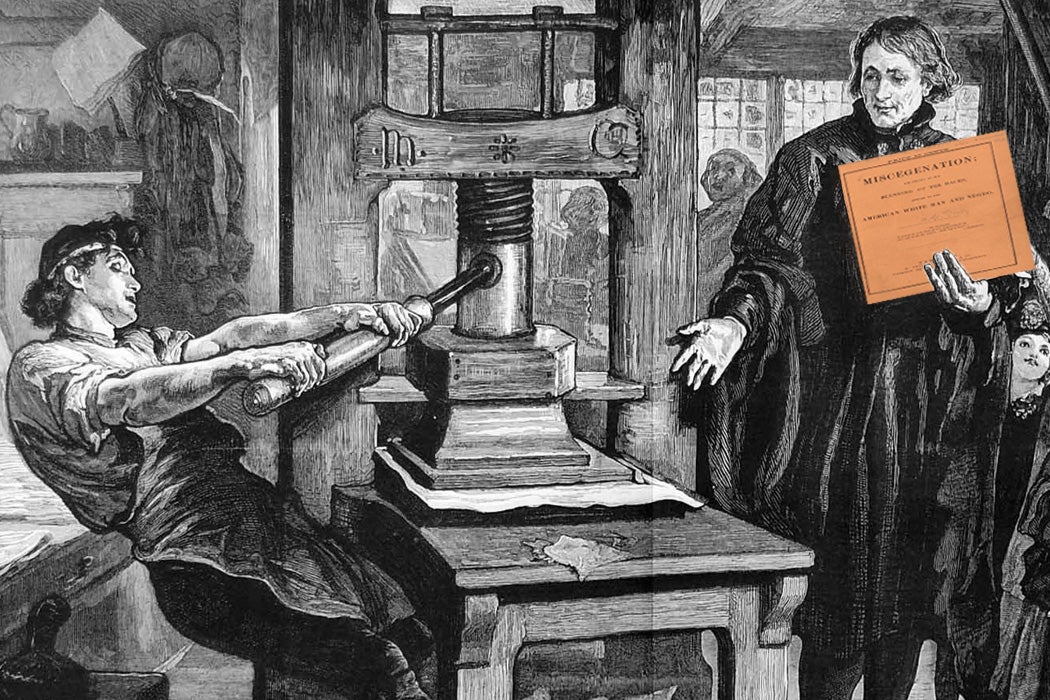
The “Miscegenation” Troll
Decades before eugenics peaked around the turn of the twentieth century, eugenic thinking lay at the foundation of chattel slavery. Debates over the fertility of mixed-race women were enmeshed in what was essentially a mass slave-breeding program in the US—reproduction as a form of population control.
“The fecundity of mixed-race women was potentially economic profit, but it was also a threat, as it disestablished the color line that was the keystone of slavery’s infrastructure.”
The US ban on the Atlantic slave trade after January 1, 1808 did not lessen the demand for enslaved labor. An illegal African slave trade continued, but the slave states depended for new labor on the domestic control of the reproduction of enslaved women.
Plantation owners in the older eastern seaboard states, sitting on land growing ever less productive, found that the real money was to be made in selling the enslaved “down South,” or “down the river” to newer plantations in the Mississippi Delta. “The reproduction of these women was essential to the future stability of the plantation economy, as well as to the immediate wealth of enslavers.”
Weekly Newsletter
As Perez Sheldon documents, the phrase “her generating qualities” was often found in the “for sale” descriptions of the enslaved in the decades just preceding the Civil War. The language of “livestock breeding was used to commodify the reproductive potential of enslaved persons.”
However, for the economy of slave-breeding, “‘breeding true’ to the racial line was an essential but intractable problem.” It was slavery, after all, that produced mixed-race women in the first place, in the “violence born out of colonialism and the Atlantic slave trade.” While the scientists might have looked askance at what was happening, since it violated their notions of the separate races, mixed-race women also literally “produced the slave society of which they were a part.”
“And even after the Civil War, as Darwinian science transformed sexual desire into the engineer of race, the biopolitical imperatives of the American nation-state ensnared the lives and choices of mixed-race women.”