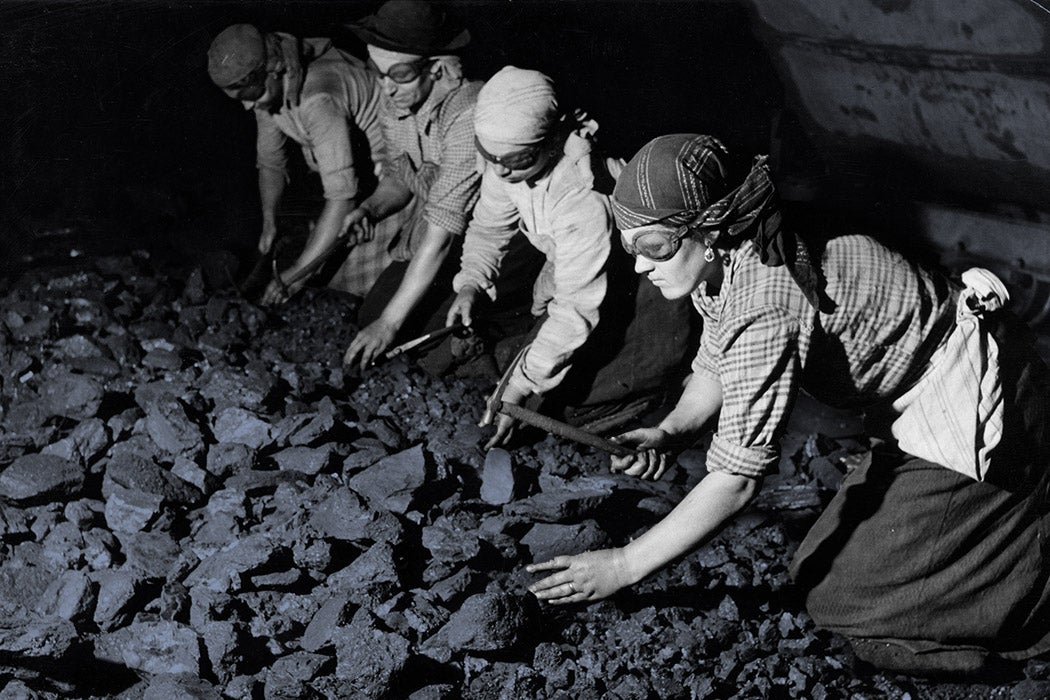
A miner is typically envisioned as a brawny bro at the coal face or a crusty Forty-niner sourdough sluicing for gold. In other words, as masculine as you can get. That’s the image, yet women have mined around the world throughout history.


And today, as scholars Rossana Barragán Romano and Leda Papastefanaki explain, in some countries they can make up to 50% of the millions of people who work in artisanal and small-scale mining, known as ASM to the UN and the World Bank.
Women, Romano and Papastefanaki continue, “were as active as miners in the past as they are in the present.”
But because mining has been considered and even legislated as men’s work, Romano and Papastefanaki argue that women have largely been erased from the history of mining. Their obscurity in the record carries over to the invisibility of the many women who work in mining today, often in “the worst and most precarious conditions.”
Over a span of two centuries, women were evicted from the mines of Europe and North America as “protective” laws banned them from mining. This was concurrent with the rise of the ideology of the male breadwinner and the masculinization of workplaces, part of the process of the “de-labourization” of women since the eighteenth century. Women, write Romano and Papastefanaki, “were increasingly excluded from more or less formal wage labor employment by state and employer regulations.” Instead, women came to be seen “primarily as mothers and reproducers of the labour force”—even as their work in households, in mining communities as elsewhere, was ignored or devalued. The prohibition on wage work for women, in mining as elsewhere, became widespread around the world, but of course that started to change after the mid-twentieth century.
Early modern mining was a household affair, with all members of the family performing mining tasks. As Romano and Papastefanaki note, “mining” encompasses many things, whether it takes place underground or on the surface: hewing, hauling, sorting, crushing and grinding, washing, drying, and so on. There was typically a gender division in these family operations, with men hewing and women and children hauling.
In Europe, small mines worked by families or groups of families were absorbed into larger capitalist enterprises starting in the late eighteenth century. “Mineworkers were transformed from small, independent, and petty producers into wage workers in larger enterprises.” Capitalization, centralization, and mechanization served to push out women: “the exclusion of women seems to parallel the emergence and constitution of capitalism.” Unions, working to protect men’s labor, likewise had no room for women.
More to Explore
How Sicilian Sulfur Fueled the Industrial Revolution
In Great Britain, women were prohibited from working underground in coal mines by the Mines and Collieries Act of 1842, one of the very first laws to limit labor on the basis of gender. Similar prohibitions followed in the coal-producing regions of France and Belgium and then, especially after World War I, elsewhere around the world.
Even after the 1842 Act, British women continued to mine on the surface, while other women simply evaded the law since it made no provision for compensation for the forcibly unemployed. “Women wore men’s clothes in order to pass as men in the pits.” Later, British women were “seen as heroines when they were required” in the pits during World War I, “but were quickly discarded thereafter.”
Member states of the International Labour Organization (ILO, founded in 1919) prohibited women miners through the early twentieth century. Japan, for instance, moved rapidly: from “36,759 women working in more than 198 mines in 1928 to 8,146 in 136 mines in 1931” until, after World War II, Japanese women’s employment in large mines ended.
Weekly Newsletter
"*" indicates required fields
But then in the mid-twentieth century, the domestication of women’s labor came under assault as unfair and discriminatory. There was a re-laborization, as it were, of waged work for women. In the US in 1974, for instance, two United Mine Workers members became the first union women to work underground.
Today, across Africa, Asia, and Latin America, women make up 10–50% of the mining workforce—depending on location—in artisanal and small-scale mining. Ghana and Nepal have the highest percentages of women miners. A lot of gold and 80% of the world’s gemstones come from ASM, which is characterized, note Romano and Papastefanaki, by “low technology, intensive labour, low rates of production, and poor safety, health, and environmental conditions.”
The World Bank puts the number of people directly employed in ASM at 43 million in 80 countries, with at least three times that number being dependent on such activity.